
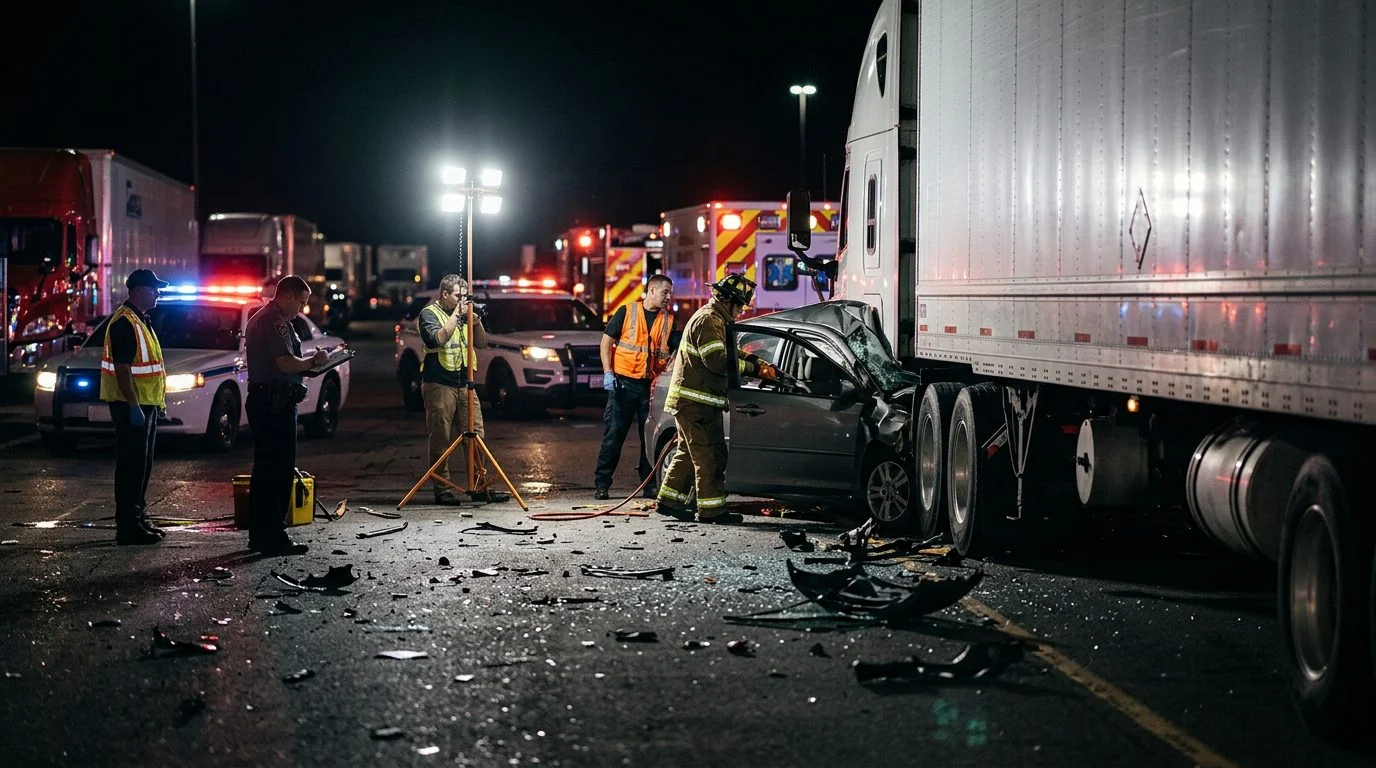
Truck Underride Crashes | West Virginia
Hurt in an Underride Crash? Talk With a West Virginia Injury Firm
Underride crashes can cause catastrophic injuries and wrongful death. Big Bubba Injury Law represents people and families across West Virginia. We serve Charleston, Huntington, Morgantown, Wheeling, and communities statewide.
Published October 26, 2026
A truck underride crash happens when a passenger vehicle slides under the back, side, or front of a large truck or trailer. These crashes often cause brain injuries, spinal cord injuries, and death. If you need a truck underride crash lawyer in West Virginia, this page explains how these claims work and what to do next.
What Is a Truck Underride Crash?
A truck underride crash is a collision where a car, SUV, or pickup goes partly or fully under a truck or trailer. The vehicle’s front end often slides under the trailer, sometimes at windshield or roof height. That puts the people inside in the path of the trailer’s frame or body.
Rear underride gets the most attention, but side and front underride also happen. A truck underride crash lawyer in West Virginia will look closely at the guard and the trailer’s design, because both affect how far a vehicle slides.
Federal rules require most trailers to carry rear guards. Under 49 C.F.R. § 393.86, most trailers and semitrailers rated at 10,000 pounds or more, made after January 26, 1998, must have a rear impact guard. The guard’s bottom edge can sit no more than 22 inches above the ground. The federal standard aims to reduce deaths and serious injuries when light vehicles strike the rear of trailers, per 49 C.F.R. § 571.223.
This page is for injured drivers and passengers, and for families of people who were killed, across West Virginia.
If an underride crash left you or someone you love seriously hurt, you may have a claim, and we can start with a free case review. Talk it through with Big Bubba — the first case review is free, confidential, and carries no obligation.

Catastrophic Injuries Common in Underride Crashes
Underride crashes often cause catastrophic injuries because the car’s occupants can strike the trailer or the area around the windshield.
- Head injuries, including traumatic brain injury, from impact with the trailer or windshield intrusion.
- Spinal cord injuries that can cause paralysis.
- Crush and fracture injuries to the neck, spine, and chest.
- Facial, scalp, and skull fractures, amputations, and internal organ injuries.
These injuries often need long-term care, rehabilitation, and changes to work and home life. Big Bubba Injury Law handles catastrophic injury, traumatic brain injury, and spinal cord injury claims.
Early medical records help. Tell your doctor about every symptom, even minor ones, and keep every follow-up visit. Those records show how the crash affected your body over time.
What an Underride Claim Can Cover
An underride claim can seek payment for medical care, lost income, and the harm injuries cause to daily life.
- Past and future medical care, rehabilitation, and assistive equipment.
- Lost wages and reduced ability to earn in the future.
- Pain, suffering, and loss of enjoyment of life.
For wrongful death, W. Va. Code § 55-7-6 lists damages that can include sorrow, mental anguish, and solace. It also covers lost income and services, medical care before death, and reasonable funeral expenses.
Some commercial truck cases face a cap. W. Va. Code § 55-7-32 provides that, in certain civil actions for personal injury or wrongful death involving the operation of a commercial motor vehicle requiring a commercial driver’s license, the maximum compensatory damages for noneconomic loss that each person injured or killed can recover against an employer defendant may not exceed $5 million for each occurrence, regardless of the number of claims or theories of liability. This limitation is not available to every employer defendant, and exceptions may apply. Beginning January 1, 2026, that limit increases each year to account for inflation under the Consumer Price Index, but may not exceed 150 percent of the amount in subsection (b). The limitation is not available to an employer defendant that lacks commercial motor vehicle insurance of at least $3 million for each occurrence covering the personal injury, and subsection (d) lists the incidents to which the section does not apply. W. Va. Code § 55-7-32 caps noneconomic damages recoverable against an employer defendant in certain commercial motor vehicle cases, but subsection (d) provides that the cap does not apply where the operator or driver is found to have engaged in listed conduct. That conduct includes operating with an alcohol concentration of .04 or more, operating under the influence of a controlled substance, other drug, or inhalant substance, refusing required testing after the incident, operating beyond the hours of operation established under state or federal regulations, operating in willful or wanton disregard for the safety of persons or property, operating loaded in excess of the maximum gross vehicle weight rating set by state or federal regulations (unless legally operating under a permit issued under § 17C-17-11), or engaging in distracted driving. W. Va. Code § 55-7-32
Which damages apply in a given case depends on the facts, the medical evidence, and the parties involved.
Evidence That Matters After an Underride Crash
The truck, the guard, and the company’s records often hold the most important evidence. Some of it can be lost or overwritten.
- Photos of the guard, trailer height, lighting, and the point of impact.
- Guard inspection, repair, and maintenance records, which can show damage, missing parts, or poor mounting.
- Driver logs. Under 49 C.F.R. § 395.8, a motor carrier must keep duty-status records and supporting documents for at least 6 months from receipt. That window is short, so early requests matter.
- Driver qualification files.
- The police report, witness names, and your medical records and bills.
FMCSA’s hours-of-service summary explains that federal rules limit driving time and require breaks. Those rules can matter when a crash raises questions about driver fatigue.
Dealing With the Trucking Company and Insurers
Trucking companies and their insurers may contact you soon after a crash, often before you know the full picture. You can refer those calls to the firm.
Early contact has legal limits. W. Va. Code § 55-7-11a bars anyone from negotiating a settlement, or seeking a release or statement for that purpose, within 20 days of an injury. That applies while you are in the hospital or partially or totally unable to engage in your usual trade, profession or occupation.
If a settlement or release was obtained in violation of that rule, you may disavow it. Under W. Va. Code § 55-7-11a, an injured person can disavow a settlement, release of liability or statement obtained in violation of that section within one hundred eighty days from the date of the injury. To do so, the person signs a written disavowal and forwards a copy to the person who violated the section. The settlement, release or statement then may not be admitted as evidence in any court or other proceeding relating to the injury, but only if any consideration paid for the settlement or release has been repaid or returned to whoever paid it by the time the copy is forwarded.
Practical steps help:
- Keep every bill, letter, and receipt.
- Write down your account of the crash while it is fresh.
- Talk with Big Bubba Injury Law before you sign a release or give a recorded statement.
How the Process Works, Step by Step
The process starts with a free case review, then moves to evidence, damages, and negotiation or a lawsuit if needed.
- Contact the firm. Share the crash date, location, vehicles, injuries, and any hospital or police details you have.
- Free case review. This review is confidential and carries no obligation to continue.
- Evidence requests. The firm can ask for truck data, guard records, and maintenance files before they are lost.
- Medical and damages review. The firm reviews your treatment, records, and losses with you.
- Negotiation and filing. The firm negotiates with insurers. If needed, it files suit in the proper West Virginia court.
Timelines vary with the injuries and how quickly records arrive.
Not sure what your next step is?
Talk it through with Big Bubba — the first case review is free, confidential, and carries no obligation.
Fatal Underride Crashes and Wrongful Death Claims
Under W. Va. Code § 55-7-6, a wrongful death action must be brought by a duly appointed personal representative of the person who died.
The same statute sets a deadline. Under W. Va. Code § 55-7-6, a wrongful death action shall be commenced within two years after the death of the deceased person, subject to the provisions of section eighteen, article two, chapter fifty-five. Under W. Va. Code § 55-7-6, the section’s provisions do not apply to actions brought for a death that occurred before July 1, 1988. The statute says this period is subject to another section of the code, so raise timing questions early.
Damages are divided among survivors the statute names. A jury or court decides the split, and the statute names the surviving spouse and children (including adopted children and stepchildren), brothers, sisters, parents, and any persons financially dependent on the person or otherwise equitably entitled to share in the distribution.
Families often face funeral and burial decisions within days. Early action on evidence also helps. Families often learn about truck and guard records only after a delay, so ask about preserving them soon.
Frequently Asked Questions About Truck Underride Crashes in West Virginia
What should I do first after an underride crash?
Get medical care, report the crash to police, and write down what you remember. Then talk with the firm before giving a recorded statement to any insurer.
Who can be responsible in an underride crash?
This varies from case to case. Under W. Va. Code § 55-7-32, an employer defendant can include the vehicle’s owner, the operator’s employer, or an entity that holds legal control over the vehicle.
How long do I have to file a claim?
West Virginia generally allows two years to bring a personal injury action under W. Va. Code § 55-2-12. Wrongful death deadlines are covered above.
Can I recover if I was partly at fault?
West Virginia uses comparative fault. Under W. Va. Code § 55-7-13a, each person’s share of fault is assigned by percentage and allocated in direct proportion.
Does an early call from the trucking company prevent me from speaking with a lawyer?
No single call prevents you from reaching the firm. The firm can handle communications with the company and its insurer.
What to Know After an Underride Crash
If an underride crash left you or someone you love seriously hurt, or took a family member’s life, the firm can start by reviewing what happened. Truck and guard evidence can disappear, so acting early helps.