
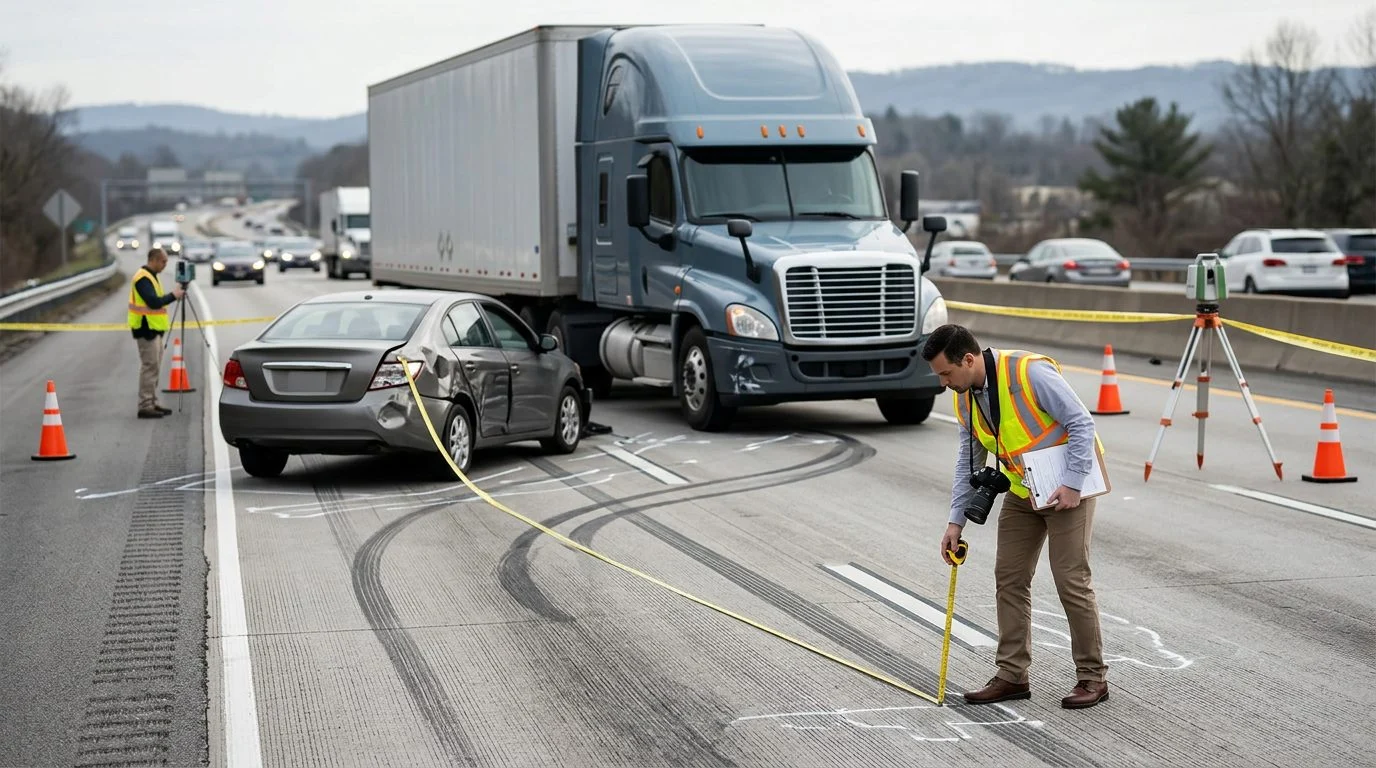
Commercial Vehicle Accidents
Spinal Cord Injury from a Commercial Vehicle Accident
When a truck or commercial vehicle leaves you with a spinal cord injury, the medical, financial, and legal road ahead is long. Big Bubba is here to help you navigate it.
Published October 04, 2026
Spinal Cord Injury from a Commercial Vehicle Accident: What You Need to Know
A spinal cord injury from a commercial vehicle accident is a catastrophic injury that often results in partial or complete paralysis, permanent disability, and a lifetime of medical care and adaptive equipment. Unlike a typical car crash, collisions with semi-trucks, delivery vehicles, and commercial vans involve extreme force and weight—factors that cause severe spinal cord damage and demand complex legal recovery.
If you or a family member suffered a spinal cord injury in a commercial vehicle accident in West Virginia, understanding what your claim may cover, why these cases are different, and what to expect is an important first step in protecting your rights.

Not sure what your next step is?
Talk it through with our team — the first case review is free, confidential, and carries no obligation.
What Is a Spinal Cord Injury from a Commercial Vehicle Accident?
A spinal cord injury from a commercial vehicle accident is damage to the spinal cord caused by the force and impact of a collision with a heavy commercial vehicle. Commercial vehicles, such as semi-trucks, delivery trucks, commercial vans, and tractor-trailers, are generally much heavier than passenger vehicles. When they collide with a passenger vehicle, pedestrian, or cyclist, the sheer force can crush, stretch, or sever the spinal cord.
Why commercial vehicles cause severe spinal cord injuries:
- Weight and speed: A fully loaded semi-truck can weigh considerably more than a passenger car and travel at highway speeds. The kinetic energy in a collision far exceeds that of a typical car crash.
- Multi-vehicle dynamics: Commercial vehicle accidents often involve rollovers, jackknifes, and secondary collisions that amplify the force on occupants.
- Impact location: The spinal cord can be damaged at any level—cervical (neck), thoracic (mid-back), or lumbar (lower back)—depending on how the collision occurs.
Immediate vs. delayed symptoms:
Some spinal cord injury symptoms appear right after the crash: severe pain, loss of sensation, inability to move limbs, or loss of bladder or bowel control. Others develop over hours or days as swelling (edema) compresses the spinal cord. Seeking immediate medical evaluation—even if you feel “okay”—is critical. Early imaging (MRI or CT scan) and treatment can prevent further damage.
How spinal cord injuries differ from other back injuries:
A spinal cord injury is not the same as a herniated disc or muscle strain. The spinal cord is the bundle of nerves that carries signals from your brain to the rest of your body. Damage to it can result in permanent loss of function below the injury site. Other back injuries may heal; spinal cord injuries generally do not, though outcomes depend on the medical facts of each case.
Who We Represent in Commercial Vehicle Spinal Cord Injury Cases
We serve all 55 West Virginia counties, including Charleston, Huntington, Morgantown, Wheeling, Martinsburg, Parkersburg, Beckley, Clarksburg, Fairmont, and Weirton. We represent:
- Occupants of passenger vehicles hit by commercial trucks or vans
- Pedestrians and cyclists struck by commercial vehicles
- Workers in commercial vehicles injured in crashes (delivery drivers, passengers, etc.)
- Family members of those who died from spinal cord injuries in commercial vehicle accidents
No matter where you are in West Virginia, we come to you.
What a Spinal Cord Injury Claim Covers
Depending on the facts of each case, a spinal cord injury claim from a commercial vehicle accident may generally include:
Medical expenses: – Emergency care, surgery, and hospitalization – Acute rehabilitation and ongoing physical therapy – Specialist care (neurology, orthopedics, pain management) – Medications and medical devices – Diagnostic imaging and testing
Long-term care and adaptive equipment: – Home modifications (wheelchair ramps, accessible bathrooms, lifts) – Wheelchairs, motorized mobility devices, and assistive technology – Nursing care, personal attendant services, and homecare – Specialized beds, mattresses, and pressure-relief equipment
Lost income and earning capacity: – Wages lost during recovery and treatment – Reduced earning capacity if you cannot return to your previous job – Loss of career advancement and future income
Pain, suffering, and quality of life: – Physical pain and emotional distress – Loss of enjoyment of life, independence, and relationships – Psychological impact and need for counseling
Future medical care and life-care planning: – Lifetime medical needs projected by life-care planners and medical professionals – Costs of future surgeries, treatments, and equipment replacement
Damages against responsible parties: – The commercial vehicle driver – The trucking company or employer – The vehicle owner – Maintenance contractors (if poor maintenance contributed) – The shipper or freight company (if improper loading contributed) – The vehicle manufacturer (if a defect contributed to the injury)
Why Commercial Vehicle Accident Cases Are Different
Commercial vehicle accident cases are fundamentally different from typical car accidents. Here’s why:
Federal and state regulations:
Commercial drivers and trucking companies are subject to strict federal regulations. Drivers generally must comply with hours-of-service rules that limit driving time, though exceptions may apply depending on the facts.
Higher insurance limits:
Trucking companies may carry insurance with higher limits than typical drivers. Depending on the facts of your case, that coverage may be available to help compensate you.
Professional duty of care: Commercial drivers are generally expected to exercise a professional duty of care because they operate large, potentially dangerous vehicles. Depending on the facts, a failure to meet that duty may constitute a breach, though exceptions may apply..
Evidence preservation:
Commercial vehicles contain black boxes (electronic data recorders) that capture speed, braking, acceleration, and other data. Maintenance records, driver logs, dispatch records, and communications are all critical evidence. We move quickly to preserve this evidence before it is lost or destroyed.
Multiple liable parties:
Unlike a two-car accident, a commercial vehicle crash may involve the driver, employer, vehicle owner, maintenance contractor, shipper, and manufacturer. Generally, identifying every potentially responsible party is part of evaluating a commercial vehicle case, though who may be liable depends on the facts of each case.
.
Have questions about what happened?
Ask our team directly. The first conversation is free, confidential, and there is no obligation to continue.
How We Handle Your Spinal Cord Injury Case
Step 1: Free case review
We listen to what happened, review your medical records, and explain your legal options. There is no obligation and no cost.
Step 2: Investigation
We gather police reports, interview witnesses, obtain commercial vehicle records, and secure black box data. We preserve evidence before it disappears.
Step 3: Professional review
We work with medical professionals, life-care planners, and vocational analysts to document the severity, prognosis, and lifetime impact of your spinal cord injury.
Step 4: Demand and negotiation
We identify the damages connected to your claim—medical costs, lost wages, future care, pain and suffering—and present them to the responsible parties and their insurers. We then negotiate with them on your behalf.
Step 5: Settlement or trial Some cases are resolved through settlement, while others may proceed to trial. The path and timing depend on the facts of each claim.. If the offer does not reflect the true value of your injury, we are prepared to take your case to court.
Timeline:
Spinal cord injury cases are complex, and how long one takes depends on its facts. Medical treatment and prognosis must become clear before we can accurately value your claim. We do not rush the process.
How Big Bubba Approaches Commercial Vehicle Injury Cases
- Representation for West Virginia residents in catastrophic injury cases, including spinal cord injuries from commercial vehicle accidents
- Focus on commercial vehicle regulations, trucking industry practices, and liability
- Commitment to thorough investigation and careful analysis of the facts in your case
- We handle all aspects: medical coordination, evidence gathering, negotiation, and litigation
- We serve all 55 West Virginia counties; no matter where you are, we come to you
Common Questions About Spinal Cord Injury Claims from Commercial Vehicle Accidents
How long do these cases take?
Spinal cord injury cases are complex, and how long one takes depends on medical progress and settlement negotiations.
What if I was partially at fault?
West Virginia follows modified comparative fault: generally, you may recover even if partially at fault, as long as your fault is not greater than the combined fault of all other parties, though exceptions may apply depending on the facts. Your award may be reduced by your percentage of fault.
Do I have to go to trial?
Some cases resolve through settlement, while others may require litigation, depending on the facts of your claim and the offers made.
What if the commercial driver was an independent contractor?
We look into the parties who may be liable, including the company that hired or contracted the driver.
How is compensation calculated?
We consider medical costs, lost wages, future care needs, pain and suffering, and the permanent impact on your life. Life-care planners and medical professionals help us project lifetime costs.
What is the deadline to file a claim?
In West Virginia, you generally must file a personal-injury lawsuit within two years after the right to bring the action has accrued, though exceptions may apply depending on the facts. Do not wait.
What are my costs and fees?
Information about costs and fees is explained at the end of this page, and how court costs and case expenses apply can depend on the facts of your case.
The Impact of a Spinal Cord Injury: Why This Matters
Spinal cord injuries often result in partial or complete paralysis, loss of sensation, and permanent disability. Lifetime medical care, adaptive equipment, and home modifications are generally costly and ongoing, though their extent depends on the individual and the facts of each case. Loss of employment, independence, and quality of life may affect each person differently. Families face emotional, financial, and caregiving burdens.

Want to know where you stand?
Tell us what happened and our team will walk you through the options available to you, at no cost.
You do not have to figure this out alone. You can reach out to Big Bubba to understand your rights and explore your options. A free case review is the first step—no obligation, no cost.
Related practice areas
- Spinal Cord Injury from a Crash in West Virginia
- Incomplete vs. Complete Spinal Cord Injury: What’s the Difference?