
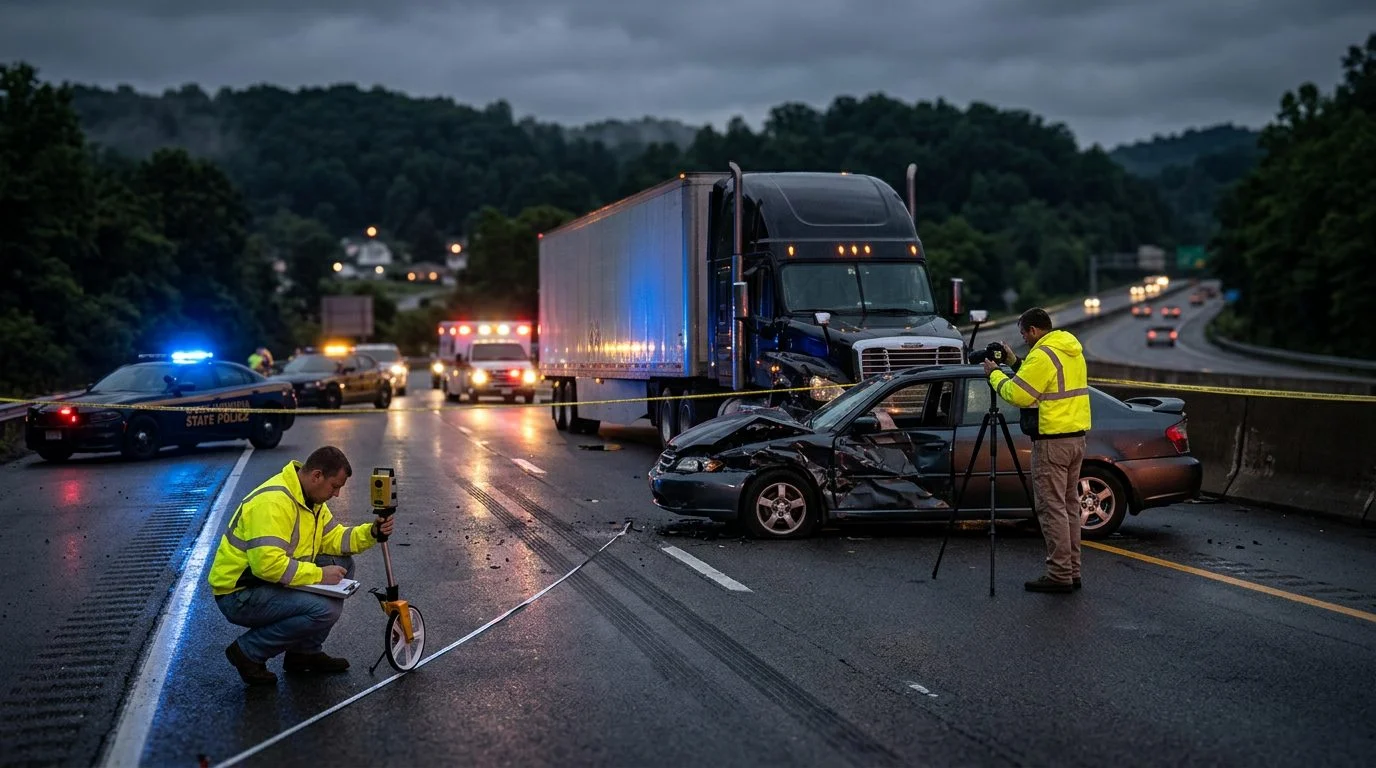
Wrongful Death | West Virginia
When a Fatal Crash Takes a Family Member
Questions come fast after a loss like this. The firm helps West Virginia families sort out what happened and what comes next.
Published November 11, 2026
Losing someone in a car crash is painful, and the questions arrive fast. You may be wondering whether your family has any legal claim at all.
In short, West Virginia law lets certain family members bring a wrongful death claim when another person’s wrongful act causes a death. The claim is generally brought by the personal representative of the deceased person’s estate, and it generally must be filed within two years of the date of death (W. Va. Code § 55-7-6). This guide explains how a fatal car crash wrongful death claim generally works in West Virginia.
What a Wrongful Death Claim Is in West Virginia
A wrongful death claim is a civil lawsuit. It may be brought when someone’s wrongful act, neglect, or default causes a death. West Virginia Code § 55-7-5 says the responsible person may be liable for damages even though the injured person has died.
A criminal case is different. The state brings a criminal case, and it can lead to punishment. A wrongful death claim is brought by the family’s representative, and it asks a court for money damages to make up for the family’s losses.
Many families are dealing with funeral expenses, lost income, and a sudden gap in the household when they first look into this. The law recognizes those losses as part of the claim.
Some families also hear about a survival claim. That type of claim may address harm the person suffered before dying. Whether one applies depends on the facts, so it’s worth asking about both during a review.
If your family is dealing with a fatal crash, you don't have to work out the legal questions alone, and we're glad to talk them through with you. Talk it through with Big Bubba — the first case review is free, confidential, and carries no obligation.

Who Can Bring a Claim Under West Virginia Code §55-7-6
Under West Virginia Code § 55-7-6, the action is brought by the personal representative of the deceased person’s estate. That person must be duly appointed, which means a court has formally named them.
The personal representative acts for the estate. They file the claim for the people the law allows to recover. If no one has been appointed yet, that step may need to happen before a claim is filed.
The statute names family members who may share in the damages. These include a surviving spouse, children (including adopted children and stepchildren), brothers, sisters, parents, and people who depended financially on the deceased. The jury or court decides how damages are split, so who shares depends on the facts and the family’s situation.
The law also lists the kinds of damages a verdict may include. These cover sorrow, mental anguish, and solace, which may include society, companionship, comfort, guidance, kindly offices and advice of the decedent; the verdict shall include, but may not be limited to, damages of this kind. They also cover reasonably expected loss of income and of services and care, medical and hospital expenses tied to the injury, and reasonable funeral expenses.
Deadlines: The Time Limit to File
West Virginia generally allows two years from the date of death to file a wrongful death action, and exceptions may apply. West Virginia Code § 55-7-6 sets that two-year rule, subject to other provisions that can change how the time runs.
Sometimes the crash and the death happen on different days.
If an injured person dies before filing their own claim, the personal representative may generally bring it within the same period that would have applied had the person lived. West Virginia Code § 55-7-8a covers that rule.
Other filing requirements may also apply. Waiting can put a claim at risk, so families should look at timing early, even while they’re still gathering information.
Fault, Negligence, and Comparative Responsibility
Most fatal crash claims turn on one question: did someone fail to use reasonable care, and did that failure cause the death?
Questions often raised in these cases include whether the driver was speeding, distracted, impaired, too tired, or failed to yield. These are questions to investigate, not conclusions.
For commercial drivers, federal rules say a driver may not operate a commercial motor vehicle, and a motor carrier may not require or permit a driver to do so, while the driver’s ability or alertness is so impaired, or so likely to become impaired, through fatigue, illness, or another cause, as to make it unsafe, except in a grave emergency where compliance would increase the hazard, in which case the driver may continue to the nearest place at which that hazard is removed. 49 C.F.R. § 392.3 states that rule.
West Virginia uses comparative fault. Under West Virginia Code § 55-7-13c, a plaintiff’s fault does not bar recovery unless it is greater than the combined fault of all others responsible. If it is less, recovery is reduced in proportion to that fault. Under W. Va. Code § 55-7-13c, a plaintiff’s fault generally does not bar recovery unless the plaintiff’s fault is greater than the combined fault of all other persons responsible for the total amount of damages, if any, to be awarded, and the statute’s exceptions may apply.
Each defendant generally pays only its own share of fault. The statute lists certain conduct, including driving under the influence, that can make a defendant jointly and severally liable.
Types of Fatal Crashes the Firm Handles
We handle wrongful death claims from car, truck, and other commercial vehicle crashes in West Virginia. Each type raises different questions.
- Crashes involving passenger cars and SUVs on interstates, state routes, and local roads may raise different questions than crashes involving commercial vehicles, depending on the facts, including whether the vehicle was transporting passengers for hire or hazardous materials that require marking or placarding.
- Tractor-trailer and commercial truck crashes, where more than one company may be involved, such as a carrier, owner, or contractor, depending on the facts.
- Bus, van, and other commercial vehicle crashes, which may fall under federal or state rules that apply to commercial operations.
Federal rules can matter after a fatal truck crash. 49 C.F.R. § 382.303 generally requires employers to test a surviving driver for alcohol as soon as practicable after a crash involving a commercial motor vehicle operating on a public road in commerce, if the driver was performing safety-sensitive functions and the crash involved the loss of human life. Other conditions and exceptions apply.
We serve families across West Virginia, including Charleston, Huntington, Morgantown, Wheeling, Martinsburg, Parkersburg, Beckley, Clarksburg, Fairmont, and Weirton.
What the Process Generally Involves
A fatal crash claim usually moves through a free case review, record gathering, investigation, contact with insurers, and then filing or resolution talks.
- Free case review. The family shares the basic facts. The firm explains the options that may apply under West Virginia law.
- Gathering records. Common items include the police crash report, photos, witness names, vehicle damage details, and medical and medical examiner or coroner records.
- Investigation. This may include vehicle data, traffic camera footage, and roadway conditions, depending on what still exists.
- Insurer contact. Some insurers may dispute a claim, and their responses can take time.
- Filing or resolution. If the family decides to pursue the claim, it is filed within the legal deadline. Otherwise, the parties may work toward a resolution.
The length of each step depends on the facts, the parties involved, and whether the claim is resolved before or after filing.
Not sure what your next step is?
Talk it through with Big Bubba — the first case review is free, confidential, and carries no obligation.
Questions Families Ask About Wrongful Death Claims
Most families ask the same questions early on. Short answers follow.
Can a family bring a claim after a single-vehicle crash?
It may be possible, depending on the facts.
What should the family keep?
Keep the crash report number, photos, witness names, medical and funeral records, and any letters from insurers.
Should the family give a recorded statement to an insurer?
Families may want to speak with a lawyer first, because statements can be used in later disputes.
What should we bring to a free case review?
Bring the crash date, the parties involved, your family’s relationship to the person who died, and any reports you already have.

Your Family’s Situation
If you are researching a fatal crash right now, you may be juggling funeral plans, paperwork, and hard questions at the same time. Those are heavy things to carry.
The firm can review what happened and explain how West Virginia’s rules may apply to your family’s situation. When you’re ready, reach out to Big Bubba to tell us what happened and request a free case review.