
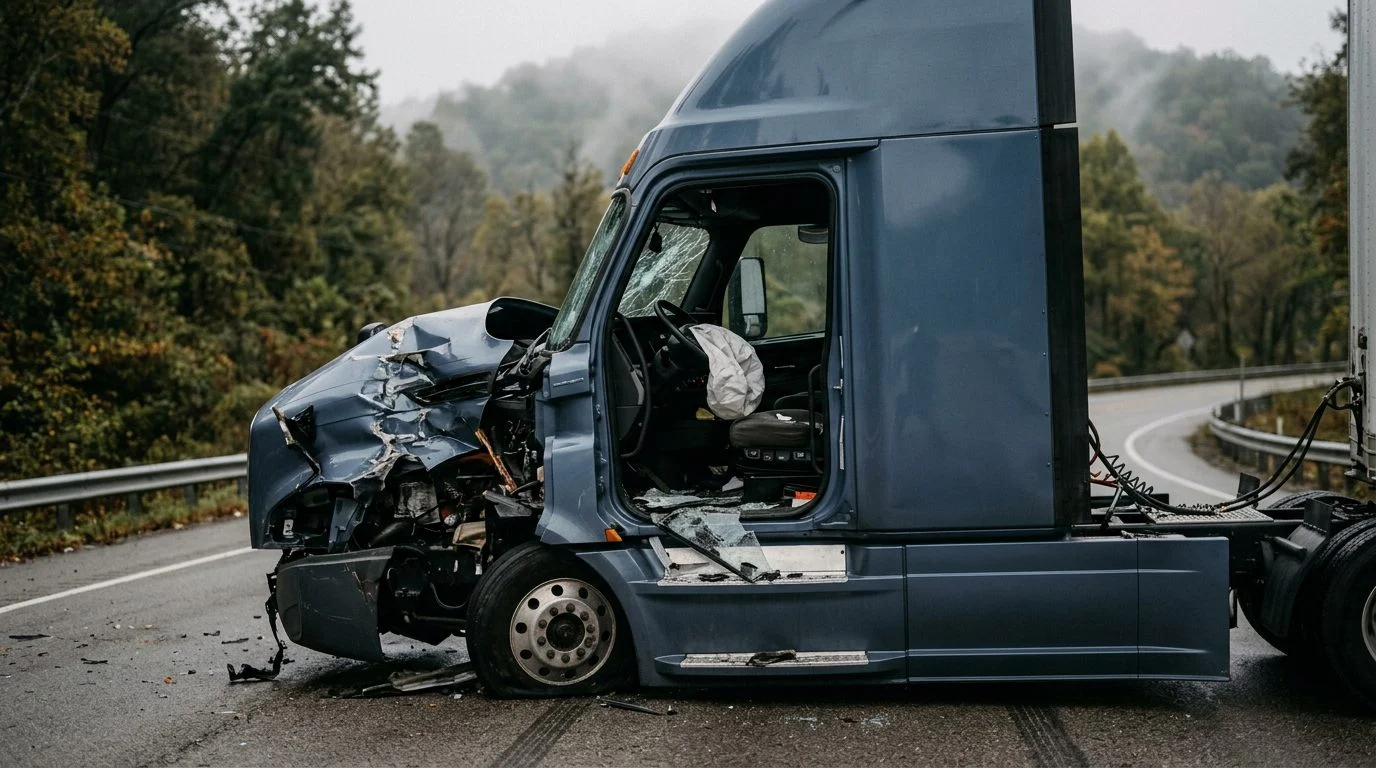
West Virginia Semi Truck Crash Injury Law
Hurt in a Head-On Crash With a Semi Truck? Tell the Firm What Happened
Big Bubba Injury Law represents people seriously hurt in head-on collisions with commercial trucks, and families in wrongful death cases. We serve Charleston, Huntington, Morgantown, Wheeling, Martinsburg, Parkersburg, Beckley, Clarksburg, Fairmont and Weirton, and across West Virginia.
Published October 24, 2026
A head-on or rear-end crash with a semi truck can cause severe injuries, and the people hurt may have legal options against the driver and the trucking company. Families searching for a head-on collision semi truck lawyer West Virginia often ask one hard question first: what happens next? This guide explains how these crashes happen, who may be responsible, and which deadlines apply in West Virginia. We serve people hurt in car and commercial vehicle crashes across the state, including Charleston, Huntington, Morgantown, Wheeling, Martinsburg, Parkersburg, Beckley, Clarksburg, Fairmont and Weirton.
What Head-On and Rear-End Semi Truck Crashes Are
A head-on crash happens when two vehicles traveling in opposite directions collide. A rear-end crash happens when one vehicle strikes the back of another. When a semi truck is in either crash, the injured person is usually in the smaller vehicle.
A loaded tractor-trailer weighs far more than a passenger car. It also needs much more distance to stop. That difference means occupants of the smaller vehicle usually absorb far more force.
These crashes happen on West Virginia interstates, U.S. routes and two-lane mountain roads. Curves, steep grades and bad weather add risk on those roads.
This page is written for injured drivers and passengers, pedestrians, and families who lost a loved one in these crashes.
If a semi truck crash changed your life or a family member's, you do not have to face the next steps alone, and we are ready to listen when you are. Talk it through with Big Bubba — the first case review is free, confidential, and carries no obligation.

Common Causes of Head-On and Rear-End Truck Crashes
Most of these crashes trace back to driver conduct, company decisions or equipment problems. Common causes include:
- Fatigue and hours-of-service violations. Federal rules limit driving time. A property-carrying driver may not drive once 14 consecutive hours have passed after coming on duty following 10 hours off duty, and may drive only 11 hours in that window (49 CFR 395.3). Drivers also may not operate a truck when fatigue makes it unsafe (49 CFR 392.3).
- Following too closely. Many rear-end impacts happen when a truck does not leave enough room or fails to slow for traffic ahead.
- Distracted driving. Phone use and other distractions pull a driver’s attention away from the road.
- Speed for conditions. Driving too fast for weather, curves or a mountain grade leaves too little time to stop.
- Brake, tire or steering failure. Poorly maintained equipment can fail at the worst moment.
- Unsecured loads and lane drift. Shifting cargo can change how a truck handles. An overcorrection can carry a truck into oncoming traffic.
- Impairment. Alcohol, prescription drugs or other substances can slow reaction time.
Each cause leaves a trail of records. That trail is why early evidence matters, as explained below.
Who Else May Be Responsible Besides the Driver
More than one party can be responsible for a semi truck crash. West Virginia law defines an “employer defendant” to include the owner of a commercial motor vehicle, the operator’s employer, and any other entity that owns, leases, rents or holds legal control over the vehicle or operator (W. Va. Code § 55-7-32). Federal rules also make the motor carrier responsible for requiring drivers to follow driver rules (49 CFR 390.11).
Other parties may include:
- The trucking company that employed or dispatched the driver, including how the driver’s schedule was set.
- Companies that lease or own the truck or trailer.
- Maintenance shops whose repairs may have been done poorly.
- Shippers or loading companies responsible for weight and cargo securement.
- Manufacturers, when a defective part played a role.
Claims may also examine how a company hired, trained and supervised its driver. Whether a particular party can be held responsible depends on the facts of the crash.
Injuries and Wrongful Death in Semi Truck Crashes
Head-on and rear-end truck crashes often cause catastrophic injuries, meaning serious harm with lasting effects. Traumatic brain injury and spinal cord injury are two examples. Other serious injuries include multiple fractures, internal organ damage and crush injuries.
Some injuries do not show their full effect for days or weeks. Prompt medical evaluation protects your health and creates a clear record of what happened.
Long-term effects can include lost income, reduced ability to work, future medical care and changes to daily life. Keep track of these losses from the start.
Wrongful Death Claims in West Virginia
When a crash is fatal, the action must be brought by the personal representative of the deceased person’s estate, the person duly appointed to handle the estate. The verdict may include damages for sorrow, mental anguish and solace, including companionship and guidance. It may also include compensation for reasonably expected loss of income and services, expenses for the care, treatment and hospitalization of the decedent incident to the injury resulting in death, and reasonable funeral expenses (W. Va. Code § 55-7-6).
West Virginia Negligence Law and Filing Deadlines
Under West Virginia law, an injured person generally must show that another party’s fault caused the harm. The state also sets filing deadlines, and exceptions may apply.
West Virginia uses modified comparative fault. Fault is measured by percentage, including the injured person’s own share, and each person’s liability follows that percentage (W. Va. Code § 55-7-13a). Your own share of fault can affect how much you recover.
Key deadlines are short:
- Personal injury: A personal injury claim generally must be brought within two years after the right to bring it accrues (W. Va. Code § 55-2-12).
- Wrongful death: The action must be commenced within two years after the death, subject to the provisions of section eighteen, article two, chapter fifty-five (W. Va. Code § 55-7-6). W. Va. Code § 55-7-6 reads: “The provisions of this section shall not apply to actions brought for the death of any person occurring prior to July 1, 1988.”
Deadlines keep running while insurers investigate. Waiting can make it harder to gather records and witness memories.
Evidence to Preserve and What Happens at a Free Case Review
Trucking records can disappear quickly, so early steps matter most. Evidence that may be lost includes:
- Electronic logging device and duty-status records. Motor carriers must keep records of duty status and supporting documents for at least six months from receipt (49 CFR 395.8).
- Engine data, dashcam footage and maintenance files. These can show how the truck was driven and maintained.
- Drug and alcohol testing records. After certain crashes, including those involving a loss of human life, employers must test surviving drivers as soon as practicable. Alcohol testing must stop if a test is not administered within eight hours following the accident (49 CFR 382.303).
Injured people and families can also help by taking a few simple steps:
- Keep photos, the crash report number and names of witnesses.
- Save medical records, bills and receipts.
- Write a journal of symptoms, missed work and daily limits.
Recorded statements need care. West Virginia law bars negotiating a settlement, or obtaining a release or a statement for use in negotiating a settlement or obtaining a partial or general release of liability, within 20 days of the injury while the injured person is a hospital inpatient or partially or totally unable to engage in his or her usual trade, profession or occupation (W. Va. Code § 55-7-11a). Before you give a detailed recorded statement, take time to review the facts.
A free case review is a confidential conversation about what happened, your injuries, the parties involved and the evidence that exists. It carries no obligation to continue. After that, the firm can review records, request data from the carrier and communicate with insurers. Timelines vary with the injuries, the evidence and the insurer’s response.
Not sure what your next step is?
Talk it through with Big Bubba — the first case review is free, confidential, and carries no obligation.
Frequently Asked Questions About Semi Truck Head-On and Rear-End Crashes
Here are short answers to common questions about these crashes.
Can I sue a trucking company after a head-on or rear-end crash?
It may be possible when the company’s driver, dispatch practices or equipment contributed to the crash.
Does the police report decide who is at fault?
No. The report is important evidence, but investigations can change and other records also matter.
What if I was partly at fault?
West Virginia uses modified comparative fault, so your own percentage of fault can affect your recovery (W. Va. Code § 55-7-13c).
Is there a limit on damages against a trucking company?
For a commercial motor vehicle case requiring a commercial driver’s license, West Virginia limits noneconomic damages against an employer defendant to $5 million per occurrence. That figure increases each year for inflation beginning January 1, 2026, up to 150 percent of the stated amount, and the limit is subject to the conditions and exceptions set out in the statute. The cap is not available to a defendant without at least $3 million in commercial vehicle insurance, and it has other exceptions (W. Va. Code § 55-7-32). W. Va. Code § 55-7-32(d) says the section does not apply if the civil action involving a commercial motor vehicle arises from an incident in which the operator or driver is found to have done any of the following. At the time of the incident, the driver operated the vehicle with an alcohol concentration of .04 or more as defined in §17E-1-14, or under the influence of any controlled substance, other drug, or inhalant substance. The driver operated it beyond the hours of operation set by state or federal regulations, or in willful or wanton disregard for the safety of persons or property. The driver operated it loaded over the maximum gross vehicle weight rating set by state or federal regulations, unless legally operating under a permit issued under §17C-17-11. The driver operated it while engaging in distracted driving as set forth in §17C-14-15(e). Or, following the incident, the driver refused to submit to testing required under §17E-1-15 (W. Va. Code § 55-7-32).
Who can bring a wrongful death claim?
The claim must be brought by the personal representative of the deceased person’s estate. Damages are then distributed under state law.
What kind of head-on collision semi truck lawyer West Virginia residents can reach out to?
A personal injury lawyer handles these claims. The firm handles car and commercial vehicle crash claims for people across West Virginia.

If a Semi Truck Crash Changed Your Life or a Family Member’s
The next steps after a head-on or rear-end truck crash include getting medical care, keeping records and watching the filing deadline. Here is a simple checklist:
- Follow your medical care plan and keep every appointment you can.
- Write down names of drivers, carriers and witnesses, and save the crash report number.
- Note any USDOT Number you can find, since qualifying interstate carriers must have one (FMCSA).
- Keep in mind that every such action must be brought by and in the name of the personal representative of the deceased person (W. Va. Code § 55-7-6).
Looking into a head-on collision semi truck lawyer West Virginia while bills and missed paychecks pile up is hard. If you are ready to talk about your own situation, you can request a free case review. The firm can listen to what happened and explain your options.
Related practice areas
- Truck Accident Claims in West Virginia | Big Bubba Legal