
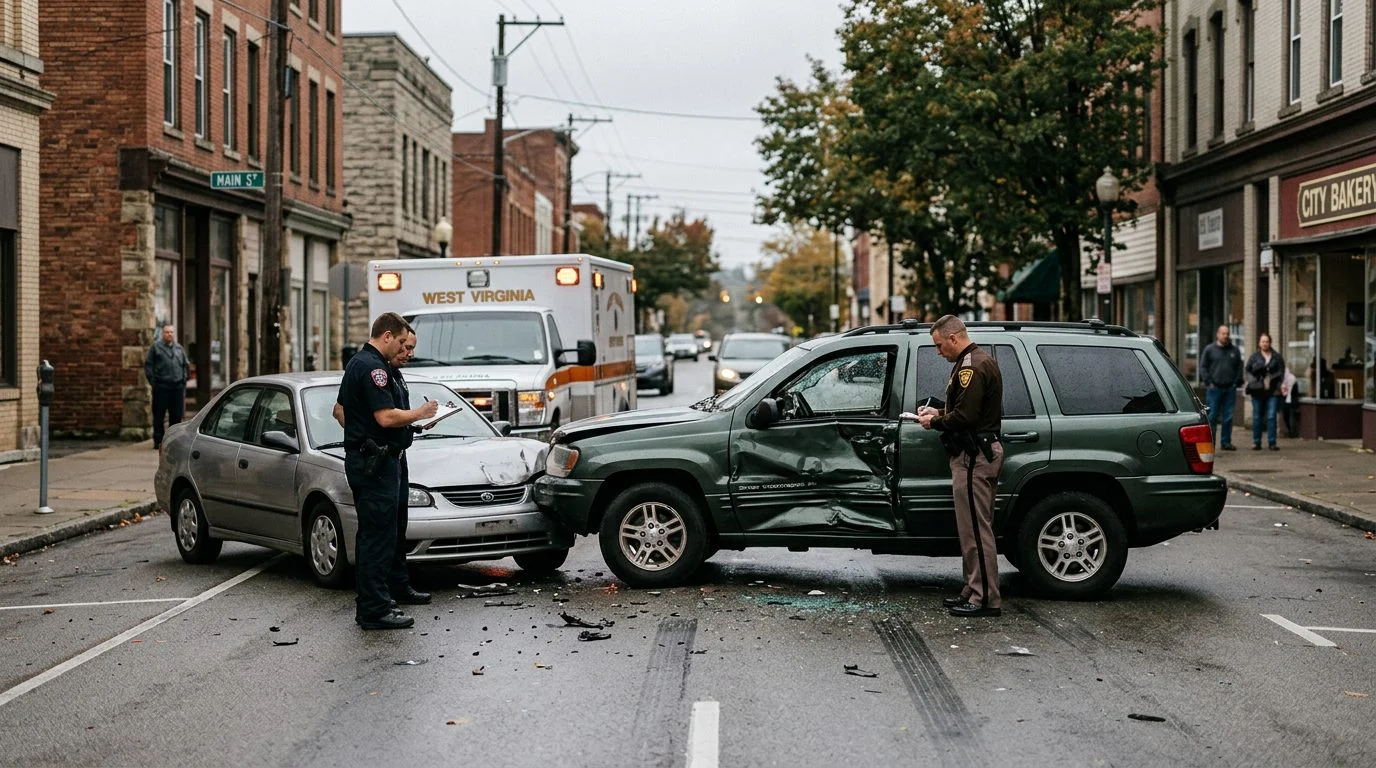
Car Accidents in West Virginia
Hurt in a crash? Here's what happens next.
After a car accident, you have rights—and a limited window to protect them. Big Bubba focuses on serious crash injuries, and we serve injury victims across West Virginia.
Published October 01, 2026
Car Accidents in West Virginia: What You Need to Know
After a car accident in West Virginia, your next moves—and the decisions you make in the first hours—shape everything that follows: your safety, your evidence, your claim, and your recovery. This guide walks you through what actually happens after a crash in West Virginia, how fault is determined, what compensation looks like, and why early legal guidance matters.
Not sure what your next step is?
Talk it through with our team — the first case review is free, confidential, and carries no obligation.
What Happens After a Car Accident in West Virginia
The immediate aftermath of a crash is critical—and most people don’t realize how much their actions in those first hours affect their claim later.
First, check for injuries and call 911 if anyone is hurt. Move to safety if possible. When police arrive, give a factual account of what happened—but don’t admit fault or apologize for the accident. Statements like “I didn’t see you” or “I’m sorry” can be used against you later. Get the other driver’s name, phone number, address, insurance company, and policy number. Write down the names and contact information of any witnesses. Take photographs of vehicle damage, the accident scene, road conditions, traffic signs, and the overall layout. These images become evidence.
West Virginia operates under an at-fault insurance system, meaning the driver responsible for the accident is liable for damages to the other party. This is different from no-fault states, where each driver’s own insurance covers their injuries regardless of who caused the crash. In West Virginia, determining who is at fault is central to your claim.
The first hours matter because evidence disappears. Skid marks fade. Witnesses move away or forget details. Vehicle damage is repaired. Medical records document your injuries at the time of the crash. If you’re injured, see a doctor or go to the emergency room—even if you feel okay. Some injuries, like traumatic brain injury or internal injuries, don’t show symptoms immediately. Medical documentation creates the record that proves your harm.
Common mistakes people make early on: talking to the other driver’s insurance company without legal guidance, posting about the accident on social media, accepting a quick settlement offer, or delaying medical care because they think they’re fine. Each of these can weaken your claim.
How Fault Is Determined in West Virginia Car Accidents
West Virginia applies comparative negligence, a rule that may reduce your recovery if you are found partially at fault for the accident. Here’s how it works: if you are 20% at fault and the other driver is 80% at fault, you can still recover damages—but your award is reduced by your percentage of fault. If you are 51% or more at fault, you cannot recover anything. This rule makes fault determination a central battle in car accident claims.
Evidence that establishes fault includes:
- Police reports. The officer’s account, citations issued, and observations at the scene carry weight. However, police reports are not final determinations of fault—they are one piece of evidence.
- Witness statements. People who saw the crash provide independent accounts. Their credibility and detail matter.
- Vehicle damage. Where and how vehicles are damaged often reveals the direction of impact and the sequence of events.
- Traffic laws. Violations—running a red light, speeding, failing to yield—can be evidence of negligence when the violation caused the injury. West Virginia’s texting-while-driving law prohibits drivers from using handheld devices while operating a vehicle, and violations can prove distraction and negligence.
- Vehicle data. Modern cars record speed, braking, and other data that can be extracted and used as evidence.
Insurance company fault determinations are not final legal determinations. An adjuster’s decision that you are at fault can be challenged with proper evidence and legal representation. Many accident victims accept an insurer’s initial determination without realizing it can be disputed.
When multiple vehicles are involved—common on West Virginia’s I-77 and I-79 corridors—liability can shift depending on which driver caused the initial collision and whether subsequent drivers had time to avoid the crash. A multi-vehicle pile-up requires careful investigation to sort out who is responsible for what.
Common Types of Car Accidents in West Virginia
Different accident types often reveal patterns about fault.
Rear-end collisions are among the most common. The driver who hits the car in front is usually at fault because they failed to maintain a safe following distance or were distracted. Rear-end accidents often cause whiplash, neck and back injuries, and sometimes more serious harm.
Head-on and sideswipe accidents typically involve one driver crossing into the other’s lane. These crashes often result from distraction, impaired driving, or loss of control. Head-on collisions are particularly dangerous and frequently cause catastrophic injuries.
Multi-vehicle pile-ups happen regularly on West Virginia’s major routes, especially during bad weather or heavy traffic. Determining fault in a chain-reaction crash requires evidence of which driver initiated the sequence.
Weather-related accidents occur when rain, snow, or fog reduces visibility or traction. Drivers remain responsible for adjusting their speed and following distance to road conditions. Blaming weather doesn’t eliminate driver responsibility.
Distracted Driving and Car Accidents in West Virginia
Distracted driving includes texting, talking on a phone, eating, adjusting the radio, or any activity that takes attention from the road. West Virginia’s texting-while-driving law makes it illegal for drivers to use handheld devices while operating a vehicle. If the other driver was texting or using their phone when they hit you, that violation strengthens your claim significantly.
Phone records and vehicle data (extracted from the car’s computer) can prove distraction. Text messages sent or received at the moment of the crash, call logs, and app usage all become evidence. This data is powerful because it’s objective—it doesn’t rely on memory or witness accounts.
Have questions about what happened?
Ask our team directly. The first conversation is free, confidential, and there is no obligation to continue.
Are Car Accidents Public Record in West Virginia?
A police report can help support your accident claim; contact the law enforcement agency that responded to your crash to ask how to request a copy.
Your police report includes the officer’s account of what happened, citations issued, injuries reported, vehicle damage descriptions, and sometimes witness statements. It’s one of the first pieces of evidence in your claim. The report isn’t perfect—officers don’t always get every detail right—but it’s an official record that insurers and courts take seriously.
You can request your crash report from the law enforcement agency that investigated the crash. Having the report in hand allows you and your attorney to review it, spot errors, and gather additional evidence if needed.
Compensation for Car Accident Injuries in West Virginia
West Virginia law allows recovery for:
- Medical expenses: emergency room visits, hospital stays, surgery, physical therapy, medications, and ongoing treatment.
- Lost wages: income you missed because of the accident and recovery.
- Pain and suffering: compensation for physical pain, emotional distress, and reduced quality of life.
- Other damages: property damage to your vehicle, transportation costs, and in some cases, permanent disability or disfigurement.
Insurance settlement offers are often too low because adjusters are trained to minimize payouts. They may offer a quick settlement before you’ve finished medical treatment or before you understand the full scope of your injuries. Accepting early can leave you without compensation for future care.
What Not to Do After a Car Accident
Don’t admit fault at the scene. Statements like “I didn’t see you” or “I’m sorry” can be used against you in your claim.
Don’t talk to the other driver’s insurance company without legal guidance. Adjusters are skilled at getting you to say things that hurt your claim. They may ask leading questions designed to establish your fault or minimize your injuries. Anything you say can be recorded and used against you.
Don’t post about the accident on social media. Photos, comments, or updates can be taken out of context and used to argue you weren’t as hurt as you claim or that you were partially at fault.
Don’t delay medical care. Waiting weeks to see a doctor creates a gap in your medical record that insurers use to argue your injuries aren’t serious.
Don’t accept the first settlement offer. Early offers rarely reflect the true value of your claim.
Early legal guidance prevents these mistakes. An attorney handles communication with insurers, protects your rights, and ensures you don’t accidentally say something that weakens your case.
Why You Need a West Virginia Car Accident Attorney
Insurance companies have teams of adjusters, lawyers, and investigators working to minimize what they pay. You should have professional representation too.
A West Virginia attorney can explain state law and the court procedures that apply to your case. They understand West Virginia’s comparative negligence rule and how to present evidence to minimize your assigned fault (W. Va. Code § 55-7-13c). They know the insurance companies operating in the state and their practices.
An attorney investigates the accident thoroughly: reviewing police reports, interviewing witnesses, obtaining vehicle data, analyzing medical records, and building a strong case. They handle all communication with insurers so you don’t accidentally hurt your claim. They calculate the true value of your damages—not just what the insurance company offers.
Most importantly, an attorney levels the playing field. You’re not facing the insurance company alone.

Want to know where you stand?
Tell us what happened and our team will walk you through the options available to you, at no cost.
Frequently Asked Questions
How long do I have to file a car accident claim in West Virginia?
West Virginia generally allows two years to file a personal injury lawsuit, running from when the right to bring the claim accrues (W. Va. Code § 55-2-12), and exceptions may apply. Don’t wait—evidence fades and witnesses become harder to reach.
Can I recover damages if I was partially at fault?
Yes, under West Virginia’s comparative negligence rule, as long as you are less than 51% at fault (W. Va. Code § 55-7-13c). Your recovery is reduced by your percentage of fault.
What if the other driver doesn’t have insurance?
Your own uninsured motorist coverage may cover your damages. An attorney can help you navigate this.
Should I talk to the other driver’s insurance company?
Not without an attorney. Anything you say can be used against you. Let your attorney handle communications.
What if the accident caused a serious injury like a brain or spinal cord injury?
Catastrophic injuries require focused legal handling and often involve higher damages. An experienced attorney is essential.
If you’ve been hurt in a car crash in West Virginia and aren’t sure what comes next, you’re not alone—people in your situation can reach out to us, and we’re here to listen to what happened. Tell Bubba what happened and request a free case review.
Time matters.
West Virginia law sets a two-year deadline to file a personal injury lawsuit (W. Va. Code § 55-2-12). Evidence fades and witnesses become harder to reach as time passes. Don't delay.
What to do after a car accident
Get medical attention
Even if you feel fine, some injuries appear hours or days later. A medical record also documents your injuries for your claim.
Document the scene
Take photos of vehicle damage, road conditions, traffic signs, and the other driver's information. Note the names and contact details of any witnesses.
Report to your insurance
Notify your insurer promptly, but stick to the facts. Avoid admitting fault or signing anything without legal review.
Talk to a lawyer
Before accepting any settlement or giving a recorded statement, speak with Big Bubba about your rights and what your case may be worth.
Why choose Big Bubba for your car accident case
Focused on serious injuries
We represent people with catastrophic injuries, traumatic brain injuries, spinal cord damage, and families in wrongful death cases—not minor fender-benders.
West Virginia through and through
We serve injury victims across West Virginia.
No fees unless there is a recovery
You pay nothing upfront. We only collect a fee if your case results in a settlement or judgment in your favor. You may still be responsible for court costs and case expenses.
We listen to your story
Every crash is different. We take time to understand what happened to you and what you need to move forward.
Common questions about car accidents in West Virginia
Can I recover damages if I was partially at fault?
West Virginia's comparative negligence rule allows recovery as long as you are less than 51% at fault (W. Va. Code § 55-7-13c). Your recovery may be reduced by your percentage of fault.
What damages can I claim?
You may recover medical expenses, lost wages, property damage, and compensation for pain and suffering. An attorney can help you understand what your specific situation may warrant.
What if the other driver doesn't have insurance?
West Virginia requires drivers to carry uninsured motorist coverage. Your own policy may cover you if the at-fault driver is uninsured or underinsured.
Should I accept the insurance company's first offer?
Insurance companies often offer less than a claim is worth. Before accepting, have an attorney review the offer and explain your options.