
Car and Truck Crash Claims | West Virginia
Asked for a Recorded Statement After a Crash? Talk to Us First
Big Bubba Injury Law helps people hurt in car, truck and commercial vehicle crashes across West Virginia understand their options before they speak with an insurance adjuster.
Published November 1, 2026
Whether to answer an adjuster’s request for a recorded statement is a question many injured people ask, and the firm is available to talk through it with you during a free case review. West Virginia also limits when an insurer can seek a statement soon after an injury. This page explains what the request means, what state law says, and how to respond without guessing. If you’re hurt, or you’re handling a loss in your family, you don’t have to work this out alone.
What Is a Recorded Statement, and Who Is Asking for One?
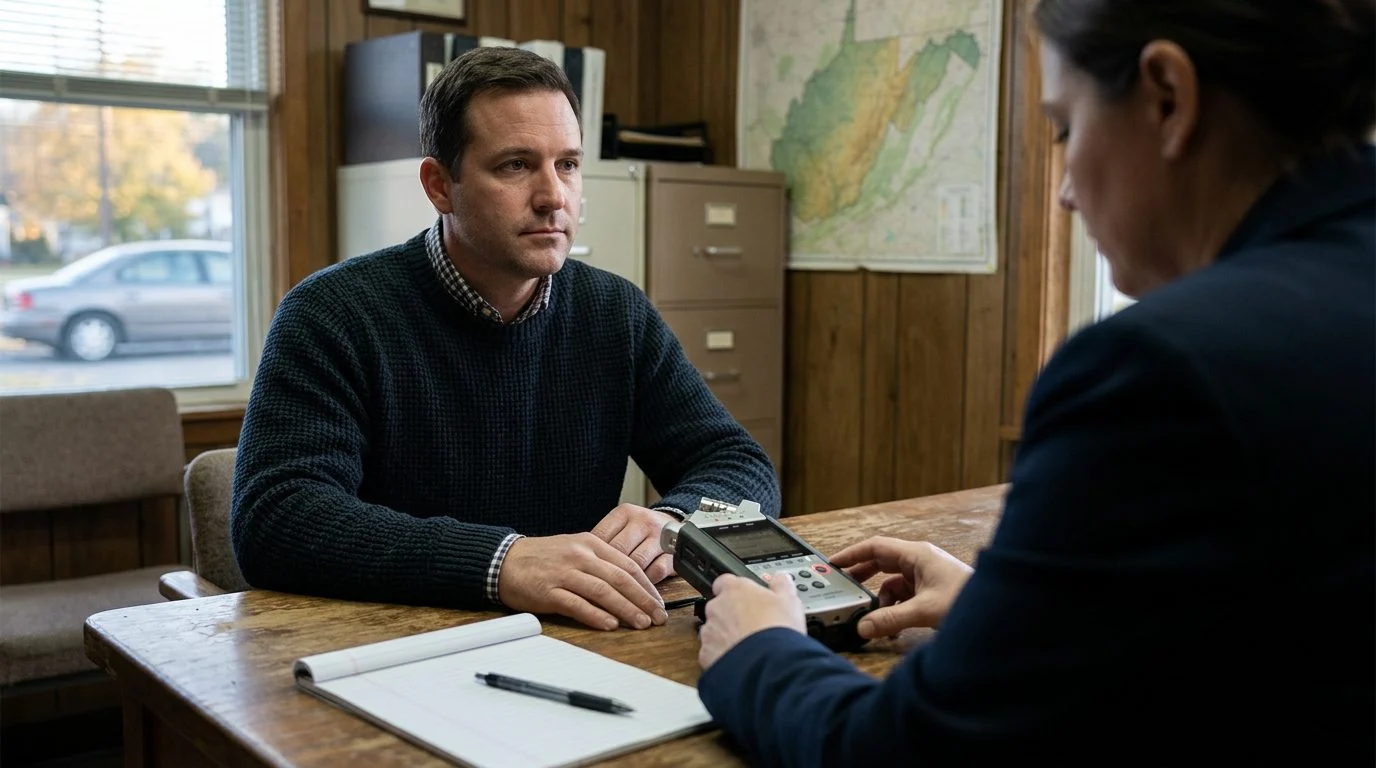
A recorded statement is a question-and-answer session with an insurance adjuster, captured on audio or video. The adjuster asks how the crash happened and how you were hurt. The company keeps the recording on file.
The request can come from several places. The other driver’s insurer may ask. Your own insurer may ask under your policy. In a crash involving a company vehicle, the trucking company’s insurer may also call.
Timing is often the hardest part. Many calls come within days of the crash. You may be sore, waiting on test results, or still in a hospital bed. Pain and medication can make the details of the crash blurry.
Remember who the adjuster works for. An adjuster works for an insurance company, and that company is trying to resolve its own side of the claim. That goal is not the same as yours, so it helps to slow down before you talk.
If an adjuster has called about a crash that left you or someone you love badly hurt, you don't have to work out the next step alone. The firm can talk it through in a free case review. Talk it through with Big Bubba — the first case review is free, confidential, and carries no obligation.

Are You Legally Required to Give One in West Virginia?
Many people wonder how to respond to a request for a recorded statement, and you can bring that question to the firm for a free case review. West Virginia does set a special rule for the first twenty days after an injury. Under W. Va. Code § 55-7-11a, during that window, if you are an inpatient in any hospital or are partly or totally unable to do your usual work, no one may try to negotiate a settlement with you. No one may try to get a statement from you for use in a settlement either. The one exception is when you expressly ask for the statement to be taken: the statute does not prohibit a person acting or intending to act for and on behalf of the injured person from obtaining a statement, oral or written, upon your express request.
Under W. Va. Code § 55-7-11a, a settlement, release or statement obtained in violation of the statute’s twenty-day rule may be disavowed by the injured person at any time within one hundred eighty days from the date of the personal injury, by executing a written statement of disavowal and forwarding a copy to the person who violated the statute; if any consideration paid for the settlement or release is repaid or returned to the person who paid it at the time the copy is forwarded, the settlement, release or statement may not be admissible in evidence for any purpose in any court or other proceeding relating to the personal injury.
Reporting a crash and exchanging information at the scene is a separate step from an adjuster’s interview. Those steps are covered in a later section. What fits your facts depends on the crash and the policies involved.
Why Adjusters Ask Early and What the Questions Often Cover
Adjusters ask early because the answers help the insurer judge fault, injuries and the likely size of a claim. West Virginia uses comparative fault, which means each person’s share of fault matters. Under W. Va. Code § 55-7-13c, your fault does not bar recovery unless it is greater than the combined fault of all other persons responsible. If your fault is less, your recovery is reduced in proportion to your share.
That is why a statement about how the crash happened matters so much. Common topics include the sequence of events, speed, traffic, lanes, phone use, what you were doing, prior injuries, and medical treatment so far.
Some questions set traps. A question like “You didn’t see him coming, did you?” invites a yes that can later be read as an admission. A short answer given in pain can be quoted out of context. Saying you “felt fine” at the scene may later be set against a diagnosis you received days afterward.
Statements about symptoms made before a full medical picture is known are easy to misread. Your doctor’s records will tell a fuller story than a phone call made on day two.
Can Declining or Delaying a Statement Affect Your Claim?
Declining a recorded statement does not mean you have no path forward. An insurer may respond by asking for information in another form, such as written questions or medical records. It may also slow the file while it waits for a reply.
Some insurer conduct has its own remedy. Under W. Va. Code § 33-11-4a, a third-party claimant may not bring a private action against any person for an unfair claims settlement practice.
Asking for requests in writing and asking for time to gather records are common, reasonable steps. A polite letter that says you will respond once you have the records is a normal way to handle a request you are not ready to answer.
Your Duty to Your Own Insurer Versus the Other Driver’s Insurer
The other driver’s insurer works for its own insured. Your own insurer has a contract with you. Those are two different relationships, and they call for two different approaches.
Your own policy may ask you to cooperate with your claim. That duty runs to your own insurer. It is a separate question from a request made by the other driver’s adjuster, and it helps to keep the two apart in your mind.
Handle your own insurer with the same care. Ask for requests in writing where possible. Keep copies of every letter and every claim number. Write down the adjuster’s name, the date, and the time of each call.
West Virginia requires motor vehicle insurance. The West Virginia Division of Motor Vehicles explains the mandatory coverage rules, required proof of coverage, and minimum liability limits.
Crashes Involving Commercial Trucks and Company Vehicles
A crash with a commercial truck can involve more than two drivers and two insurers. The trucking company, its insurer, and the driver’s employer may each reach out for a statement.
West Virginia has its own statute for claims against employers of commercial vehicle operators. Under W. Va. Code § 55-7-32, the employer defendant includes the owner of the vehicle and the employer of the person driving it. That statute also caps certain noneconomic damages against that employer, with exceptions in some cases.
Records matter in these claims. Federal rules require drivers of covered trucks to record their duty status for each 24-hour period, either on an electronic logging device or on a paper grid. See 49 C.F.R. § 395.8. Records may be kept in any technology that accurately reflects the information and remains accessible in a form that can be accurately reproduced later for reference, as described in 49 C.F.R. § 379.7.
Early requests help make sure relevant records are kept. The firm handles car accident, truck accident and commercial vehicle matters, so a call about a company truck falls within what the firm does.
Not sure what your next step is?
Talk it through with Big Bubba — the first case review is free, confidential, and carries no obligation.
How to Respond When the Adjuster Calls
Start by writing down the caller’s name, the company, and the claim number. Ask that the request come in writing, so you can see the questions before you answer.
You can say you are not ready to give a statement, and you can ask for a later date. That is a normal reply, and it doesn’t need an apology.
Answer only what you know. Don’t guess about speed, distance, or the time of day. A guess that turns out to be wrong can be used against you later.
Don’t sign releases or medical authorizations until you have read them. Ask what each one covers, and keep a copy of anything you sign.
Ask whether the caller is contacting you as a driver, a witness, or a person making a claim. The answer changes what the insurer may ask and why.
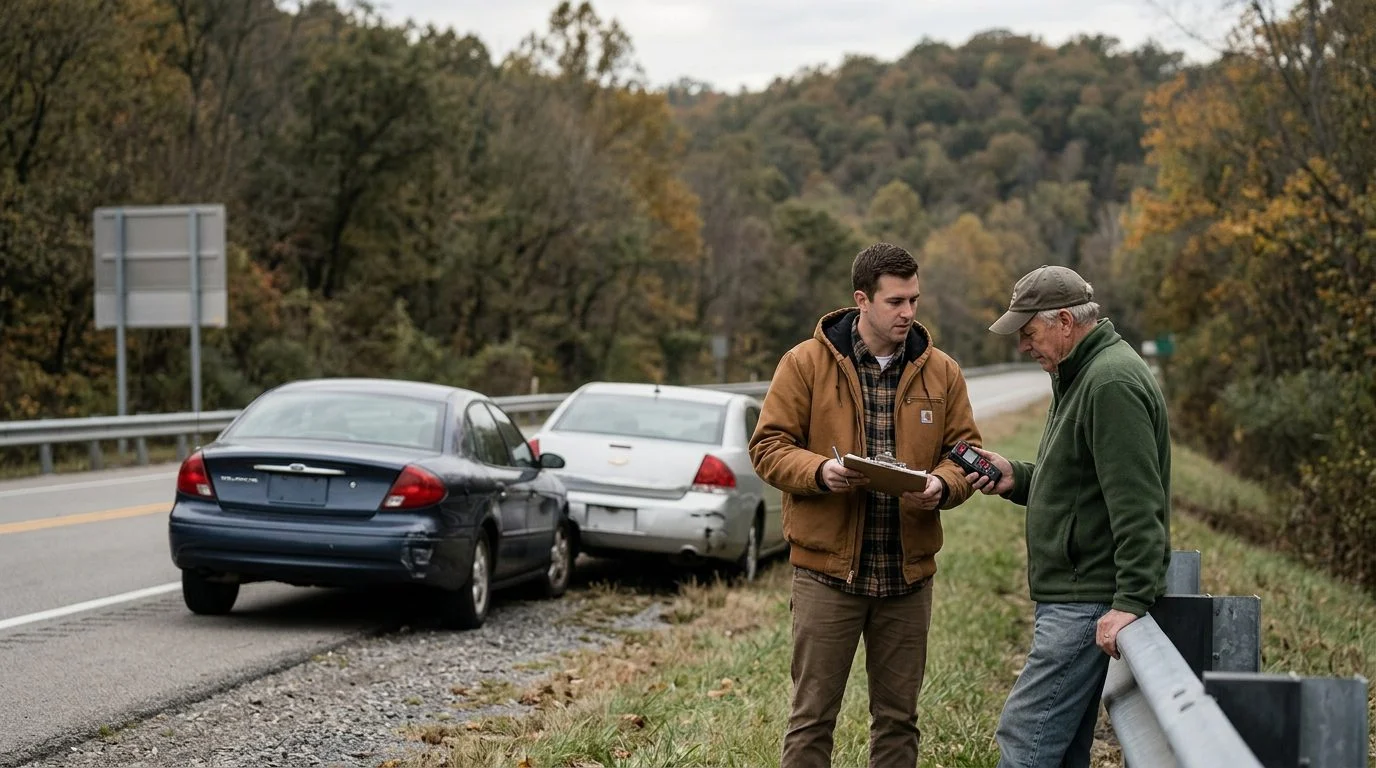
At the scene, the usual exchange is names, contact details, insurance information, and vehicle details. Keep that exchange short and factual. Do not discuss who was at fault.
Talking Through Your Crash With the Firm
If an adjuster has called about a crash that left you or someone you love badly hurt, you do not have to answer every question on your own. Many people reach this point while still in pain or grieving, and that is a hard place to make careful decisions.
The firm handles car accident, truck accident and commercial vehicle matters. It also handles catastrophic injury, traumatic brain injury, spinal cord injury, and wrongful death claims. We serve Charleston, Huntington, Morgantown, Wheeling, Martinsburg, Parkersburg, Beckley, Clarksburg, Fairmont, Weirton, and communities across West Virginia.
Can an adjuster ask me for a statement while I’m in the hospital?
Under W. Va. Code § 55-7-11a, within twenty days from the date of a personal injury, no person may obtain or attempt to obtain a statement, written or oral, from you for use in negotiating a settlement or obtaining a partial or general release of liability while you are a hospital inpatient or are partially or totally unable to engage in your usual trade, profession or occupation. If such a statement is obtained in violation of the statute, you may disavow it in writing within one hundred eighty days from the date of the injury, by sending a copy to the person who obtained it. A disavowed statement may not be admissible in evidence for any purpose in any court or other proceeding relating to the injury, if any consideration paid for the settlement or general release of liability is repaid or returned to the person who paid it at the time you forward the copy of your written disavowal. The only exception is a statement taken by a person acting for you, at your express request, and an insurer or adjuster for the other side does not qualify. W. Va. Code § 55-7-11a
When You Have Already Spoken on a Recorded Call With an Insurer
How long do I have to file a claim?
The general deadline for a personal injury action is two years under W. Va. Code § 55-2-12. A wrongful death action must be commenced within two years after the death, subject to the provisions of section eighteen, article two, chapter fifty-five, under W. Va. Code § 55-7-6. W. Va. Code § 55-7-6 reads: “The provisions of this section shall not apply to actions brought for the death of any person occurring prior to July 1, 1988.”
If an adjuster is waiting on your answer about a crash that changed your life, you can request a free case review with the firm and talk through what comes next.
Related practice areas
- Catastrophic Injuries
- West Virginia Truck Accident Lawsuit: Suing the Company