
Spinal Cord Injury Claims
After a Serious Crash in West Virginia, You Need a Clear Path Forward
A spinal cord injury changes everything. Big Bubba focuses exclusively on helping people and families in West Virginia pursue claims for the full cost of care, lost income, and pain after catastrophic crashes.
Published October 01, 2026
Spinal Cord Injury Claims After a Serious Crash in West Virginia: What You Need to Know
A spinal cord injury from a car or truck crash is one of the most life-altering injuries a person can suffer. The damage to the bundle of nerves that carries signals between your brain and the rest of your body can result in permanent loss of strength, sensation, or function below the injury site—and the path to recovery, both medical and legal, is complex and demanding. West Virginia law provides a pathway to hold the responsible party accountable and to pursue compensation for the staggering costs of care, lost income, and profound changes to your quality of life.
This guide walks you through what a spinal cord injury is, how crashes cause them, the legal landscape in West Virginia, and the steps you need to take to protect your rights and your family’s future.

Not sure what your next step is?
Talk it through with our team — the first case review is free, confidential, and carries no obligation.
Understanding Spinal Cord Injuries from Car and Truck Accidents
A spinal cord injury occurs when trauma damages the bundle of nerves and nerve fibers that carry signals between the brain and the rest of the body, potentially resulting in permanent loss of strength, sensation, or function below the site of injury. Unlike a broken bone in the spine (a vertebral fracture), a spinal cord injury involves damage to the nerve tissue itself—damage that the body cannot fully repair.
Spinal cord injuries are classified into two main categories: complete and incomplete. A complete spinal cord injury means total loss of sensory and motor function below the level of injury. An incomplete spinal cord injury means some sensory or motor function remains below the injury level, which often offers greater potential for recovery and rehabilitation. The distinction matters enormously for your long-term prognosis, the intensity and cost of rehabilitation, and the damages you may recover.
Motor vehicle crashes are a leading cause of spinal cord injury. The force of impact—whether from a high-speed collision, a rollover, or a rear-end strike—can compress, stretch, or tear the spinal cord. A single moment of negligence or recklessness can transform a person’s entire life. The immediate effects may include paralysis, loss of sensation, loss of bladder or bowel control, and difficulty breathing or speaking. But spinal cord injuries also trigger secondary injury mechanisms: inflammation, swelling, and reduced blood flow can worsen neurological function over hours or days following the initial trauma, which is why emergency medical evaluation and imaging are critical.
How Spinal Cord Injuries Happen in West Virginia Crashes
Car accidents can cause spinal cord injury in several ways. High-speed collisions create sudden, violent deceleration that can compress or stretch the spinal cord. Rear-end impacts force the head and neck backward (whiplash) and can injure the cervical spine. Rollover accidents expose occupants to multiple impacts and crushing forces. The severity of a spinal cord injury often depends on the speed of impact, the angle of collision, and whether the vehicle’s safety features (airbags, crumple zones) functioned properly.
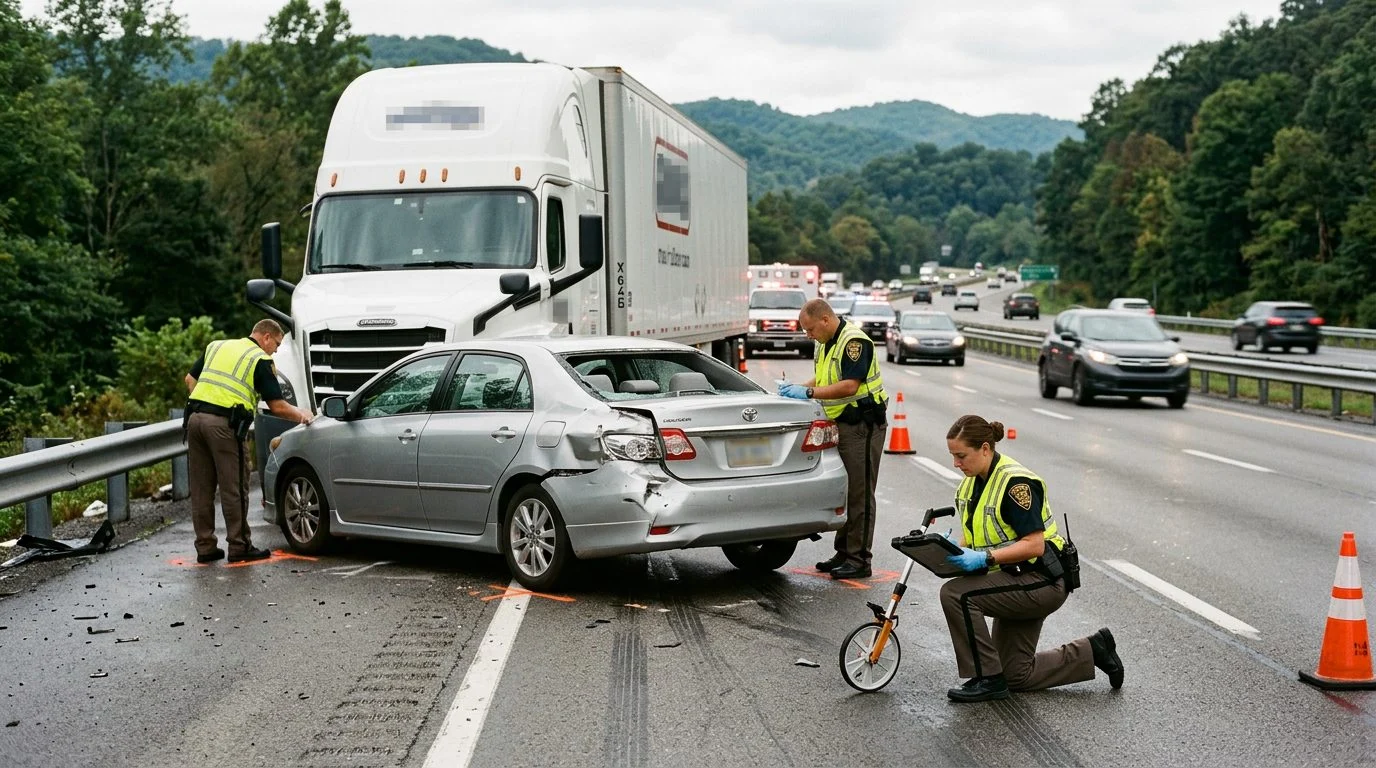
Truck and commercial vehicle accidents often result in more severe spinal cord injuries. The sheer mass and force of a fully loaded commercial truck—which can weigh 80,000 pounds or more—creates catastrophic trauma. Jackknife crashes, where the trailer swings out at an angle to the tractor, can crush smaller vehicles. Underride incidents, where a passenger vehicle slides under the rear or side of a trailer, expose occupants to severe crushing and shearing forces. Cargo shifts can destabilize a truck and cause rollover or loss of control. In these cases, multiple parties may bear responsibility: the driver, the trucking company, maintenance contractors, and cargo loaders.
Signs and Symptoms of a Spinal Cord Injury After a Crash
Immediate warning signs of a spinal cord injury include loss of sensation, paralysis, loss of bladder or bowel control, and loss of sexual function. You may experience pain, numbness, tingling, or weakness in your limbs. Cervical (neck) injuries can cause difficulty breathing or speaking. Some people describe a feeling of pressure or burning in the spine at the injury site.
Critically, not all symptoms appear immediately. Secondary injury mechanisms—swelling, inflammation, and reduced blood flow to the spinal cord—can worsen neurological function over hours or days. This is why seeking emergency medical attention is essential, even if you feel “okay” right after the crash. Imaging studies (MRI, CT scan) can reveal the extent of injury and guide treatment decisions.
If you suspect a spinal cord injury after a crash, do not move the injured person unnecessarily. Call 911. Immobilization during transport helps prevent further damage.
The Legal Landscape for Spinal Cord Injury Claims in West Virginia
West Virginia applies a fault-based negligence system. To recover compensation, you must establish that the other driver or operator owed you a duty of care, breached that duty, and caused your injury. Every driver and commercial vehicle operator has a legal duty to operate their vehicle safely and in compliance with traffic laws. To prevail, you must prove by a preponderance of the evidence that the driver breached that duty—for example, by speeding, reckless driving, distracted driving, or failing to maintain a commercial vehicle—and that the breach proximately caused your injuries.
West Virginia follows a comparative negligence rule. If you are found partially responsible for the accident, your recovery is reduced in proportion to your degree of fault, and you cannot recover if your fault is greater than the combined fault of all other persons responsible (W. Va. Code § 55-7-13c). For example, if you are found 10% at fault and your total damages are $100,000, you may recover $90,000. This underscores the importance of early investigation and evidence preservation to establish the other party’s liability clearly.
Insurance requirements in West Virginia mandate that drivers carry liability coverage. However, insurance limits are often insufficient for catastrophic spinal cord injury claims, which can involve lifetime costs in the hundreds of thousands or millions of dollars. This is where pursuing claims against multiple defendants (the at-fault driver, their employer, a trucking company, or others) becomes critical.
Erin’s Law is the West Virginia statute that requires the driver of any vehicle involved in a crash resulting in injury to or death of any person to immediately stop the vehicle.
The statute of limitations for filing a personal injury claim in West Virginia is generally two years from when the right to bring the action accrued. Consulting with an attorney early may help you understand how the deadline applies to your claim.
What Compensation May Be Available
Compensation in a spinal cord injury claim includes both economic (financial) and non-economic (personal) damages.
Economic damages cover: – Emergency medical care, surgery, hospitalization, and ongoing medical treatment – Rehabilitation and physical therapy – Assistive devices (wheelchairs, braces, communication devices) – Home modifications and accessibility equipment (ramps, bathroom renovations, accessible vehicles) – Lost wages and loss of earning capacity (the income you would have earned if not for the injury) – Caregiver costs and long-term care expenses – Medical equipment, medications, and supplies
Non-economic damages include pain and suffering, emotional distress, loss of enjoyment of life, and loss of consortium (the impact on your relationships and family life).
The lifetime cost of care for a person with a spinal cord injury varies dramatically based on severity, age at injury, and complications. Depending on these factors, lifetime costs of care can be substantial. A person injured at a young age faces decades of medical care, equipment replacement, home modifications, and lost earning potential. This is why each case is unique, and settlement amounts vary widely. Insurance companies often underestimate these costs and offer inadequate settlements. An attorney can help document the long-term cost of your care so it is considered in any settlement discussions.
Have questions about what happened?
Ask our team directly. The first conversation is free, confidential, and there is no obligation to continue.
Steps to Take After a Spinal Cord Injury Crash
Immediate actions: 1. Seek emergency medical attention. Spinal cord injuries require urgent evaluation and imaging. 2. Report the crash to law enforcement. Obtain the police report number. 3. Preserve evidence: take photos of vehicle damage, road conditions, and the accident scene. Collect contact information from witnesses. 4. Notify your insurance company of the crash. 5. Do not give recorded statements or sign documents without legal review.
In the days and weeks following: 6. Keep detailed records of all medical treatment, hospitalizations, surgeries, and rehabilitation. 7. Document all expenses: medical bills, prescriptions, assistive devices, home modifications, and caregiver costs. 8. Keep a journal of how the injury affects your daily life: pain levels, mobility limitations, emotional impact, and changes to work and relationships. 9. Consult with a spinal cord injury attorney as soon as possible. Early legal intervention helps preserve evidence, identify all liable parties, and protect your rights.
The Claims Process and Timeline
A spinal cord injury claim typically moves through several phases:
Investigation involves gathering evidence of negligence, including the police report, witness statements, vehicle inspection reports, and the at-fault driver’s history of violations or accidents. In commercial vehicle cases, we obtain maintenance records, driver logs, and company safety policies to establish liability.
Medical evaluation includes obtaining your medical records, imaging studies, and expert assessment of injury severity. Life care planners—specialists who project your lifetime medical and care needs—prepare detailed reports that form the foundation of your damages claim.
Demand and negotiation begins when we send a detailed demand letter to the insurance company, outlining liability and damages. Insurance adjusters often respond with lowball offers. Negotiation can take weeks or months as we push back and educate the insurer about the true cost of your care.
Settlement or litigation follows if negotiation reaches an impasse. Some cases settle after demand; others proceed to litigation and trial. Spinal cord injury cases often require more time and experience than routine injury claims because the damages are substantial, the liability may be complex (especially in commercial vehicle cases), and insurance companies fight hard to minimize payouts.
The timeline varies. Some cases settle within six months to a year. Others take two to three years or longer, particularly if litigation is necessary. The key is to move deliberately and thoroughly—rushing to settle for an inadequate amount can leave you and your family facing financial hardship years later when medical needs and care costs escalate.
Spinal Cord Injuries from Truck and Commercial Vehicle Accidents
Commercial vehicle accidents often result in more severe spinal cord injuries because of the mass and force involved. A fully loaded tractor-trailer can weigh 80,000 pounds; a passenger vehicle weighs 3,000 to 4,000 pounds. The disparity in force creates catastrophic trauma.
Liability in commercial vehicle crashes often extends beyond the driver. You may have claims against: – The truck driver (for negligent operation) – The trucking company (for negligent hiring, training, or supervision; failure to maintain the vehicle; or violation of federal safety regulations) – Maintenance contractors (for failure to repair or inspect the vehicle properly) – Cargo loaders (for improper loading that caused instability) – The manufacturer of the vehicle or equipment (if a defect contributed to the crash)
Commercial motor vehicles are subject to federal safety regulations under 49 CFR Part 391 and related standards governing driver qualifications, vehicle maintenance, and hours of service. A violation of these regulations may be relevant evidence of negligence, depending on the facts. For example, a driver who exceeds the hours-of-service limits under 49 C.F.R. § 395.3 may be found at fault if that violation contributed to the crash, and a company that failed to maintain brakes or tires may also be found at fault if that failure contributed to the crash.
When a Spinal Cord Injury Results in Wrongful Death
Spinal cord injuries carry serious complications. Respiratory infections, blood clots (deep vein thrombosis), pressure ulcers (bedsores), and autonomic dysreflexia can develop weeks or months after the initial injury. These complications can be life-threatening. In some cases, a crash-related spinal cord injury leads to death—either from the immediate trauma or from complications that develop over time.
If a loved one has died as a result of a spinal cord injury from a crash, a wrongful death claim may be brought by and in the name of the deceased person’s personal representative, who must be duly appointed in West Virginia or in another state, territory, district or foreign country. Damages in wrongful death cases include the deceased’s lost earning capacity, medical expenses incurred before death, and the family’s loss of companionship, guidance, and emotional support. These claims can be as serious and complex as spinal cord injury claims themselves.
Want to know where you stand?
Tell us what happened and our team will walk you through the options available to you, at no cost.
Why You Need an Experienced Spinal Cord Injury Attorney
Spinal cord injury claims are among the most complex and high-value personal injury cases. The medical science is intricate. The damages are enormous. Insurance companies deploy aggressive tactics to minimize payouts on catastrophic injury cases—disputing the severity of injury, challenging medical opinions, or arguing comparative negligence to reduce your recovery (W. Va. Code § 55-7-13c).
A spinal cord injury claim can involve: – West Virginia negligence law – The medical science of spinal cord injury and secondary injury mechanisms – Life care planning and the true, long-term cost of care – Medical experts, vocational rehabilitation specialists, and life care planners – Negotiation and, if necessary, litigation – Commercial vehicle regulations and trucking company liability
Early investigation and evidence preservation are critical. Accident scenes change. Witnesses move or forget details. Vehicles are repaired or scrapped. Medical records are archived. An attorney who moves quickly can secure evidence, interview witnesses, and build a compelling case before critical information is lost.
At Big Bubba, we approach each spinal cord injury claim as a fight for your family’s financial security and your right to the care and quality of life you deserve. We investigate thoroughly, work with qualified experts, and negotiate aggressively—or litigate if necessary—to hold the responsible party accountable.

Your Next Step: Get Your Case Reviewed
If a car or truck crash has left you facing paralysis, loss of sensation, or permanent disability from a spinal cord injury, you’re confronting not only the immediate medical crisis but also enormous questions about your future: How will you afford the specialized care you need? How will your family manage? What happens to your career, your independence, your life as you knew it?
People in this situation often face the same challenges. They’ve been told by insurance companies that their claims are worth far less than they actually are. They’re overwhelmed by medical decisions and legal deadlines. They need someone who understands both the medicine and the law, and who will fight to protect their interests.
Contact Big Bubba today for a free case review. Tell Bubba what happened. We’ll listen, answer your questions, and explain your legal options—with no pressure and no obligation. You don’t have to face this alone.
Why Big Bubba Handles These Cases Differently
Focused on Catastrophic Injury
We represent people with spinal cord injuries, traumatic brain injuries, and other life-altering harm from crashes. We understand the medical complexity and the long-term costs you face.
Thorough Case Investigation
We gather evidence, work with medical experts, and build a complete picture of what happened and what you need—so your claim reflects the true scope of your injury and recovery.
Plain Talk About Your Claim
We explain the legal process, answer your questions, and keep you informed every step of the way. No jargon, no surprises.
We Serve West Virginia
Big Bubba represents people injured in crashes across West Virginia. We serve injury victims in all 55 West Virginia counties.
Important: Time Matters
Claims arising from crashes are subject to legal deadlines. The sooner you reach out, the sooner we can protect your rights and begin gathering evidence. Don't wait.
What Happens Next
You Share Your Story
Tell us about the crash, your injuries, and how they've affected your life. The more we know, the better we can help.
We Investigate and Evaluate
We review police reports, medical records, and evidence to understand liability and the full extent of your damages.
We Pursue Your Claim
Whether through negotiation or litigation, we work to hold the responsible party accountable and pursue fair compensation for your losses.
You Stay Informed
We keep you updated on progress, explain your options, and answer your questions throughout the process.
Types of Crashes We Handle
Car Accidents
Collisions involving passenger vehicles that result in spinal cord injury, traumatic brain injury, or other catastrophic harm.
Truck Accidents
Crashes involving commercial trucks, where the size and force of the vehicle often cause severe and permanent injury.
Commercial Vehicle Accidents
Incidents involving delivery vehicles, buses, and other commercial operators whose negligence causes life-altering injury.
Wrongful Death
When a crash takes a loved one's life, we help families pursue claims on behalf of the deceased's estate and surviving dependents.
About Fees and Costs
Big Bubba works on a contingency basis: no fees unless there is a recovery. You may be responsible for certain costs and expenses (such as court filing fees, medical records, and expert reports) regardless of the outcome. We'll discuss all fees and costs with you upfront.