
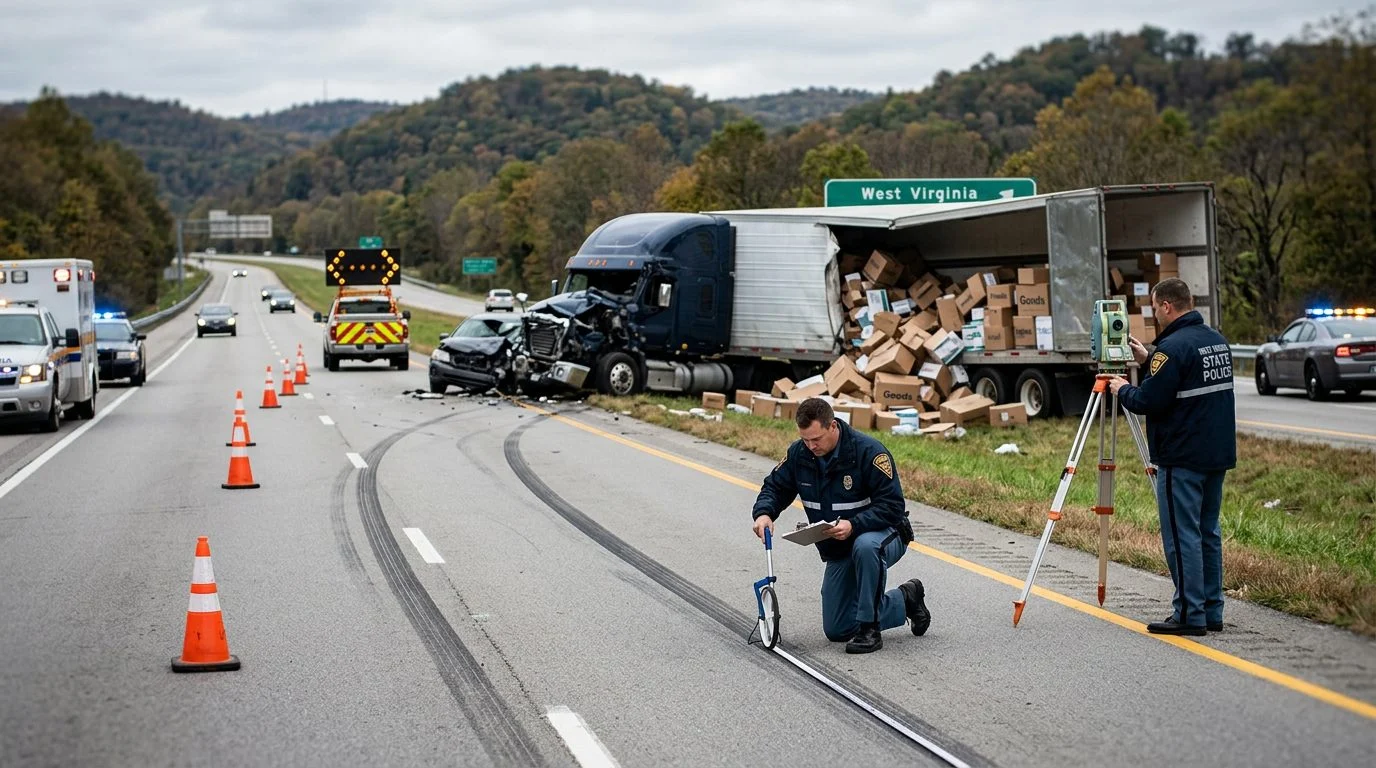
Truck Accident Brain Injury
Brain Injury from a Commercial Truck Accident in West Virginia
Traumatic brain injuries from truck crashes can change your life in an instant. We help injured people and families get answers and pursue the compensation they deserve.
Published October 07, 2026
Brain Injury from a Commercial Truck Accident in West Virginia
A brain injury from a commercial truck accident can happen in an instant—and the damage may not be obvious until hours or days later. The sheer mass and force of a commercial truck create collision physics that your brain cannot absorb safely, even at moderate speeds. Understanding why these injuries occur, what symptoms to watch for, and what rights you have under West Virginia law is the first step toward protecting yourself and your family.

Not sure what your next step is?
Talk it through with our team — the first case review is free, confidential, and carries no obligation.
Why Commercial Truck Accidents Cause Severe Brain Injuries
Commercial trucks weigh 80,000 pounds or more—roughly 15 to 20 times heavier than a passenger car. When a truck collides with a vehicle, the acceleration and deceleration forces on your brain are extreme. Your brain floats inside your skull in cerebrospinal fluid, and during impact, it can shift and rotate violently, tearing nerve fibers and causing bleeding or swelling even if the skull doesn’t break.
The physics are unforgiving. Even at speeds that seem survivable, the brain can suffer diffuse axonal injury (widespread tearing of nerve connections), contusions (bruising), or intracranial bleeding. The skull, while protective, cannot absorb the energy of a large truck collision the way vehicle frames and airbags do. Your brain bears the cost.
One critical fact: brain injury symptoms often don’t appear immediately. You may feel fine at the accident scene, only to develop confusion, severe headaches, or memory problems hours or even days later. This delayed onset is why seeking medical evaluation right after any truck accident—even if you feel okay—is so important.
Types of Brain Injuries in Commercial Truck Crashes
Traumatic brain injury (TBI) is the medical term for brain damage caused by impact or sudden movement. In commercial truck accidents, several patterns emerge:
Closed head injury occurs when there is no break in the skull, but the brain shifts inside it, causing internal bleeding, swelling, or tissue damage. This is the most common type in truck crashes.
Diffuse axonal injury happens when the brain rotates or shifts so violently that nerve fibers (axons) tear throughout the brain tissue. The injury is widespread rather than localized to one spot, making it harder to detect on imaging and often more disabling.
Coup-contrecoup injury occurs when the brain strikes the inside of the skull at the point of impact, then bounces and strikes the opposite side. This creates two injury sites and compounds the damage.
Penetrating injury, though less common in truck accidents, can occur if debris or vehicle parts penetrate the skull. These injuries are typically more immediately obvious but also more severe.
The severity of any brain injury depends on the force of impact and where on the brain it occurs. A mild concussion may resolve in weeks; a severe diffuse axonal injury can cause lifelong disability.
Common Symptoms and Long-Term Effects
Brain injury symptoms vary widely and can emerge gradually. In the immediate aftermath, watch for loss of consciousness (even brief), confusion, severe headache, nausea, dizziness, or sensitivity to light or sound. These are red flags to seek emergency care.
Over days and weeks, cognitive changes often appear: memory loss, trouble concentrating, slowed thinking, or difficulty making decisions. Physical effects include balance problems, chronic fatigue, sleep disturbance, or chronic pain. Some people develop seizures.
Emotional and behavioral changes are common and often underestimated. Mood swings, irritability, anxiety, depression, and personality changes can strain relationships and make work or school impossible. These changes are not character flaws—they are direct effects of brain injury.
Recovery from traumatic brain injury is unpredictable. Some people recover fully within months. Others face lifelong disability requiring ongoing therapy, medication, and support. The variability is why early, thorough medical evaluation and documentation are critical to understanding your situation and planning for the future.
Your Rights After a Brain Injury from a Commercial Truck Accident in West Virginia
West Virginia law allows you to pursue damages (financial compensation) from the at-fault party or parties. Damages may include past and future medical expenses, lost wages, pain and suffering, loss of enjoyment of life, and the cost of long-term care.
In commercial truck accidents, liability often extends beyond the truck driver. The trucking company may be liable for inadequate driver training, failure to enforce safety rules, negligent hiring or retention, or pressure to meet unrealistic schedules that encourage unsafe driving. The truck owner, cargo loader, or even the truck manufacturer may share responsibility if mechanical defects or improper loading contributed to the crash.
West Virginia’s comparative fault rule is important: under West Virginia law, each defendant is generally liable only for the share of compensatory damages that matches that defendant’s own percentage of fault, with limited exceptions (W. Va. Code § 55-7-13c). This means that even if your actions contributed to the crash, you may still have a valid claim. However, your recovery will be reduced by your percentage of fault.
Commercial trucks carry higher liability insurance limits than passenger vehicles, but insurance companies fight hard to minimize or deny claims. Understanding your rights protects you from accepting an unfair settlement.
What to Do Immediately After a Commercial Truck Accident
The hours and days after a crash are critical to your claim. Here are the steps that matter:
Seek medical attention first. Even if you feel okay, get evaluated by a doctor or emergency room. Tell them about any head impact, loss of consciousness, or unusual sensations. Medical records created immediately after the accident establish the baseline and begin the chain of evidence.
Call emergency services. A police report creates an official record of the accident, including the officer’s observations and the truck driver’s statements.
Document the scene if it is safe. Take photos of vehicle damage, road conditions, traffic signs, weather, and the truck’s final position. Photos preserve evidence that fades or is cleaned up.
Get witness information. Names, phone numbers, and email addresses of people who saw the crash are invaluable. Witnesses often move away or forget details over time.
Preserve evidence. Keep the damaged vehicle, medical records, photos, receipts, and any communications with insurance companies. Do not allow the vehicle to be scrapped or repaired without consulting an attorney.
Do not admit fault or sign anything. Speak with police and medical personnel, but avoid discussing the accident with the truck driver, company representatives, or their insurance adjuster. Statements you make can be used against you later.
Have questions about what happened?
Ask our team directly. The first conversation is free, confidential, and there is no obligation to continue.
Proving a Brain Injury Claim After a Commercial Truck Accident
Medical evidence is central to any brain injury claim. Imaging such as CT scans or MRI studies can show bleeding, swelling, or structural damage. Neuropsychological testing—a battery of cognitive and behavioral assessments—documents the injury’s effect on memory, attention, reasoning, and emotional function.
You must establish causation: that the truck accident caused the brain injury, not a pre-existing condition. This is where medical records matter. If you had no brain injury symptoms before the crash and clear symptoms after, the link is strong.
Liability evidence shows that the truck driver or company was negligent. Federal hours-of-service regulations set limits on how long commercial drivers may stay behind the wheel, and fatigue is a common factor in crashes. Speeding, improper lane changes, failure to maintain safe following distance, or mechanical defects are all evidence of negligence.
Damages documentation includes medical bills, rehabilitation records, lost wage statements from your employer, and testimony about how the injury changed your daily life, work, and relationships. Expert testimony from medical doctors and neuropsychologists about the injury, prognosis, and future care needs strengthens the value of your claim.
Commercial Truck Accident Liability in West Virginia
Multiple parties may be liable in a commercial truck accident that causes brain injury:
- Truck driver: speeding, drowsy driving, distracted driving, failure to maintain safe following distance, improper lane changes, or violation of hours-of-service rules.
- Trucking company: inadequate driver training, failure to enforce safety rules, negligent hiring or retention, pressure to meet unrealistic schedules, or failure to maintain the vehicle.
- Truck owner: if different from the company, responsible for maintenance and safe operation.
- Cargo loader: improper loading, unsecured cargo, or overloading that affects stability or braking.
- Truck manufacturer: defective design, brakes, or components that contributed to the crash.
Often more than one party shares responsibility, and each may carry insurance. Identifying all liable parties and their insurance coverage is essential to maximizing your recovery.
Long-Term Care and Costs After a Brain Injury
Severe brain injuries require years or decades of care. Rehabilitation—physical therapy, occupational therapy, speech therapy, cognitive rehabilitation—may continue for months or years. Ongoing medical care includes neurology appointments, neuropsychological evaluations, medication management, and monitoring for complications like seizures or hydrocephalus.
Home modifications such as accessibility upgrades, safety equipment, or assisted living arrangements add significant cost. If the injury prevents you from returning to work, your lost earning capacity is part of your claim. If family members must leave their jobs to provide care, that lost income is compensable.
Calculating lifetime costs accurately is essential. A severe brain injury may require 50+ years of care. Underestimating these costs means accepting far less than you deserve. Medical experts, life care planners, and economists often testify to support accurate damage calculations.
Why You Need Legal Guidance for a Commercial Truck Brain Injury Case
Commercial truck accident cases are complex. They involve federal and state trucking regulations, multiple insurance policies, and often multiple defendants. Trucking companies and their insurers have teams of lawyers and adjusters working to minimize your claim. You need representation on your side.
West Virginia law sets a deadline—a statute of limitations—for filing a lawsuit. Missing this deadline may bar your claim, and exceptions may apply.
Brain injury cases require expert testimony and careful valuation. Experienced representation increases the likelihood of a fair resolution, whether through negotiation or litigation. Early investigation preserves evidence and witness testimony that fade over time.

Want to know where you stand?
Tell us what happened and our team will walk you through the options available to you, at no cost.
Frequently Asked Questions
How long after a truck accident can brain injury symptoms appear?
Symptoms can emerge hours or days after the crash, which is why medical evaluation immediately after any truck accident is critical, even if you feel okay at the scene.
Can I recover compensation if I was partially at fault in the truck accident?
West Virginia law addresses how fault is allocated among those responsible for a crash. Under the state’s rules, each defendant is generally liable only for the share of compensatory damages that matches that defendant’s own percentage of fault, with limited exceptions (W. Va. Code § 55-7-13c).tps://code.wvlegislature.gov/55-7-13c/)).
What evidence do I need to prove a brain injury claim?
Medical imaging (CT, MRI), neuropsychological testing, medical records, documentation of symptoms and treatment, lost wage statements, and expert testimony about the injury and its long-term effects are all central to proving your claim.
Who can be held liable in a commercial truck accident?
The truck driver, trucking company, truck owner, cargo loader, and truck manufacturer may all share liability depending on the cause of the accident.
How much does long-term brain injury care cost?
Costs vary widely depending on injury severity, but severe traumatic brain injuries often require decades of rehabilitation, medical care, home modifications, and caregiver support—potentially totaling hundreds of thousands of dollars or more.
If you or a family member suffered a brain injury in a commercial truck accident in West Virginia, the medical, financial, and legal decisions ahead are substantial. Many people in your situation reach out to discuss what happened and explore their options. Contact Big Bubba for a case review to understand your rights and next steps.
Big Bubba142 N Queen St, Suite 121, Martinsburg, WV 25401
Related practice areas
- Traumatic Brain Injury from Car and Truck Accidents in West Virginia
- Brain Injury Case Value in West Virginia | Big Bubba