
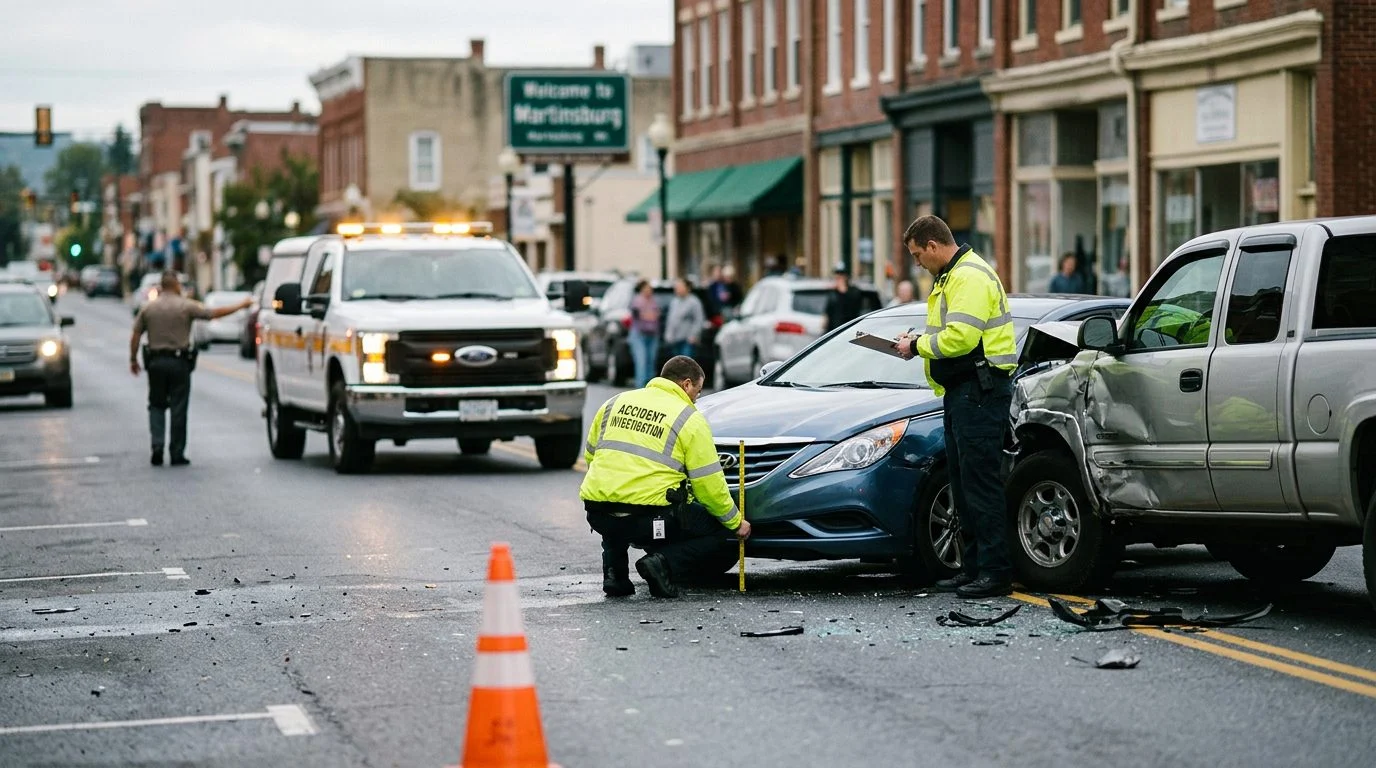
Car Accident Lawyer | Eastern Panhandle, West Virginia
Hurt in a Car Accident in the Eastern Panhandle? Talk With the Firm.
Big Bubba Injury Law represents people seriously hurt in car and commercial truck crashes, families in wrongful death cases, and people facing catastrophic brain and spinal cord injuries. We serve the Eastern Panhandle and communities across West Virginia.
Published October 23, 2026
Big Bubba Injury Law represents people hurt in car and commercial vehicle crashes across West Virginia, including the Eastern Panhandle. This page explains what the firm handles and how state law shapes a claim, so you can decide your next step with clear facts.
What Our Car Accident Representation Covers in the Eastern Panhandle
The firm represents people hurt in car accidents, and we serve all 55 West Virginia counties. We serve Berkeley, Jefferson, and Morgan counties and communities such as Martinsburg, Charles Town, and Shepherdstown. Our only office is in Martinsburg.
A car accident claim can involve:
- Injuries to drivers and passengers
- Pedestrians struck by vehicles
- Crashes at intersections, on highways such as I-81 and US-340, and rear-end or head-on collisions
- Crashes involving tractor-trailers, delivery vans, and other commercial vehicles
- Wrongful death claims for families of people killed in a crash
Commercial vehicle crashes often raise extra questions about the driver’s employer and the company that operates the truck. Those questions are covered below. Whatever the vehicle, the early steps are similar: document the crash, get medical care, and understand your insurance options.
If a crash left you or a family member hurt in the Eastern Panhandle, you do not have to sort out the claim alone. The firm can review what happened with you. Talk it through with Big Bubba — the first case review is free, confidential, and carries no obligation.
Injuries and Losses a Car Accident Claim Can Include
A car accident claim can seek compensation for medical bills, lost income, property damage, and pain and suffering. The losses that matter most depend on your injury and how it affects your daily life.
Serious crashes can cause catastrophic injuries, including traumatic brain injury and spinal cord injury. These injuries can affect work, family life, and independence for months or years.
Medical records are a central part of an injury claim. Tell every provider about every symptom, even the ones that seem minor at first. Keep copies of bills, prescriptions, and records of missed work.
When a crash causes a death, a wrongful death action in West Virginia is brought by and in the name of the personal representative of the deceased person’s estate, as W. Va. Code § 55-7-6(a) provides. Under W. Va. Code § 55-7-6, the jury may consider sorrow, mental anguish, and solace. It may also consider lost income and services, care and hospital costs, and reasonable funeral expenses.
How West Virginia Fault Rules and Insurance Work in a Crash Claim
West Virginia uses comparative fault, so each person’s share of blame is measured as a percentage. Under W. Va. Code § 55-7-13a, recovery is based on comparative fault, and each person’s liability is allocated in direct proportion to their percentage of fault.
The state also sets minimum insurance amounts for motor vehicles. Under W. Va. Code § 17d-4-2, beginning January 1, 2016, the statute sets $25,000 for one person hurt or killed in one accident, $50,000 for two or more people, and $25,000 for property damage. A policy in effect on December 31, 2015 in the prior minimum amounts continues to provide adequate proof of financial responsibility until the policy expires or is renewed.
Insurers may contact you soon after a crash. Under W. Va. Code § 55-7-11a, for twenty days after a personal injury, no one may try to negotiate a settlement, seek a release, or take a statement for settlement from an injured person who is in the hospital or unable to work. That protection does not bar a person acting for the injured person from obtaining a statement, oral or written, upon the express request of the injured person, but that exception covers only obtaining a statement, not negotiating a settlement or obtaining a release. Under W. Va. Code § 55-7-11a, a settlement, release of liability or statement obtained in violation of that section may be disavowed by the injured person at any time within one hundred eighty days from the date of the personal injury by executing a written statement of disavowal and forwarding a copy of the same to the person violating this section; the settlement, release or statement then may not be admissible in evidence for any purpose in any court or other proceeding relating to the personal injury if any consideration paid is repaid or returned to the person who paid the consideration at the time the copy is forwarded.
Commercial vehicle cases can carry extra rules. W. Va. Code § 55-7-32 caps certain noneconomic damages against an employer defendant in commercial motor vehicle cases, with exceptions. Federal rules also set post-accident alcohol and drug testing for commercial drivers in some situations, as the Federal Motor Carrier Safety Administration explains.
Filing Deadlines for Car Accident Claims in West Virginia
West Virginia generally gives two years to file a personal injury lawsuit. Under W. Va. Code § 55-2-12, that two-year period runs from when the right to bring the claim arises. The same statute sets two years for property damage claims.
Wrongful death follows its own timing. Under W. Va. Code § 55-7-6, the action must start within two years after the death, subject to the provisions of section eighteen, article two, chapter fifty-five, and the duly appointed personal representative brings it. W. Va. Code § 55-7-6(d) provides that every such action shall be commenced within two years after the death of the deceased person, subject to the provisions of section eighteen, article two, chapter fifty-five. Subsection (d) also contains an exception for actions brought for the death of any person occurring before July 1, 1988.
Claims against political subdivisions, such as cities and counties, follow W. Va. Code § 29-12a-6.
Waiting also makes evidence harder to collect. Witness memories fade, and traffic camera footage and vehicle data can be harder to get as time passes. How the deadline applies to your crash depends on the facts, so review the timing early.
How the Process Works After You Contact the Firm
The process starts with a free case review. It is confidential, and there is no obligation to continue. Here is what typically happens next.
- Reach out. Call the firm or use the online contact form to start your free case review.
- Share the basics. Give the crash date, location, vehicles involved, police report number, and the medical care you have received.
- Review the facts. The firm looks at fault, insurance information, and documented injuries, then explains the options that may apply.
- Build the file. If the firm takes your matter, it gathers crash reports, photos, medical records, and vehicle data. It may communicate with insurers on your behalf.
- Negotiate or file suit. The claim moves toward settlement talks or, if needed, a lawsuit filed before the deadline.
The pace varies with injury treatment, insurer responses, and court schedules. Each claim moves on its own timeline.
Why Eastern Panhandle Residents Contact This Firm
The firm’s work centers on injury claims from car, truck, and commercial vehicle crashes. It also handles catastrophic injuries, traumatic brain injuries, spinal cord injuries, and wrongful death.
- The firm serves injured people across West Virginia.
- Its only office is in Martinsburg, which is where the firm’s Eastern Panhandle work is based.
- Support staff, including assistants and office staff, help keep communication and documents organized.
- A lawyer at the firm is responsible for this page.
- Each crash is different, so the firm reviews the facts of your situation rather than applying a template.
Not sure what your next step is?
Talk it through with Big Bubba — the first case review is free, confidential, and carries no obligation.

Common Questions About Car Accident Claims in the Eastern Panhandle
Most questions come down to fault, insurers, and timing. Here are short answers to the ones readers ask most.
Should I talk to the other driver’s insurance company?
Insurers may ask for a statement early on. West Virginia law limits certain settlement contact for twenty days after an injury, while the injured person is an inpatient in any hospital or is partially or totally unable to engage in his or her usual trade, profession or occupation, under W. Va. Code § 55-7-11a.
What if I was partly at fault for the crash?
You can still have a claim. Under W. Va. Code § 55-7-13a, fault is split by percentage, and each person’s liability follows that split.
Do I need a police report?
A police report helps document how the crash happened. Keep the report number and share it when you reach out.
How long do I have to file a claim?
For most personal injury claims, West Virginia generally allows two years, under W. Va. Code § 55-2-12.
Do I have to file a lawsuit?
Some claims resolve without a lawsuit, but the filing deadline still applies.
If a crash left you or a family member with injuries, medical bills, and insurance calls to handle, you don’t have to sort it out alone. Tell us what happened through our contact page.