
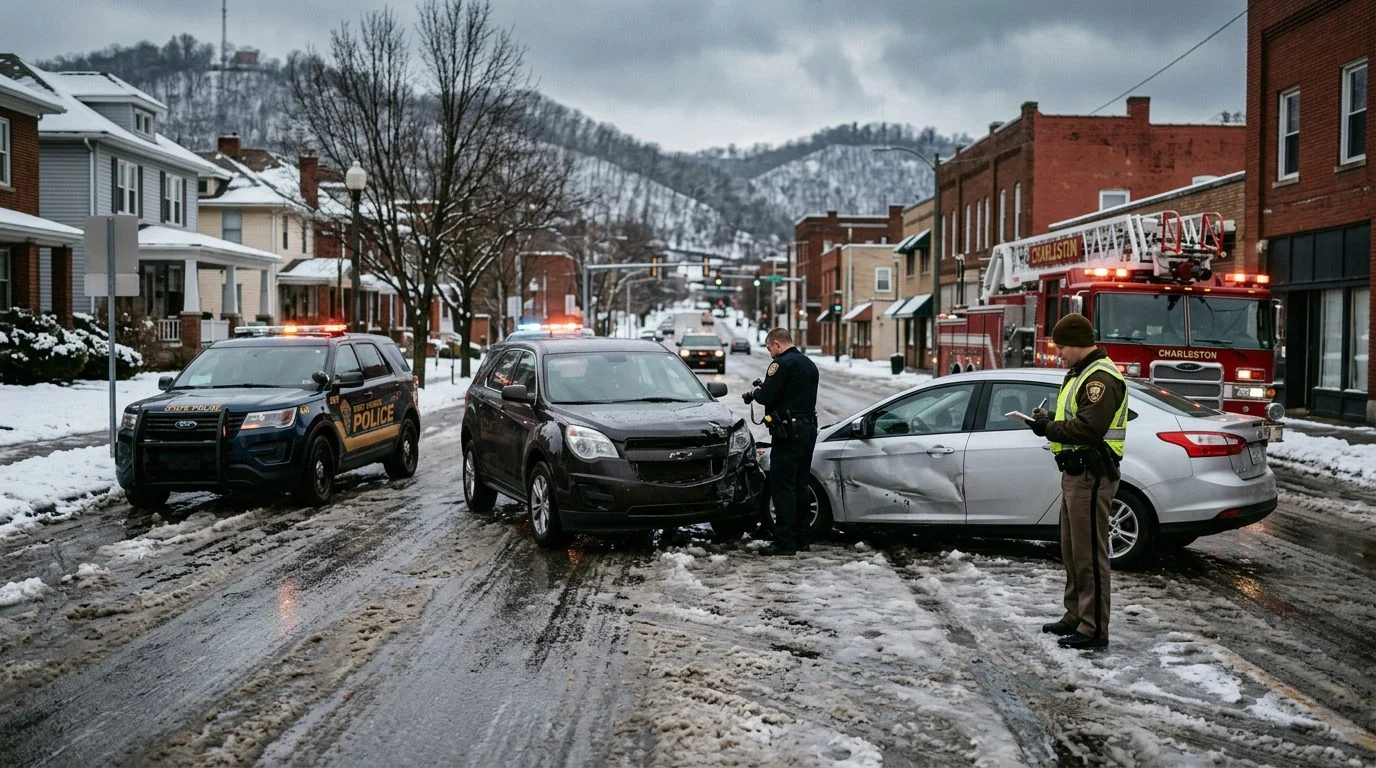
West Virginia Car Accident Guide
Hit on an Icy Road? Find Out Who May Be Responsible
Winter weather can turn a routine drive into a serious crash. Talk with the firm about what happened and get clear answers about your next steps.
Published November 13, 2026
Your car slid on ice, or someone you love was hit on a slick West Virginia road, and now you want to know who is responsible. Ice alone rarely answers that question. In West Virginia, fault is usually sorted out by looking at each driver’s conduct, the evidence from the crash, and the state’s comparative fault rules (W. Va. Code § 55-7-13c).
This page explains how that review is commonly done.
What This Page Covers for an Icy Road Crash
This page explains how fault is usually examined after an icy road crash in West Virginia. It is for people hurt on an icy or slick road, and for family members handling one for someone else. It covers five questions: why ice is only one piece of the picture, which driver choices are usually reviewed, what evidence is commonly examined, how West Virginia divides fault, and what changes when the injury is serious or someone has died.
We handle car accident, truck accident, and wrongful death claims for people across West Virginia. Each case turns on its own facts, so treat what follows as a way to understand the questions, not a forecast of your result.
If someone you love was hurt on an icy West Virginia road, we can talk through the questions with you in a free case review, and you don't have to face them alone. Talk it through with Big Bubba — the first case review is free, confidential, and carries no obligation.

Why Ice Alone Rarely Answers Who Is at Fault
Ice is a road condition, so the main question is usually whether each driver responded to it reasonably.
Drivers are generally expected to slow down and drive with care when roads are icy. Black ice is hard to see, and a crash on it can happen even to careful drivers. That is why reviewers look at what each person did before and during the crash, not only the weather.
A driver who was going too fast for the ice may be examined more closely than one who slowed down. The same is often true of a driver who followed too closely, braked hard on a slick curve, or did not adjust after the road changed, such as on a shaded bridge deck.
Black ice does not end the review. It moves the question from “Was the road slick?” to “How did each driver handle a slick road?” Those are different questions, and the answers can point in different directions for different drivers.
Which Parties and Conduct Are Usually Reviewed
The drivers involved are the first people a reviewer looks at. The review usually covers their choices in the minutes before impact. Common points include:
- speed for the conditions
- following distance
- braking and steering
- lane position, including turns and lane changes
- whether headlights were on
- attention, including phone use
Vehicle condition can matter too. Worn tires or weak brakes may be relevant, depending on the facts.
A road can also be part of the story. Subject to the immunities and limits in sections five and six of the same article, a county, city, or other political subdivision can face liability for negligent failure to keep public roads open, in repair, or free from nuisance, under W. Va. Code § 29-12a-4. Under W. Va. Code § 29-12a-4, political subdivisions are liable for injury, death, or loss to persons or property caused by their negligent failure to keep public roads, highways, streets, avenues, alleys, sidewalks, bridges, aqueducts, viaducts, or public grounds within the political subdivisions open, in repair, or free from nuisance, except that it is a full defense to such liability, when a bridge within a municipality is involved, that the municipality does not have the responsibility for maintaining or inspecting the bridge. Other parties may be relevant only if the evidence points to them.
If a commercial truck was involved, federal rules may also apply. The Federal Motor Carrier Safety Regulations apply to commercial motor vehicle operations alongside state law: a commercial motor vehicle must be operated in accordance with the laws of the jurisdiction where it is operated, and if a federal regulation imposes a higher standard of care than that law, the federal regulation must be complied with, so a truck crash may be reviewed under those rules as well as state law.
Evidence Commonly Reviewed After an Icy Road Crash
The police crash report is usually the first record people look at after a crash on ice.
Other evidence often gets reviewed too. This can include photos of the scene and vehicles, notes on road and weather conditions from the time of the crash, witness statements, and vehicle data where it exists. Phone records and messages may also show what a driver was doing before the crash.
Timing matters. Photos taken soon after the crash can show ice, tire marks, and where the vehicles came to rest. Written notes made while memories are fresh can help a reviewer understand each person’s account.
Keeping things organized helps. Save the crash report, medical visit papers, repair records, and messages about the trip. If you can, keep damaged vehicles or parts until someone has had a chance to look at them. Vehicle repair records also matter if you are pursuing a property damage claim.
Each item may or may not matter, based on what it shows.
How West Virginia Comparative Fault Works in Simple Terms
West Virginia uses comparative fault, which means fault can be split among everyone who contributed to a crash (W. Va. Code § 55-7-13c).
The state’s comparative fault law bases recovery on each person’s share of fault, expressed as a percentage. Under W. Va. Code § 55-7-13a, each person is allocated fault in direct proportion to that person’s percentage. The percentages for one crash must total either zero or 100 percent.
Your own share of fault generally does not bar recovery unless it is greater than the combined fault of all other people responsible for the damages. Under W. Va. Code § 55-7-13c, if your share is smaller, your recovery is reduced in proportion to your share of fault. In plain terms, a bar generally applies only when your share is more than half of the total fault.
Other people count too. Under W. Va. Code § 55-7-13d, the fault of everyone who contributed to the damages is considered, even a person who was never named in the lawsuit. Under W. Va. Code § 55-7-13d, a nonparty’s fault is considered if the plaintiff settled with that nonparty, or if a defending party gives notice no later than one hundred eighty days after service of process upon that defendant that the nonparty was wholly or partially at fault.
Who sets the percentages? In a jury case, the jury is generally asked to state the fault for each party and nonparty. Under W. Va. Code § 55-7-13d, in all actions involving fault of more than one person, unless otherwise agreed by all parties to the action, the court shall instruct the jury to answer special interrogatories or, if there is no jury, shall make findings indicating the percentage of the total fault allocated to each party and nonparty.
When an Icy Road Crash Causes a Serious Injury or Death
A serious brain or spinal cord injury usually makes the review more detailed. Doctors’ reports, imaging, and therapy records may be needed to show what the injury involved and what care it may require over time. Questions about future work and daily care tend to need more documentation.
When a crash causes a death, a wrongful death action may be available; this section, W. Va. Code § 55-7-13d, does not create a cause of action, but its damages provision includes all damages recoverable for personal injury, death, or loss of or damage to property, including those recoverable in a wrongful death action. Under W. Va. Code § 55-7-6, the action is brought by the personal representative of the person who died, and it generally must start within two years after the death.
The statute also lists the kinds of losses a jury may consider. These include sorrow, mental anguish, and solace; compensation for reasonably expected loss of income of the decedent and of services, protection, care and assistance provided by the decedent; expenses for the care, treatment and hospitalization of the decedent incident to the injury resulting in death; and reasonable funeral expenses.
West Virginia also allows an action when someone is injured by a wrongful act and later dies.
Families dealing with a serious injury can help by asking providers for copies of the records they receive. Keep a running list of appointments, symptoms, and daily changes. That list can help the people reviewing the case understand what happened over time.
Not sure what your next step is?
Talk it through with Big Bubba — the first case review is free, confidential, and carries no obligation.

Next Steps If You Are Looking Into an Icy Road Crash
A practical next step is keeping the facts together while you deal with medical care and paperwork.
Keep the crash report in one place. Write down the date, the time, and the road conditions while you still remember them. Track each medical visit, and save photos and messages. Write what each person remembers while it is fresh, and note who was present.
West Virginia generally gives two years to bring a personal injury claim, under W. Va. Code § 55-2-12, and exceptions may apply. Because deadlines are easy to lose track of, it’s wise to look at yours early. Claims against a government body may follow different timing, as noted above.
If you are trying to understand who may be responsible for an icy road crash, you can request a free case review with Big Bubba. The review is confidential and carries no obligation to continue, and you don’t have to sort out the fault questions alone.
Related practice areas
- Traumatic Brain Injury from Car and Truck Accidents in West Virginia
- Deer Strike Car Accident in West Virginia: What to Do