
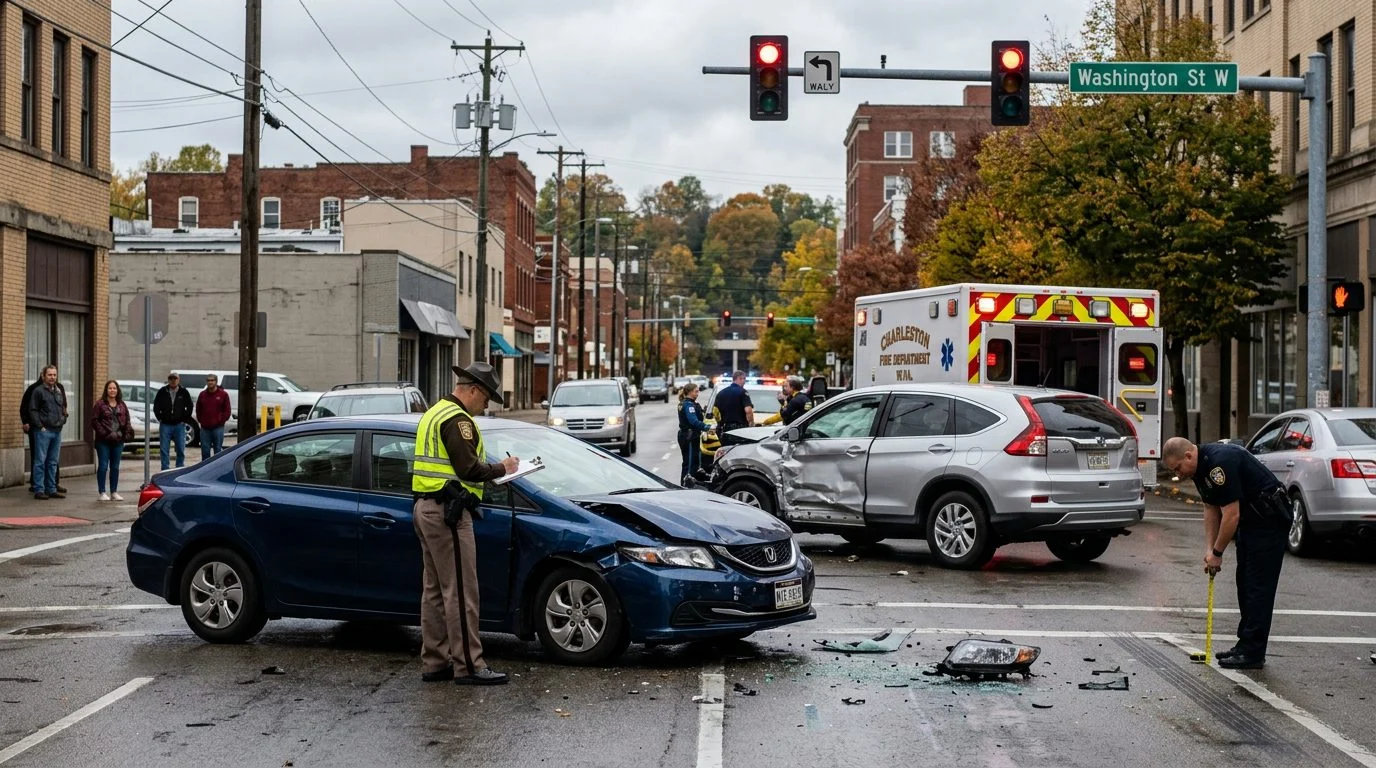
Intersection Crashes | West Virginia
Hurt in an Intersection Crash? Talk With Our Team
Intersections bring drivers together from several directions at once, and fault is not always obvious. We help people across West Virginia sort through what happened after a crash.
Published November 11, 2026
If you were hurt in a crash at an intersection, you may be dealing with pain, paperwork, and a lot of unanswered questions. In West Virginia, an intersection car accident injury claim is generally made against the driver or party whose fault caused the crash, and the claim generally must be filed within two years (W. Va. Code § 55-2-12). Exceptions may apply, and the details of each crash matter. This guide explains how these claims usually work, from fault and injuries to evidence, deadlines, and what happens when you request a free case review.
What an Intersection Car Accident Injury Claim Covers
An intersection car accident injury claim seeks payment for physical injuries and related losses after a crash at or near a road intersection. The claim is usually directed at the at-fault driver and that driver’s insurance.
Losses a claim may address include medical treatment, lost income, pain and suffering, and, where the facts support it, damage to your vehicle. Because the claim is built on one crash, the details you record early can be useful.
Your own auto policy may matter too. West Virginia law addresses uninsured and underinsured motorist coverage under W. Va. Code § 33-6-31.
We serve injury victims across West Virginia, including Charleston, Huntington, Morgantown, Wheeling, Martinsburg, Parkersburg, Beckley, Clarksburg, Fairmont and Weirton. We handle car accident, truck accident, and commercial vehicle claims, along with catastrophic injury and wrongful death cases.
This page is for injured drivers, passengers, pedestrians, and bicyclists, as well as family members acting for someone who was hurt.
Not sure what your next step is?
Talk it through with Big Bubba — the first case review is free, confidential, and carries no obligation.

Who May Be Responsible When Vehicles Meet at an Intersection
Fault usually goes to the driver who broke a traffic rule at the moment of the crash. A driver who ran a red light, failed to yield, or turned in front of oncoming traffic may be found at fault.
Common intersection patterns include:
- Left turn crashes, where a driver turns across oncoming traffic
- T-bone collisions, where one vehicle strikes the side of another
- Rear-end crashes at stop lights
- Red light and stop sign violations
A left turn car accident often turns on who had the right of way and what the signal showed.
West Virginia uses a comparative fault rule. Under W. Va. Code § 55-7-13c, an injured person’s fault generally does not bar recovery unless it is greater than the combined fault of everyone else responsible. If it is less, recovery is reduced by that person’s share of fault. Each defendant generally pays only its own share. There are exceptions. A defendant may be jointly and severally liable if their drunk or drugged driving, or other criminal conduct, is a proximate cause of the plaintiff’s damages. Defendants who consciously conspire and deliberately pursue a common plan or design to commit a tortious act may also be jointly liable.
More than one driver, and in some cases a city, county, or other government vehicle, may share responsibility. Identifying every party early can matter.
Injuries That Often Follow Intersection Crashes
Intersection crashes can cause serious injuries, and some symptoms may not show up for hours or days. Side-impact and high-speed crashes may lead to traumatic brain injury, spinal cord injury, broken bones, and soft tissue injuries.
The MedlinePlus spinal cord injury overview notes that motor vehicle accidents can cause spinal cord injuries, and that weakness, paralysis, and sensory loss may result.
Signs of a possible brain injury after a crash include:
- A headache that does not fade
- Confusion or memory gaps
- Dizziness or balance problems
- Changes in sleep or mood
If you notice any of these, get medical evaluation promptly. A brain injury can change how a person works, drives, and handles daily tasks, so these losses may be part of a claim.
Medical records matter. The notes from your treating providers help show how an injury happened and how it has affected you. Keep copies of appointment summaries and bills. Recovery time varies from person to person.
Evidence That May Help Show What Happened
The crash report is usually the first document to gather. It may list the parties, the vehicles, any witnesses, and the investigating officer’s observations.
Other evidence may also be relevant:
- Photos of the intersection, traffic signals, and vehicle damage
- Where the vehicles came to rest
- Witness names and phone numbers
- Your own written account, written soon after the crash
- Video from a traffic camera or nearby business, if one exists
Video may be overwritten after a period of time, so asking early may matter. Note where you were sitting and where the other vehicle came from while the details are fresh.
Signal timing and phone records may matter in some cases. Whether they apply to your crash is a question the firm can discuss during a free case review.
Deadlines and Why Timing Matters
West Virginia generally allows two years to file a personal injury lawsuit. The law is in W. Va. Code § 55-2-12, and exceptions may apply.
Under W. Va. Code § 55-7-6, a wrongful death action generally must be brought within two years after the death, and the deceased person’s personal representative brings it. Exceptions may apply.
Claims against a city, county, or other political subdivision may follow different rules. W. Va. Code § 29-12a-6 sets a two-year period that runs from when the cause of action arose or when the injury, death or loss was discovered or reasonably should have been discovered, whichever last occurs, and notes that a shorter period may apply under other provisions of the code. For a minor who was under the age of ten years at the time of injury, the action may instead be brought prior to the minor’s twelfth birthday if that provides the longer period.
Evidence and records can be lost over time, so raising questions early can help. Because deadlines differ by claim type, it helps to ask early which rules may apply to your crash. How long a claim takes depends on the facts, the injuries, and how the other parties respond.
What to Expect When You Request a Free Case Review
A free case review is an offer from the firm: a first look at your crash and injuries, with no obligation to continue.
Here is how the process usually works:
- Reach out. Use the online contact form or call. Briefly describe the crash, the intersection, and your injuries.
- Review the basics. The firm talks through the crash details, the medical care you have received, and questions about fault and insurance.
- Look at options. The firm explains the paths a claim may take and what information would be needed.
- Decide what’s next. You choose whether to continue. The firm can explain what a next step would involve.
If you can, bring photos, the crash report number, insurance cards, medical bills and discharge papers, and any witness names.
Not sure what your next step is?
Talk it through with Big Bubba — the first case review is free, confidential, and carries no obligation.
Common Questions About Intersection Crash Claims
Here are short answers to common questions after an intersection crash.
Should I give a recorded statement to the other driver’s insurer?
Some insurers may ask for one soon after a crash.
What if I think I was partly at fault?
Partial fault does not always end a claim. Under West Virginia’s comparative fault rule, your recovery may be reduced by your share of fault (W. Va. Code § 55-7-13c).
What if the other driver ran a red light but was never cited?
A citation is not the only way to show fault. The crash report, witness statements, and photos may still be relevant.
Can a family member start a claim after a fatal intersection crash?
Wrongful death claims are brought by the personal representative of the person who died. Families can contact the firm to talk through their situation.
If you are still sorting out what happened, or you are helping a family member who was hurt, you can contact the firm and ask about a free case review.