
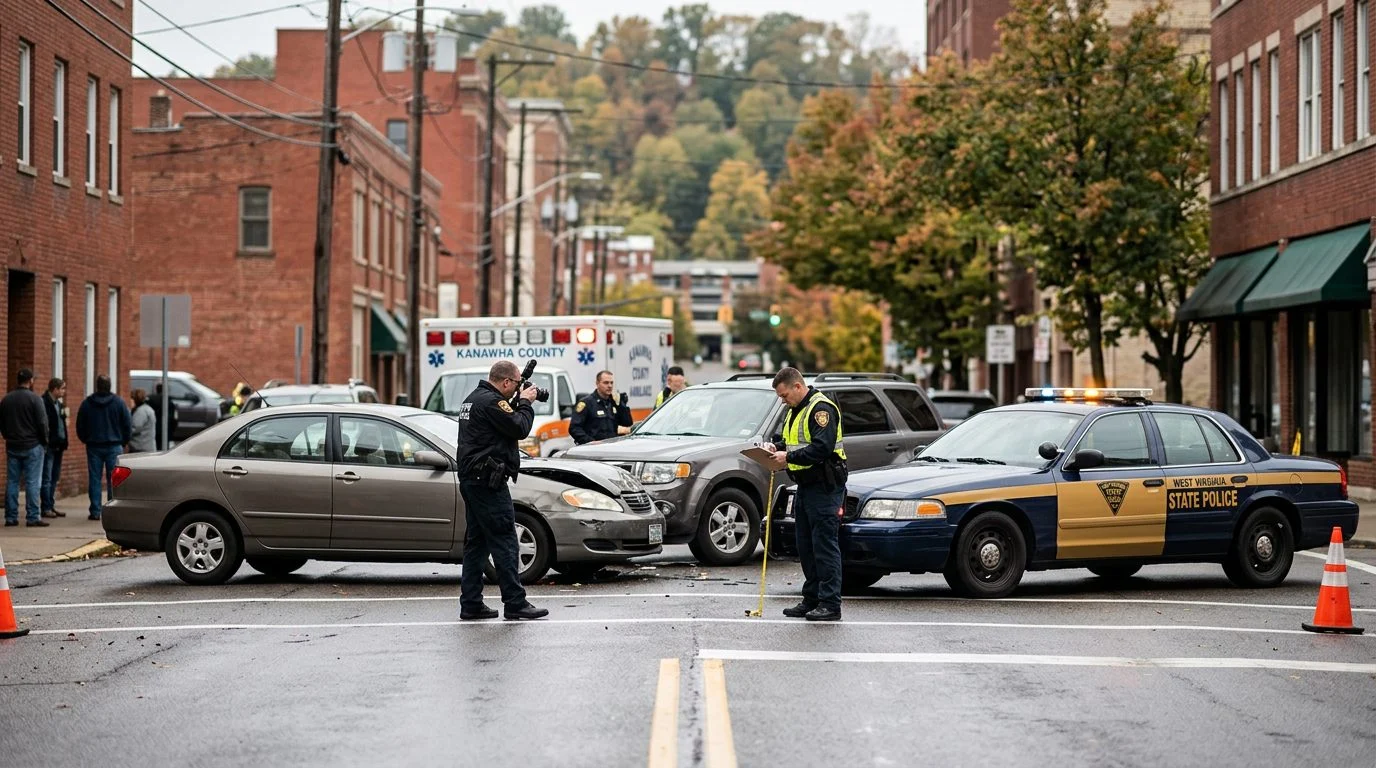
Car Accidents | West Virginia
Caused a Crash? Know What to Do Next
Feeling shaken is normal. Here is how to protect the people involved and yourself, and how the firm can help you think through what comes next.
Published November 22, 2026
If you think you caused a car accident in West Virginia, you may feel scared, confused, or worried about someone who got hurt. The short answer is this: stop, stay at the scene, get help for anyone hurt, and share your identifying details as state law requires. After that, keep your words factual and write down what you remember.
Start With Safety and Medical Care
Check for injuries first, and call 911 if anyone may be hurt. That includes you, your passengers, and the other people involved. Safety comes before any talk about the crash.
A medical check is worth getting even if you feel fine. Some symptoms show up hours or days later. Headaches, dizziness, neck or back pain, numbness, and confusion can signal a head or spinal injury. Those signs should be checked promptly.
The spinal cord is protected by bone and cushioned by fluid, but it can still be badly hurt in a crash. Injuries high in the neck can affect breathing, because the nerves in that area control the diaphragm. The NINDS spinal cord injury overview explains how these injuries happen and what they can affect.
If you were partly at fault, a claim may still be possible, but the amount can change. Talk it through with Big Bubba — the first case review is free, confidential, and carries no obligation.

Your Duties at the Scene Under West Virginia Law
West Virginia law generally requires a driver in a crash with injury to stop and stay at the scene. The driver may leave only as reasonably needed to help someone who is hurt. The W. Va. Code § 17C-4-1 sets out this duty.
The driver must also give certain information. Under W. Va. Code § 17C-4-3, a driver involved in a crash who is physically able to do so shall provide the other party with their name, a valid phone number, and details about the vehicle they are driving. You must also show proof of financial responsibility, which can include insurance details.
The same section says a driver involved in a crash resulting in injury to or death of any person, if physically able to do so, shall render to any person injured in such crash reasonable assistance. That can include arranging a ride to a doctor, surgeon, or hospital when that care is apparent or the injured person asks for it.
Police notice is also required. Under W. Va. Code § 17C-4-6, a driver in a crash causing injury, death, or total property damage of $1,000 or more must notify the proper agency right away. Inside a municipality, that is the local police department. Elsewhere, it is the county sheriff or the nearest State Police office.
Leaving the scene can bring criminal charges. Under § 17C-4-1, intentionally leaving when the driver knows or has reason to believe someone was injured is a misdemeanor.
Stay factual at the scene. Describe what you saw and did. Don’t guess about who was at fault, and don’t downplay injuries. Whether a report is required, and what it must include, may depend on the facts.
How Injured People May Pursue Claims Against an At-Fault Driver
An injured person may bring a claim against a driver whose fault caused the crash. If you were partly at fault, a claim may still be possible, but the amount can change. The W. Va. Code § 55-7-13c explains how West Virginia handles shared fault.
Under that section, a person’s own fault generally bars recovery only if it is greater than the combined fault of everyone else responsible, depending on the facts (W. Va. Code § 55-7-13c). If it is less than the combined fault of everyone else, the recovery is reduced in proportion to that person’s share of fault.
The W. Va. Code § 55-7-13a describes the same idea. Recovery depends on comparative fault, and each person’s share is expressed as a percentage.
Generally, each defendant pays only its own share of fault, under § 55-7-13c. Some exceptions apply, so the outcome can differ from case to case.
Fault is decided on the facts. Speed, road conditions, traffic signals, witness accounts, and photos can all shape how fault is viewed. Serious brain and spinal injuries can need long-term medical care. Claims involving those injuries usually need careful review.
Notifying Your Own Insurer and Handling Insurance Questions
Tell your own insurer about the crash promptly, and keep what you say factual. Many policies ask for prompt notice of a crash. Waiting can create problems with your coverage.
If an officer investigates, W. Va. Code § 17C-4-7 requires the officer to provide owner, operator, and insurance information to the involved parties within 24 hours, upon request, at no cost.
Some insurers may ask for a recorded statement or push for a quick settlement. West Virginia limits that early contact for a short window. Under W. Va. Code § 55-7-11a, for 20 days after a personal injury, while the injured person is either an inpatient in any hospital or partially or totally unable to engage in his or her usual trade, profession or occupation, no one may negotiate or attempt to negotiate a settlement, obtain a release of liability, or take a statement for settlement or release purposes. That applies while the injured person is an inpatient in any hospital or partially or totally unable to engage in his or her usual trade, profession or occupation. Nothing in that restriction prohibits a person acting or intending to act for and on behalf of the injured person from obtaining a statement upon the express request of the injured person.
Keep copies of every letter, claim number, and policy document. Write down adjusters’ names and the dates of each call. Read any paper before you sign it.
When Work Driving or a Work Vehicle Is Involved
If you were driving for a job, your employer may share responsibility in some situations. Whether it does depends on the facts, including the driver’s role and the purpose of the trip.
West Virginia has a separate statute for commercial motor vehicles. It also lists exceptions, such as certain alcohol levels or driving beyond hours-of-service rules.
Federal rules add another layer. The FMCSA drug and alcohol testing guidance explains that testing may be required after some commercial vehicle crashes.
If you drove a company vehicle, keep trip records, delivery paperwork, dispatch messages, and any logs. These records may be important later, depending on the facts.
Time Limits and Records to Keep
West Virginia generally allows two years to file a personal injury lawsuit, and exceptions may apply. The W. Va. Code § 55-2-12 sets that general rule. The same two-year period applies to damage to property. Waiting can limit your options, so timing matters.
Keep photos of the vehicles and the scene. Write a short account of what happened while it’s fresh. Save medical records, bills, repair estimates, and the police report number.
Preserve phone records, texts, and social media posts from around the time of the crash. Don’t delete them, because deleting content can create problems later. Those records may be relevant, depending on the facts.
Quick questions
Do I have to stop after a crash I caused? West Virginia law generally requires you to stop at or near the scene and stay until you meet the reporting duties.
Under W. Va. Code § 55-2-12, where no other limitation is otherwise prescribed, a personal action for damages for personal injuries must be brought within two years next after the right to bring the action has accrued.
Not sure what your next step is?
Talk it through with Big Bubba — the first case review is free, confidential, and carries no obligation.

Gathering Information About Your Crash
If you were hurt in a crash, you may be scared about what happens next. You may also be researching this for a family member who was behind the wheel. If you were hurt, you don’t have to work out the next steps alone.
The firm handles car accident, truck accident, commercial vehicle, catastrophic injury, traumatic brain injury, spinal cord injury, and wrongful death matters. We serve injury victims in Charleston, Huntington, Morgantown, Wheeling, Martinsburg, Parkersburg, Beckley, Clarksburg, Fairmont, and Weirton. For more on head injuries after a crash, read the traumatic brain injury accidents hub.
If you’re wondering what comes next, you can request a free case review of your situation, with no obligation to continue.