
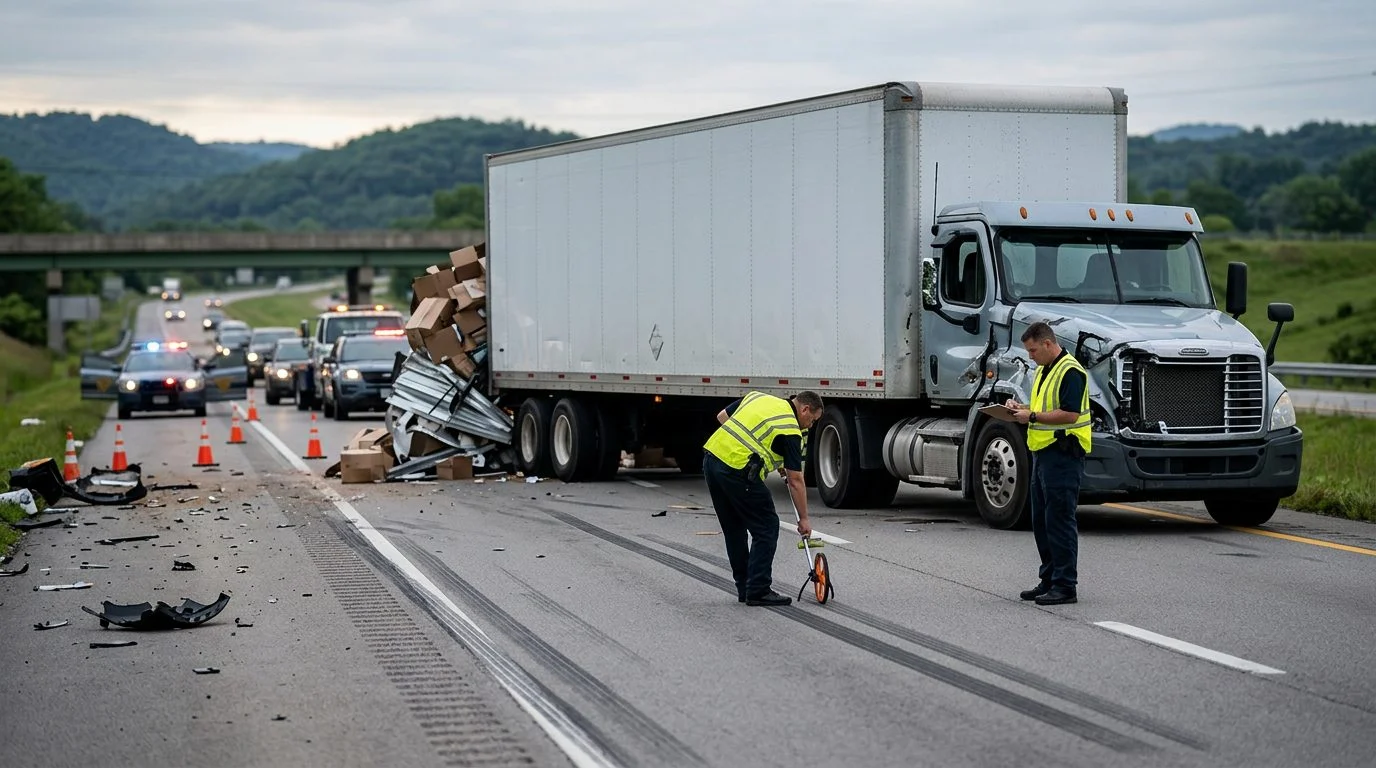
Commercial Truck Accidents | West Virginia
When a Truck Crash Changes Everything
Big Bubba represents people seriously injured in commercial truck accidents across West Virginia. We focus exclusively on catastrophic injuries and wrongful death claims.
Published October 01, 2026
Commercial Truck Accident Claims in West Virginia: What You Need to Know
A commercial truck accident claim is a legal case for compensation after a collision with a commercial vehicle—a semi-truck, 18-wheeler, delivery truck, or other commercial motor carrier. These claims are fundamentally different from personal auto accidents because commercial trucks operate under federal safety rules, carry much larger insurance policies, and often involve multiple liable parties. If you’ve been seriously injured or lost a loved one in a crash with a commercial vehicle in West Virginia, understanding how these claims work is the first step toward recovery.
Not sure what your next step is?
Talk it through with our team — the first case review is free, confidential, and carries no obligation.
What Is a Commercial Truck Accident Claim?
A commercial truck accident claim seeks damages for injuries or losses caused by a collision with a commercial vehicle. Unlike a personal auto accident, these cases involve federal regulations, higher insurance requirements, and complex liability rules that create both challenges and opportunities for injured people and their families.
Who files a claim: – The injured person – In wrongful death cases, the personal representative of the deceased person – A legal representative acting on behalf of the injured person
What the claim seeks: – Medical costs (past and future) – Lost wages and reduced earning capacity – Pain and suffering – Property damage – Funeral and burial expenses (in wrongful death cases) – Other documented losses tied to the crash
Who This Service Is For
This service is for West Virginia residents and anyone injured on West Virginia roads who has suffered serious harm in a commercial truck crash. Specifically:
- People seriously injured in a collision with a commercial truck or commercial vehicle
- Families who have lost a loved one in a commercial truck crash
- Anyone with significant injuries—catastrophic injury, permanent disability, substantial medical bills, or lost wages—who needs professional legal representation
- Those who recognize that the other party’s insurance company will have experienced lawyers working against them
If your injuries are minor and your medical bills are small, you may not need a lawyer. But if you’ve experienced serious trauma, ongoing medical treatment, or the death of a family member, legal representation is critical.
What a Commercial Truck Accident Claim Covers
Commercial truck accident claims cover a broad range of damages tied to your injuries and losses. Here’s what’s included:
Medical expenses: – Emergency care, hospitalization, and surgery – Rehabilitation and physical therapy – Ongoing treatment and medication – Future medical care and monitoring – Assistive devices and home modifications (for permanent injuries)
Lost income and earning capacity: – Wages lost during recovery – Reduced earning ability if your injury is permanent – Impact on career advancement or job changes
Pain and suffering: – Physical pain and discomfort – Emotional distress and psychological trauma – Reduced quality of life and lost enjoyment of activities – Permanent disability or disfigurement
Property damage: – Repair or replacement of your vehicle – Personal belongings damaged in the crash
Wrongful death damages (in fatal crashes): – Funeral and burial expenses – Loss of financial support to surviving family members – Loss of companionship and society
Punitive damages (only in limited cases): – Available only if the plaintiff establishes by clear and convincing evidence that the harm resulted from conduct carried out with actual malice or a conscious, reckless and outrageous indifference to the health, safety and welfare of others; W. Va. Code § 55-7-29 also limits the amount of these awards
Why Commercial Truck Claims Are Different
Commercial truck accident claims are far more complex than personal auto claims. Here’s why:
Federal Motor Carrier Safety Regulations (FMCSA)
Commercial drivers and trucking companies must comply with federal regulations governing hours of service, vehicle maintenance, and driver qualifications. These rules create a detailed roadmap for proving negligence. If a driver violated hours-of-service limits, failed to maintain the vehicle, or lacked proper licensing, that violation is evidence of liability.
Higher insurance requirements
Commercial trucks are required to carry substantially higher liability insurance than personal vehicles. This means larger pools of compensation are available—but insurance companies fight harder to minimize payouts.
Multiple liable parties
A single commercial truck accident may involve: – The truck driver – The trucking company (for negligent hiring, retention, or supervision) – The vehicle owner – The cargo loader (if improper loading caused instability) – The maintenance provider (if equipment failure caused the crash)
Each party may share responsibility, and each has different insurance coverage.
Detailed records and electronic data
Commercial trucks generate extensive records that personal vehicles don’t: – Driver logbooks (hours of service) – Vehicle maintenance records – Dispatch and routing data – GPS and electronic logging device (ELD) data – Black box recordings showing speed, braking, and steering – Engine control module information
These records provide objective evidence of negligence and are critical to building a strong case.
Focused knowledge required
Proving a commercial truck accident claim requires understanding federal law, industry standards, vehicle mechanics, and accident reconstruction. This complexity is why experienced representation matters.
How the Commercial Truck Accident Claim Process Works
The process from initial case review to resolution typically unfolds in these steps:
Step 1: Initial Case Review
You describe what happened. We review your injuries, medical records, and the accident details. We answer your questions and explain your options. There’s no obligation, and you pay nothing.
Step 2: Investigation
We obtain the police report, witness statements, and photos. We request the truck’s maintenance records, driver logbooks, dispatch records, and electronic data. We may hire an accident reconstructionist or other experts to analyze how the crash occurred.
Step 3: Liability Analysis
We identify all responsible parties and determine what violations of federal or state law contributed to the crash. We build a factual foundation for your claim.
Step 4: Demand Preparation
We calculate your full damages—medical costs, lost wages, pain and suffering, and other losses. We prepare a detailed demand letter to the insurance company explaining your injuries, the defendant’s liability, and the value of your claim.
Step 5: Negotiation
We present the claim and negotiate with the insurer. A case may settle during this phase, or it may need to go to trial. We pursue every opportunity to reach a fair resolution.
Step 6: Resolution
If we reach a settlement, we handle all paperwork and ensure you receive your compensation. If the insurer refuses a fair offer, we prepare for litigation and take your case to trial.
Timeline: – Initial investigation: 2–4 months – Settlement negotiation: 6–12 months (or longer, depending on complexity and insurer responsiveness) – Trial preparation and trial: 6–18 months (if necessary)
The exact timeline depends on the severity of your injuries, the complexity of liability, and how quickly the insurance company responds.
Have questions about what happened?
Ask our team directly. The first conversation is free, confidential, and there is no obligation to continue.
What Big Bubba Brings to Your Commercial Truck Claim
We represent only people seriously injured in car and truck crashes and families in wrongful death cases.
West Virginia law: We review how West Virginia law applies to your commercial truck claim. We review the federal regulations that apply to commercial carriers and whether they bear on liability in your case.
Investigation resources: We work with accident reconstructionists, medical experts, and industry specialists to build a comprehensive case backed by objective evidence.
No upfront cost: We work on contingency. No attorney fee unless we win; clients remain responsible for case costs. You may still be responsible for court costs and case expenses. This aligns our interests with yours.
Direct attorney access: You can speak directly with an attorney about your case.
Focused practice: We handle catastrophic injury cases, including traumatic brain injuries and spinal cord injuries, and wrongful death claims for families who have lost loved ones in commercial truck crashes.
Common Questions About Commercial Truck Accident Claims
Q: How long do I have to file a claim?
West Virginia law generally gives you two years from when your right to bring the claim accrued to file a lawsuit for personal injuries, and exceptions may apply. However, don’t wait. Evidence disappears, witness memories fade, and truck data is often deleted after a short period. Contact us as soon as possible.
Q: What if I was partially at fault?
West Virginia follows comparative negligence rules, which means being partially responsible for the crash does not bar recovery unless your fault is greater than the combined fault of all others responsible. Your award will be reduced by your percentage of fault, and you cannot recover if your fault is greater than the combined fault of all others responsible.
Q: Do I have to go to trial?
No. Most commercial truck claims settle during negotiation. We will pursue trial only if the insurer refuses a fair offer and it’s in your best interest to do so.
Q: What if the truck driver was an independent contractor?
The trucking company may still be liable under vicarious liability or negligent hiring and retention laws. We investigate all potentially responsible parties.
Q: How much is my claim worth?
Every case is unique. The value depends on the severity of your injuries, your medical costs, lost income, the strength of liability evidence, and the defendant’s insurance limits. We provide a realistic assessment after reviewing your case.
Q: What happens if the trucking company’s insurance is insufficient?
We explore other sources of recovery, including the truck owner’s insurance, cargo liability coverage, and other available policies.
Why You Should Act Now
Evidence preservation: Truck data, maintenance records, and driver logs are often deleted or lost after a short period. Early legal involvement can help preserve critical evidence.
Witness memory: Eyewitness accounts are most reliable when collected soon after the crash. Memories fade quickly.
Medical documentation: Early legal involvement ensures your injuries are properly documented for your claim, creating a strong medical record.
West Virginia generally allows two years to file a personal injury claim, measured from when the right to sue accrued, and exceptions may apply. Waiting may make your case harder to prove and may increase the risk of losing evidence (W. Va. Code § 55-2-12).
Take the Next Step
If you’ve been seriously hurt in a collision with a commercial truck or lost a loved one in a crash, you have legal options—and people in your situation can reach out to us to understand what happens next. Contact us today to describe what happened, and we’ll listen, answer your questions, and explain your options at no cost.
Want to know where you stand?
Tell us what happened and our team will walk you through the options available to you, at no cost.
Why Big Bubba Handles Your Truck Accident Claim
Focused on serious injury and wrongful death
We represent people harmed in commercial truck crashes—not minor fender-benders. Our focus is on catastrophic injuries, traumatic brain injury, spinal cord damage, and families who've lost loved ones.
We know truck accident evidence
Commercial vehicles carry data recorders, maintenance logs, and driver records. We understand how to preserve and investigate this evidence before it disappears.
Time matters in these cases
Truck data is often deleted on a short schedule. Witness memories fade. We move quickly to protect your claim and gather what matters most.
Direct access to your attorney
When you call Big Bubba, you reach people who handle your case—not a call center. Tell Big Bubba what happened.
Don't Wait—Evidence Disappears
Commercial trucks generate electronic data that trucking companies can delete within weeks. Witness memories fade. The sooner you contact us, the sooner we can preserve what matters to your claim.
What You Should Know About Truck Accident Claims
Filing deadlines exist
West Virginia law sets a time limit for filing a lawsuit. Don't let that window close. Contact us as soon as possible after your injury so we can advise you and act on your behalf.
Comparative negligence may apply
West Virginia follows comparative negligence rules (W. Va. Code § 55-7-13c). Even if you bear some responsibility for the crash, you may still have a claim. We evaluate the full picture of what happened.
Commercial trucks are different
Trucking companies carry insurance, follow federal regulations, and maintain records. We know how to investigate these cases and hold responsible parties accountable.
No fees unless there is a recovery
We work on contingency. You pay nothing upfront, and we only collect a fee if there is a recovery in your case. You may still be responsible for court costs and case expenses.
Tell Big Bubba What Happened
Related practice areas
- Truck Accident Claims in West Virginia | Big Bubba Legal