
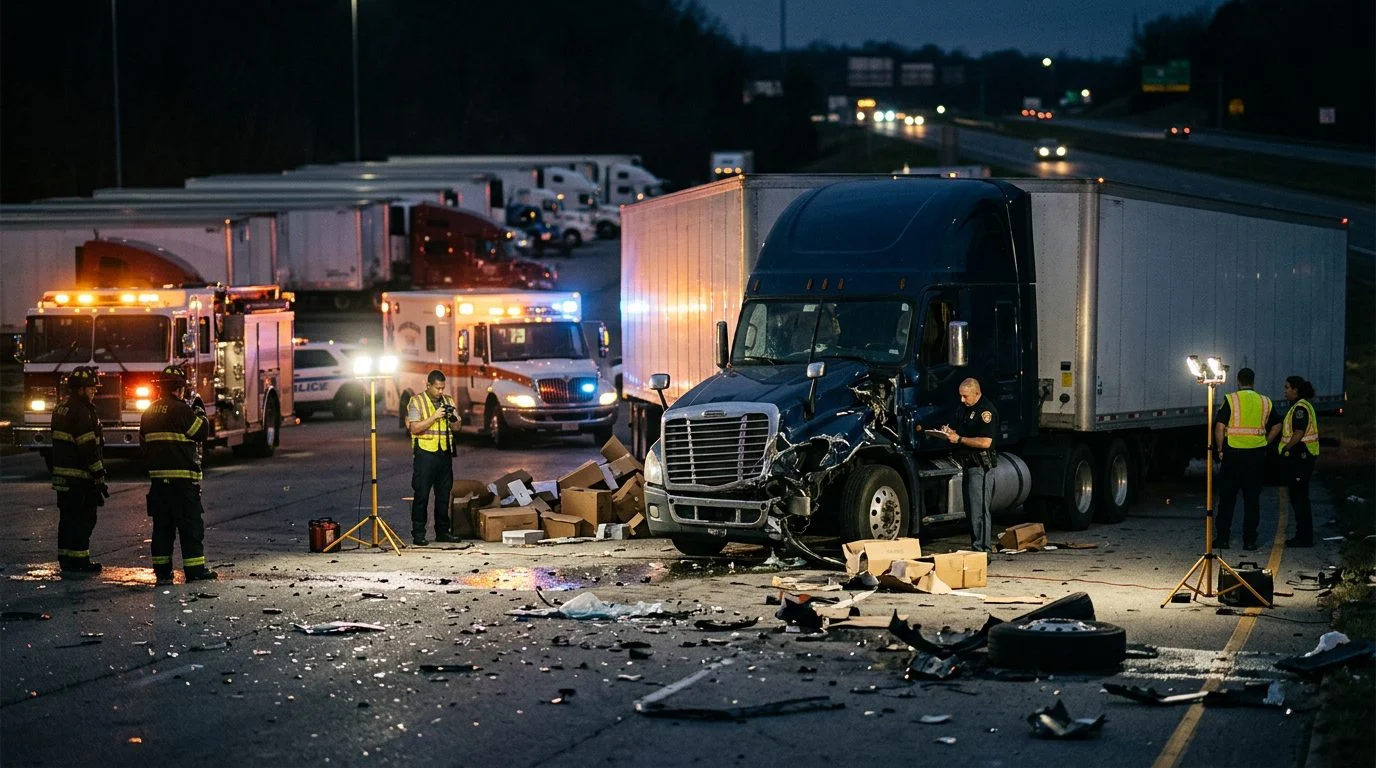
Truck Crashes Across West Virginia
When a Tired Driver Causes a Crash, the Harm Is Real
Big Bubba Injury Law represents people hurt in truck and commercial vehicle crashes, and families in wrongful death cases, across West Virginia. We serve Charleston, Huntington, Morgantown, Wheeling, Martinsburg, Parkersburg, Beckley, Clarksburg, Fairmont, Weirton and communities statewide.
Published October 27, 2026
A truck driver fatigue crash in West Virginia happens when a tired commercial driver cannot react, brake, or stay in a lane safely. Federal rules limit how long a driver may work and drive, and those limits give injured people and families a clear way to test what happened. This page explains the rules, the records that can show fatigue, and the West Virginia deadlines that matter.
What a Truck Driver Fatigue Crash Is
Fatigue means reduced alertness from too little sleep, long hours on the road, or work schedules that fight the body’s natural clock.
Fatigue slows reaction time and dulls judgment. A tired driver may miss traffic slowing ahead, or drift for a moment without noticing.
Some drivers also live with sleep disorders or other conditions that cause daytime drowsiness. People sometimes call this “trucker syndrome.” It is an informal term, not a legal finding, so the driver’s hours and medical history matter more than the label.
Heavy trucks use the I-64, I-79, I-77 and I-81 corridors across West Virginia. This page is for injured people, passengers and families who want to know where fatigue fits in a crash with a commercial truck.
If a fatigued driver's crash has changed your family's life, you don't have to sort out the logs and deadlines alone, and we're ready to hear what happened in a free case review. Talk it through with Big Bubba — the first case review is free, confidential, and carries no obligation.

Federal Hours-of-Service Limits for Truck Drivers
The core federal limits set how long a property-carrying truck driver may drive before a required rest. They appear in 49 C.F.R. § 395.3.
- A driver may not drive without first taking 10 consecutive hours off duty.
- A driver may not drive after 14 consecutive hours that begin when the driver comes on duty after 10 hours off.
- Under 49 C.F.R. § 395.3, a driver may drive a total of 11 hours during the period specified in paragraph (a)(2) of this section.
- Driving is not allowed after more than 8 hours of driving without a 30-minute break. 49 C.F.R. § 395.3 reads: “Except for drivers who qualify for either of the short-haul exceptions in § 395.1(e)(1) or (2), driving is not permitted if more than 8 hours of driving time have passed without at least a consecutive 30-minute interruption in driving status.” Some short-haul drivers have exceptions.
Weekly caps also apply. A driver may not drive after 60 hours on duty in 7 consecutive days, or 70 hours in 8 consecutive days, depending on whether the carrier runs every day of the week. An off-duty period of 34 or more consecutive hours can restart those periods.
Separately, 49 C.F.R. § 392.3 bars any driver from operating a commercial vehicle when fatigue, illness, or any other cause makes the driver’s ability or alertness so impaired, or so likely to become impaired, as to make it unsafe to start or keep driving. That standard applies on its own, apart from the hour counts.
The Federal Motor Carrier Safety Administration publishes these rules for commercial drivers.
How Fatigue Leads to Rear-End and Lane Crashes
Fatigue causes crashes when a tired driver reacts late, follows too closely, or drifts out of a lane.
- Slow reactions: the driver may brake late or not at all when traffic stops.
- Poor following distance: a loaded truck needs far more room to stop than a passenger car.
- Lane drift: on long, quiet stretches, a tired driver can leave the lane or run off the road.
Rear-end crashes are a common pattern in these cases. A heavy truck that cannot stop in time can strike a slowing car. The people in the smaller vehicle can suffer serious injuries, including brain and spinal cord injuries.
Fatigue does not always look like sleep at the scene. A crash may look like a braking error or a bad lane change. Hours records, timing and crash patterns often show the fuller picture.
Evidence That Can Show a Driver Was Fatigued
The strongest proof usually comes from comparing the driver’s logs with other records from the same trip.
- Comparing ELD entries with the trip can reveal hours violations.
- Supporting documents. Bills of lading and itineraries show where and when a trip happened. Under 49 C.F.R. § 395.11, a motor carrier must retain supporting documents in such a manner that they may be effectively matched to the corresponding driver’s record of duty status, and it generally need not retain more than eight supporting documents for an individual driver’s 24-hour period, but a carrier that requires a driver to complete paper records of duty status must also keep toll receipts for any period when the driver kept paper records, regardless of that eight-document limit. If there are more than eight, the carrier must keep the supporting documents containing the earliest and the latest time indications among the eight retained.
- Other trip records. Fuel and toll receipts, dispatch messages, GPS data and driver files can build a timeline.
- Truck data and crash reports. Engine data and police reports can help reconstruct speed, braking and timing.
- Medical and driving history. Medical records and prior hours-of-service citations can also matter.
Timing is critical. Carriers must retain each supporting document generated or received in the normal course of business, and match them to the driver’s record of duty status, under 49 C.F.R. § 395.11. ELD back-up copies must also be kept for 6 months, under 49 C.F.R. § 395.22.
How Company Pressure Can Contribute to Driver Fatigue
Company decisions about schedules and loads can be part of a fatigue claim, not only the driver’s own choices.
- Tight delivery deadlines can push a driver past the legal limits.
- Per-mile or per-load incentives can reward long runs.
- Dispatch records can show who set the schedule and whether the trip was realistic under the rules.
An employer may be liable if it did not reasonably check an employee’s background for the job and the risk to others. See McCormick v. W. Va. Dep’t of Pub. Safety.
Under W. Va. Code § 55-7-32, in any civil action for personal injury or wrongful death involving the operation of a commercial motor vehicle requiring a commercial driver’s license, the maximum amount recoverable by each person injured or killed against the employer defendant of a commercial motor vehicle as compensatory damages for noneconomic loss may not exceed $5 million for each occurrence, regardless of the number of claims or theories of liability. Under W. Va. Code § 55-7-32, on January 1, 2026, and in each year thereafter, the limitation on compensatory damages for noneconomic loss in subsection (b) increases to account for inflation by an amount equal to the Consumer Price Index published by the United States Department of Labor, not to exceed 150 percent of the amounts specified in that subsection. The section applies only to causes of action arising after its July 1, 2024 effective date. This limit is not available to an employer defendant that does not have commercial motor vehicle insurance in the aggregate amount of at least $3 million for each occurrence. The section does not apply if the civil action arises from an incident for which an operator or driver is found to have met one of the conditions listed in subsection (d), such as operating a commercial motor vehicle in willful or wanton disregard for the safety of persons or property at the time of the incident.
Federal rules set minimum insurance too. For for-hire carriage of nonhazardous property in interstate commerce, with a gross vehicle weight rating of 10,001 or more pounds, the minimum is $750,000, under 49 C.F.R. § 387.9.
What to Expect When a Fatigue Claim Moves Forward
A fatigue claim usually starts with preserving records, then builds the crash and medical picture, then moves toward settlement talks or a lawsuit.
- Free case review: you describe the crash, your injuries and any records you have.
- Preservation requests: requests for logs, ELD data and dispatch files go out early, before retention periods run out.
- Investigation: the crash report, the scene, the vehicles and witness information are reviewed.
- Medical documentation: treatment records are gathered. Some brain and spinal cord injuries show their full effects over time.
- Negotiation or lawsuit: some claims resolve through negotiation, while others need a lawsuit.
Timing matters. Under W. Va. Code § 55-2-12, a personal injury action generally must be brought within two years after the right to sue arises. A wrongful death action must be commenced within two years after the death, subject to the provisions of section eighteen, article two, chapter fifty-five, and the personal representative brings it, under W. Va. Code § 55-7-6. W. Va. Code § 55-7-6 reads: “The provisions of this section shall not apply to actions brought for the death of any person occurring prior to July 1, 1988.”
Under W. Va. Code § 55-7-13a, fault is divided by percentage among everyone who contributed to the harm.
Not sure what your next step is?
Talk it through with Big Bubba — the first case review is free, confidential, and carries no obligation.
Common Questions About Truck Driver Fatigue Crashes
Fatigue claims usually turn on three things: the hours records, the crash pattern, and the medical picture. Below are short answers to common questions about truck driver fatigue crash West Virginia claims.
Do truck drivers get tired?
Yes. Long shifts, night driving and sleep problems can all cause fatigue, which is why federal hour limits exist.
What is trucker syndrome?
It is an informal term for daytime drowsiness some drivers experience. It is not a legal finding, so hours and medical history matter more.
How can I tell if fatigue caused my crash?
Fatigue shows through a mix of hours records, ELD data, the crash pattern, and medical and witness information.
Can I still have a claim if the driver was not cited?
A claim can rest on other evidence, such as logs and crash reconstruction. Whether a claim works depends on the facts.
What if no one requests the logs?
Carriers must keep a back-up copy of ELD records for at least 6 months, on a device separate from the one holding the original data, so early requests help protect the evidence.

Where to Start If a Fatigued Truck Driver Hurt Someone
If you are researching a crash now, you do not need every answer yet.
You may be the injured person, a passenger, or a family member sorting out what happened. Some people are still recovering. Others are facing a loss they did not expect.
Big Bubba Injury Law handles car accidents, truck and commercial vehicle accidents, catastrophic injuries, traumatic brain injury, spinal cord injury and wrongful death. We serve Charleston, Huntington, Morgantown, Wheeling, Martinsburg, Parkersburg, Beckley, Clarksburg, Fairmont, Weirton and communities across West Virginia.
If a fatigued driver’s crash has changed your family’s life, you don’t have to sort through the logs and deadlines alone. Contact the firm for a free case review, and tell Big Bubba what happened in your own words.
Related practice areas
- Truck Accident Claims in West Virginia | Big Bubba Legal