
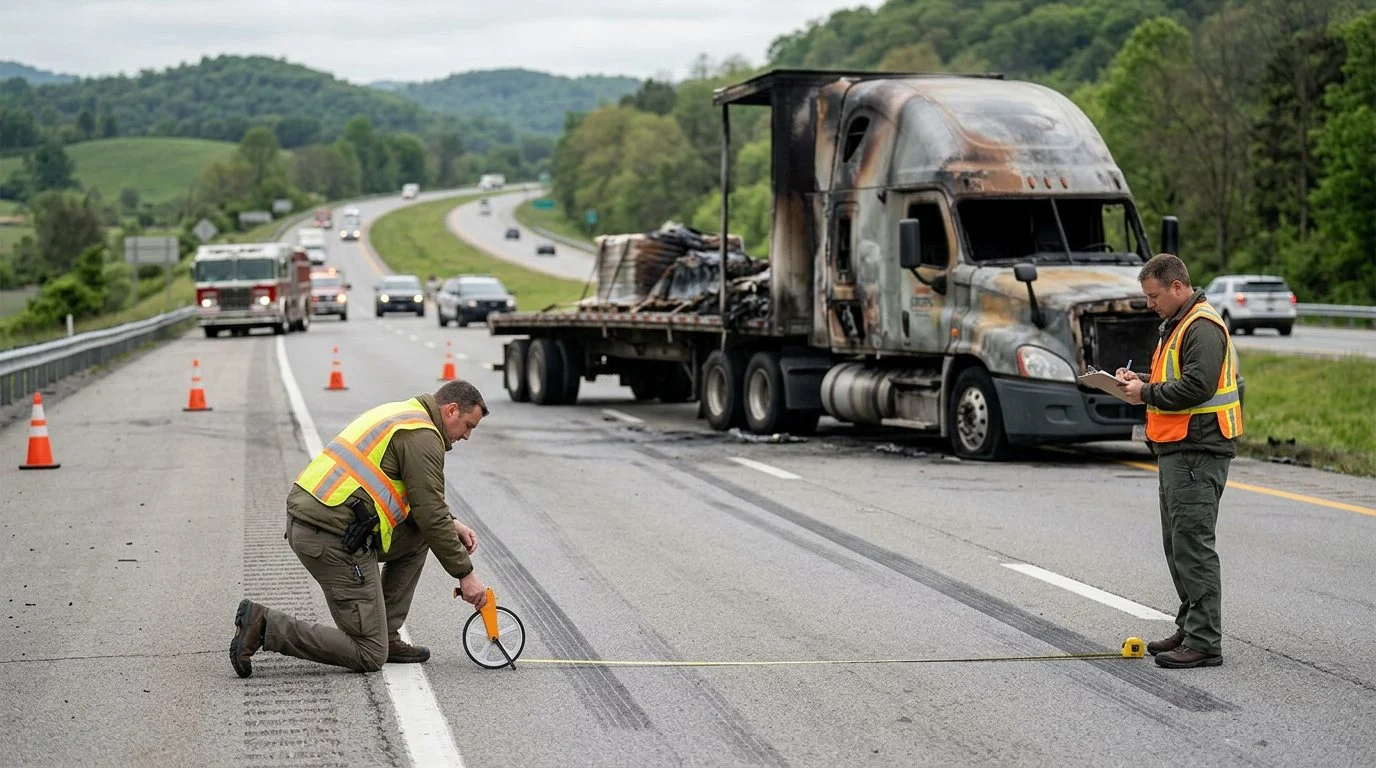
Truck Accidents | West Virginia
Burns From a Truck Crash? You Do Not Have to Handle the Claim Alone
Serious burns bring medical bills, time away from work, and questions about who is responsible. We help injured people and their families take the next step.
Published November 8, 2026
If a truck or semi crash left you or someone you love with burns, you likely have hard questions. A burn injury from a truck crash in West Virginia can support a personal injury claim. When a commercial truck is involved, the rules may differ, so the details matter.
This guide explains how truck fires start, who may share responsibility, what evidence to keep, and what to expect when you reach out.
What a Truck Fire or Burn Injury Claim Covers
A truck fire or burn injury claim is a personal injury claim for burns caused by a crash involving a commercial truck, semi, or dump truck. Burns can hurt many people in these crashes. Drivers, passengers in other vehicles, pedestrians, and roadside workers can all be injured.
If a burn injury causes a death, the family may have a wrongful death claim instead. We explain that below.
A claim may address losses such as:
- Hospital, surgical, and other medical treatment
- Rehabilitation and physical therapy
- Scar treatment and reconstructive care
- Lost income and lost ability to work
- Pain, suffering, and emotional harm
Burn injuries often overlap with catastrophic injury claims when the burns are severe. Some people also suffer brain or spinal cord injuries in the same crash. Crashes are a serious problem statewide.
If someone you love is recovering from burns after a truck crash, you may have a claim, and you can tell Big Bubba what happened in your own words. Talk it through with Big Bubba — the first case review is free, confidential, and carries no obligation.

How Truck Fires Start in Crashes
Truck fires in crashes usually start with fuel, electrical, or heat damage. Investigators confirm the cause later.
A fire may start when a crash damages a fuel line or tank. It can also come from an electrical fault, overheated brakes or wheel bearings, or leaking cargo. Some fires start at impact. Others start after the vehicles stop.
Rollovers, jackknifes, and run-off-road crashes can cause fuel leaks. Federal rules set design standards for truck fuel tanks. Federal rules for commercial vehicle fuel tanks, found in 49 C.F.R. § 393.67, set requirements that depend on the tank’s size and design. The federal fuel tank rules also require fill pipes to limit spills during a crash.
The scene may not show the full cause on its own. Investigators often look at the truck’s condition and maintenance history. If you saw anything before or during the fire, write it down while you remember it.
Burn Injuries, Medical Records, and Long-Term Effects
Your medical records are the main proof of your burn injuries. Keeping them organized early helps.
Burns are described by depth. Deeper burns may need skin grafts, repeated surgery, and long rehabilitation. Your care team can explain your treatment plan and what to expect.
Burns in an enclosed cab fire can also cause breathing injuries. These may not show right away. A medical evaluation matters even when burns look limited at first.
Scarring, tight or stiff skin, pain, and emotional effects may continue after wounds close. Medical records are one of the main ways those effects are documented. Keep these papers in one folder:
- Discharge papers and treatment plans
- Bills and insurance statements
- Appointment notes and prescriptions
- Records of missed work
Ask providers about your outlook in writing when you can. Recovery time varies widely with severity and the person, so no single timeline fits every case.
Who May Share Responsibility
In a truck fire case, more than the driver may share responsibility. Other parties may share responsibility based on how the crash happened. These can include the trucking company, the truck’s owner, maintenance contractors, parts makers, and companies that loaded or secured the cargo.
West Virginia law defines an “employer defendant” to include the owner of a commercial motor vehicle, its employer, and anyone holding legal control over the vehicle or operator.
Federal rules may matter too. Federal hours-of-service rules generally say a driver of a property-carrying commercial motor vehicle may not drive after 14 consecutive hours on duty that follow 10 consecutive hours off duty, with some exceptions. Violations may be relevant to fault.
Insurers may dispute a claim or argue the injured person was at fault. A claim may need documentation to respond.
Evidence to Preserve and Deadlines to Keep in View
The evidence that matters most is often the crash record, the truck’s paperwork, and early photos. Useful items include:
- The police crash report and fire department reports
- Photos of the scene, the vehicles, and your injuries over time
- Dashcam or onboard camera footage
- Electronic logging and engine data
- Maintenance and inspection records
- Driver logs and the cargo manifest
- Names and contact details for witnesses
Federal maintenance rules set how long records must be kept. The federal maintenance rules require 1 year where the vehicle is housed, and 6 months after it leaves the carrier’s control. Because those periods are limited, early action can matter.
West Virginia generally allows two years to file a personal injury lawsuit, and exceptions may apply. The W. Va. Code § 55-2-12 sets this general rule.
A wrongful death action has its own deadline. The W. Va. Code § 55-7-6 also requires the action to be brought by the personal representative.
What to Expect After You Reach Out
After you reach out, the first step is a free case review of what happened and where your health stands. The process usually follows these steps:
- A first conversation about the crash and your current treatment
- A free case review of the facts and medical picture. It is confidential and carries no obligation to continue.
- A review of crash records, truck paperwork, and scene evidence
- Communication with the other parties and their insurers
- A lawsuit, if one is needed
Timelines depend on the medical picture, the number of parties, and the evidence. Each case moves at its own pace.
Between steps, keep the firm informed about new symptoms, treatment changes, and any contact from an insurer or trucking company. Keep copies of anything you sign.
Not sure what your next step is?
Talk it through with Big Bubba — the first case review is free, confidential, and carries no obligation.
Truck Crash and Burn Injury Claims We Handle
The firm represents people seriously hurt in car and commercial truck crashes. It also represents people with catastrophic brain and spinal cord injuries, and families in wrongful death cases across West Virginia.
We handle truck accident claims, commercial vehicle claims, and catastrophic injury claims. Severe burn injuries often fall within that work when burns are part of a larger injury picture.
We serve injured people and families in Charleston, Huntington, Morgantown, Wheeling, Martinsburg, Parkersburg, Beckley, Clarksburg, Fairmont, and Weirton, and across the state. Our support staff help organize records and keep communication moving.
Common Questions and Next Steps
Many readers ask whether partial fault blocks a claim. West Virginia generally uses a modified comparative fault rule (W. Va. Code § 55-7-13c).
Can I still recover if I was partly at fault?
West Virginia generally does not bar recovery unless your fault is greater than the combined fault of everyone else. Otherwise, your recovery is reduced by your share. The W. Va. Code § 55-7-13c sets this rule, and exceptions may apply.
Should I see a doctor if my burns look minor?
Yes. A medical evaluation helps with care and documents your injuries. This includes breathing injuries that may not appear right away.
What if the truck came from out of state?
Interstate trucks may be subject to federal rules. The investigation may also cover more than one state.
Can a family bring a claim if a burn victim died?
A wrongful death action in West Virginia is brought by the personal representative of the person who died. A verdict may include certain family losses. The action generally must be started within two years after the death (W. Va. Code § 55-7-6). Under W. Va. Code § 55-7-6(d), a wrongful death action generally must be commenced within two years after the death, subject to the provisions of section eighteen, article two, chapter fifty-five, so exceptions may apply depending on the facts.
If someone you love is recovering from burns after a truck crash, you may have a claim. You can tell Big Bubba what happened in your own words.