
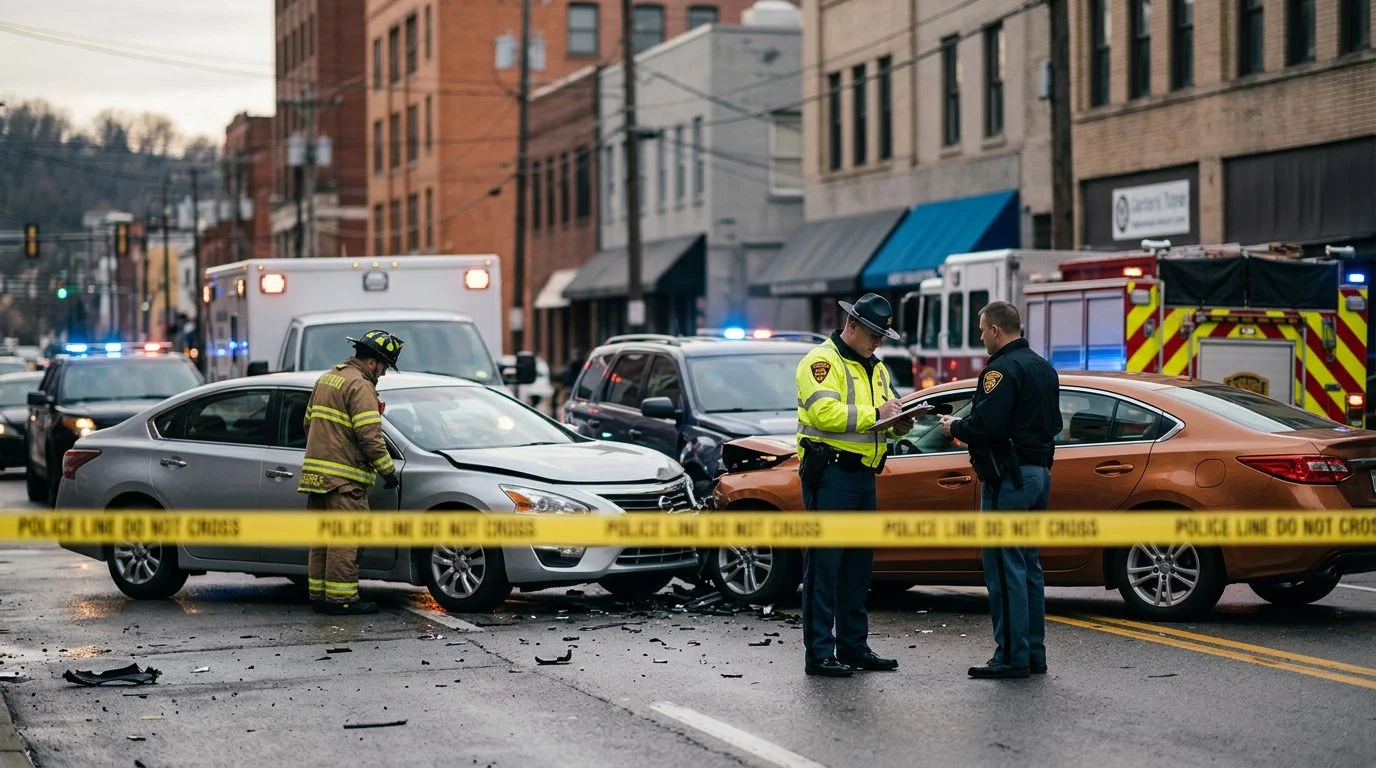
Car Accident Claims | West Virginia
Hurt in a Crash and Can't Remember What Happened?
Memory gaps are common after a serious crash. Big Bubba Injury Law helps West Virginia families understand their options, gather records and pursue a claim, even when the details are unclear.
Published October 28, 2026
Generally, that is the case. Can I still file a claim if I cannot remember the crash? The answer is generally yes. Your own recollection is only one piece of proof. Records, physical evidence and witness accounts can also show how the crash happened and what it caused.
We serve injury victims and families across West Virginia, including Charleston, Huntington and Morgantown. This page explains why memory loss happens after a brain injury. It covers filing deadlines, how evidence fills the gap, and how to handle insurers while memory is still returning.
Yes, a Gap in Memory of the Crash Does Not by Itself End a Claim
A claim is proven through many sources, not only the injured person’s account. Those sources usually include medical records, the crash report, photos of the vehicles and scene, and statements from people who saw what happened.
Think of your memory as one witness among several. If it is missing pieces, the other sources carry more weight. Serious injuries often leave records behind. Ambulance crews, emergency room staff and treating doctors write down what they observe and what you told them at the time. Those notes can show the injury and its link to the crash, even when you cannot describe the moment of impact.
Every crash and every injury is different. The facts decide which evidence matters most and how the claim is organized. For a wider look at serious harm, read our guide to catastrophic injuries.
Not sure what your next step is?
Talk it through with Big Bubba — the first case review is free, confidential, and carries no obligation.

Why a Brain Injury Can Erase Memories of a Crash
A brain injury can take away memory of the crash itself. Doctors often describe two kinds of memory loss that matter here.
Retrograde amnesia (loss of memories from before the injury) can erase the minutes or longer leading up to impact. Post-traumatic amnesia (trouble forming new memories after the injury) can leave a gap for the time right after the crash.
Concussion and more serious traumatic brain injury can both disrupt memory. Sedating medicines given at the scene or in the hospital can add to the gaps. Surgery and time in intensive care can too.
A memory gap is a medical symptom. Treating clinicians record what you can and cannot recall, often again at later visits. Those records matter later. They show the gap was real and how it changed over time. Keep copies of discharge papers and follow-up notes, and ask your care team to note your memory concerns in the chart.
How Long You Have to File a Claim in West Virginia
West Virginia generally gives two years to file a personal injury claim. Under W. Va. Code § 55-2-12, a personal action for damages for personal injuries for which no limitation is otherwise prescribed must be brought within two years after the right to bring it accrues.
A wrongful death claim has its own rule. Under W. Va. Code § 55-7-6, every wrongful death action must be commenced within two years after the death of the deceased person, subject to the provisions of section eighteen, article two, chapter fifty-five. W. Va. Code § 55-7-6 reads: “The provisions of this section shall not apply to actions brought for the death of any person occurring prior to July 1, 1988.” Under W. Va. Code § 55-7-6(d), every such action “shall be commenced within two years after the death of such deceased person, subject to the provisions of section eighteen, article two, chapter fifty-five.” W. Va. Code § 55-7-6 reads: “The provisions of this section shall not apply to actions brought for the death of any person occurring prior to July 1, 1988.”
A memory gap is not a reason to wait. The clock keeps running while you recover and while you try to remember. Missing a legal deadline can end options that were otherwise open.
West Virginia also has rules that can pause a deadline in some situations. One covers people who had a legal disability when the claim arose, as described in W. Va. Code § 55-2-15. Whether any of these rules applies depends on the facts of the case.
How Evidence Can Prove the Crash When Memory Cannot
Evidence can show what happened even when you cannot. Start with official and medical records. A crash report, an EMS run report from the ambulance crew, and emergency room and hospital records all capture facts from the day of the crash. Imaging results can show injuries that match the impact.
Next, look at the scene. Witness statements, photos of both vehicles and the roadway, and vehicle event data (information some vehicles store about speed and braking) can help rebuild the sequence. Not every vehicle stores this data, so availability varies.
Some sources are short-lived. Traffic camera footage, business surveillance video and phone records may exist, but whether they still exist depends on how quickly someone asks for them. Some of these records are kept only for a limited time.
Driver conduct can be part of the record too. A phone record or a witness can show whether that happened.
Finally, treating doctors’ notes can connect the injury to the crash. A note that describes the impact, the symptoms and the memory gap helps show that link.
Who Can Bring a Claim When the Injured Person Cannot Recall the Crash
Family members often help gather records, track appointments and keep notes while the injured person recovers.
When a person dies, the rules change. Under W. Va. Code § 55-7-6, a wrongful death action must be brought by and in the name of the personal representative of the deceased person who has been duly appointed. That representative brings the case for the people the law protects.
The statute names the surviving spouse, children (including adopted children and stepchildren), brothers, sisters, parents and any persons financially dependent on the decedent at the time of death, or who would otherwise be equitably entitled to share in the distribution. The court or jury may direct how damages are shared among them. The law also lists the kinds of damages a wrongful death verdict may include. These include sorrow, mental anguish and solace; reasonably expected loss of income of the decedent and of services, protection, care and assistance provided by the decedent; expenses for the care, treatment and hospitalization of the decedent; and reasonable funeral expenses.
Who may act for an injured adult who cannot manage their own affairs is a separate question. The answer turns on the specific facts.
How West Virginia Fault Rules Apply When Memory Is Incomplete
West Virginia uses comparative fault, which measures each person’s share of fault as a percentage. Under W. Va. Code § 55-7-13a, recovery is based on comparative fault. Liability is allocated to each person in direct proportion to that person’s percentage of fault, including the plaintiff.
In plain terms, a share of fault assigned to you can reduce what you recover. The statute also covers nonparties who proximately caused the damages. Under W. Va. Code § 55-7-13d, the trier of fact must consider the fault of all persons who contributed to the alleged damages.
Memory loss changes the picture. If you cannot describe the events, an insurer may argue about who caused the crash, the lane position, the speed or the timing of the impact. You may not be able to answer those points from memory. That is why independent evidence matters more in these cases.
Each fault question is decided on its own evidence. The rules above are the starting point.
Not sure what your next step is?
Talk it through with Big Bubba — the first case review is free, confidential, and carries no obligation.
Talking to Insurance Companies While Your Memory Is Incomplete
Do not guess, and say plainly when you do not remember a detail. A guess about speed, distance or timing can be used against you later, even when it was honest.
West Virginia has a specific rule for the early days after an injury. Under W. Va. Code § 55-7-11a, for twenty days from the date of a personal injury, no person shall negotiate or attempt to negotiate a settlement of the claim, or obtain or attempt to obtain a partial or general release of liability, while the injured person is an inpatient in any hospital or is partially or totally unable to engage in his or her usual trade, profession or occupation. This applies while the injured person is an inpatient in a hospital or partially or totally unable to engage in usual work. The same rule bars obtaining a statement for settlement use, unless a person acting or intending to act for and on behalf of the injured person obtains it upon the injured person’s express request.
A settlement, release or statement obtained in violation of that rule may be disavowed within one hundred eighty days from the date of the personal injury. The injured person does this by signing a written statement of disavowal and sending a copy to the person who violated the rule. Any money paid for the settlement or release must also be repaid or returned at that time.
A brain injury makes these calls harder. A statement given while you are still recovering can be read later in ways you did not intend. Before any recorded statement, talk through what you remember and what you do not. Read every release and medical authorization before signing, since it may cover more than you expect. Our guide on talking to an insurance adjuster after a catastrophic crash covers this in more detail.
Keep a dated, written list of what you recall and what you do not. Update it as memories come back.
Coverage Limits and Work Vehicles When the Crash Is Unclear
A memory gap does not change who may be responsible. The at-fault driver, the vehicle owner and, in some cases, an employer may each have a role. The facts of the crash decide who is responsible.
Insurance limits can be a problem. Under W. Va. Code § 33-6-31, an underinsured motor vehicle includes one whose liability insurance limits are less than the underinsured motorists’ coverage the insured carried. It also includes a vehicle whose limits have been reduced below that amount by payments to others injured in the same accident. Policy limits can fall short of the full cost of a serious injury. Our low policy limits article explains more. W. Va. Code § 33-6-31 reads: “unless it contains an endorsement or provisions undertaking to pay the insured all sums which he or she is legally entitled to recover as damages from the owner or operator of an uninsured motor vehicle, within limits which shall be no less than the requirements of section two, article four, chapter seventeen-d of this code, as amended from time to time: Provided, That such policy or contract shall provide an option to the insured with appropriately adjusted premiums to pay the insured all sums which he or she shall be legally entitled to recover as damages from the owner or operator of an uninsured motor vehicle up to an amount of $100,000 because of bodily injury to or death of one person.”
Commercial vehicles follow their own rules. In a civil action for personal injury or wrongful death involving the operation of a commercial motor vehicle that requires a commercial driver’s license, W. Va. Code § 55-7-32 limits the maximum compensatory damages for noneconomic loss that each person injured or killed can recover against an employer defendant to $5 million for each occurrence, regardless of the number of claims or theories of liability. The cap is subject to annual inflation adjustments beginning January 1, 2026, which may not exceed 150 percent of that amount, and the section applies only to causes of action arising after July 1, 2024. That cap is not available to an employer defendant without at least $3 million in commercial motor vehicle insurance for each occurrence. W. Va. Code § 55-7-32 reads: “(d) This section does not apply if the civil action involving a commercial motor vehicle arises from an incident for which an operator or driver is found to have.” The statute also sets out further exceptions in subsection (d), including findings of willful or wanton disregard for safety, operation of a vehicle loaded above its maximum gross vehicle weight rating, and distracted driving; this summary does not cover every exception.
Load safety can matter too. The West Virginia Department of Transportation states that unsecured vehicle cargo can cause serious or catastrophic crashes.
Employer responsibility can be a separate question from the driver’s. Our employer responsibility article covers that topic.

Next Steps If You Cannot Remember the Crash
Start by writing down what you do remember, and gather the records you can. You may be a patient, a spouse, a parent or an adult child piecing together a crash your loved one cannot describe. You may also be making medical decisions at the same time.
The practical steps are simple. Write down what you remember, with dates. Keep crash reports, EMS and hospital papers, imaging results and follow-up notes in one place. Avoid speculating with insurers. Track the deadline: for wrongful death, the action must be commenced within two years after the death of the deceased person, subject to the provisions of section eighteen, article two, chapter fifty-five (W. Va. Code § 55-7-6). W. Va. Code § 55-7-6 reads: “The provisions of this section shall not apply to actions brought for the death of any person occurring prior to July 1, 1988.”
Can I file a claim if I have no memory of the crash?
Yes.
Can family members help with a claim?
Yes. Family members often help gather records and keep notes. In a wrongful death case, a personal representative brings the action.
Does a memory gap pause the deadline?
No single rule answers this. Some deadline rules can pause or extend time, and those turn on the facts.