
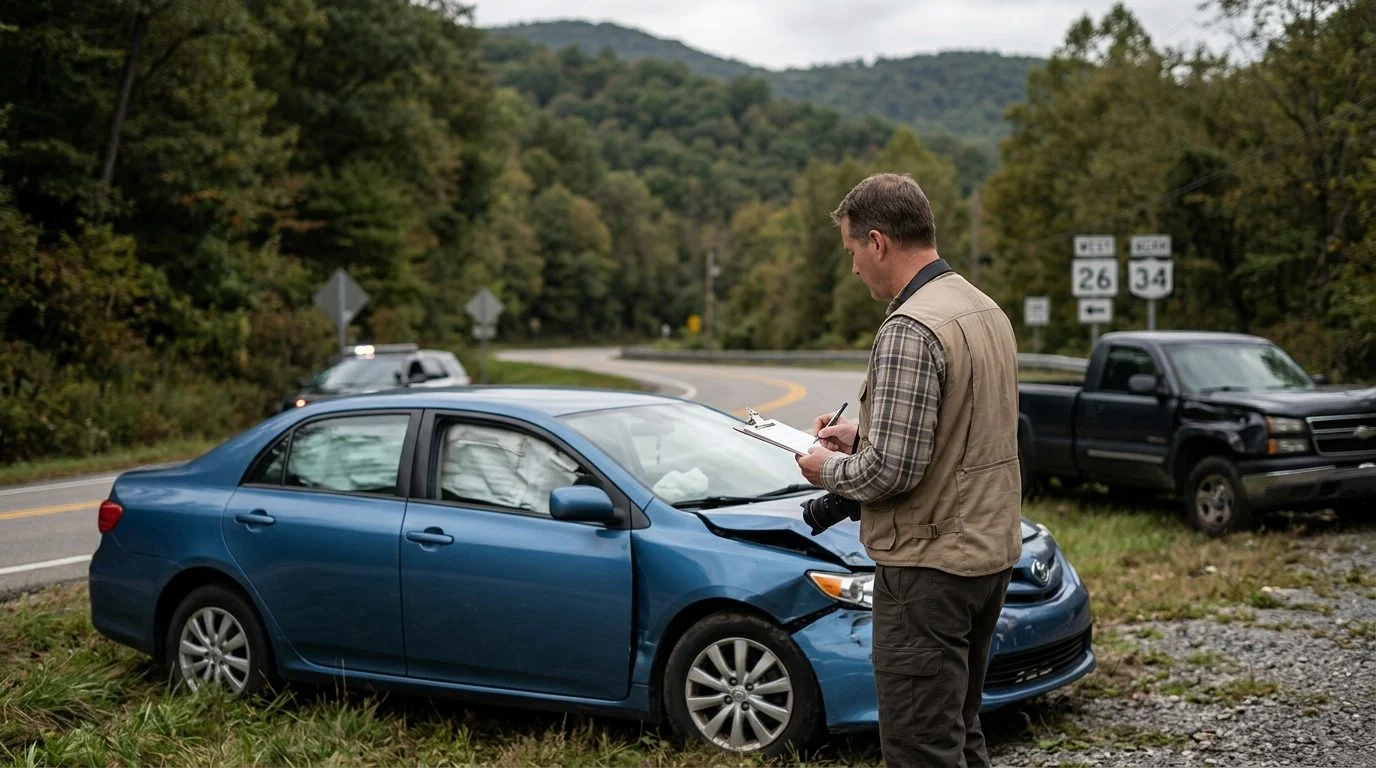
Serious crash claims in West Virginia
Insurance Adjuster Calling After a Serious Crash? Talk to the Firm First
Big Bubba Injury Law represents people hurt in car and commercial truck crashes, along with families in wrongful death cases, across West Virginia. We can help you understand what to say to the adjuster and what to hold back.
Published October 28, 2026
Should I talk to the insurance adjuster after a serious crash in West Virginia? You do not have to give a recorded statement. You can decline, ask for questions in writing, and ask for a call back at a better time. This guide explains what to share, what to hold back, and why a serious injury changes the picture.
Do You Have to Give a Recorded Statement to the Insurance Adjuster?
You can decline a recorded statement to an insurance adjuster. The adjuster works for the insurance company, not for you. Your job on that call is to protect your own account of events, not to help the insurer build its file.
West Virginia law also limits early contact in some cases. For 20 days after a personal injury, no one may try to get a statement for a settlement if you are an inpatient in a hospital or unable to do your usual work. The statute’s limits apply to anyone who seeks a statement from you for use in negotiating a settlement. W. Va. Code § 55-7-11a sets out these rules.
If someone obtained a statement in violation of that rule, you may disavow it by a written statement within one hundred eighty days from the date of the personal injury. The statute provides that an injured person may disavow a settlement, release or statement obtained in violation of W. Va. Code § 55-7-11a at any time within one hundred eighty days from the date of the personal injury by executing a written statement of disavowal and thereupon forwarding a copy of the same to the person violating this section, in which event the settlement, release or statement may not be admissible in evidence for any purpose in any court or other proceeding relating to the personal injury, if any consideration paid for the settlement of or the general release of liability for the personal injury, at the time of the forwarding of the copy of the written statement of disavowal, is repaid or returned to the person who paid the consideration.
Declining a recorded statement is not the same as ignoring the insurer. You can tell the adjuster you will answer in writing. You can ask for a call back on a set day. Before you answer any question, ask what the call is for. Keep a copy of every letter you send.
Not sure what your next step is?
Talk it through with Big Bubba — the first case review is free, confidential, and carries no obligation.
Why Adjusters Ask for Recorded Statements After a Crash
An adjuster asks for a recorded statement to collect early facts about how the crash happened and who may have caused it. The answers go into the insurer’s claim file. Those early facts often shape the insurer’s view of fault before anyone has examined the evidence.
A recording can be reviewed later. Words spoken in the first days can be quoted back, even when the speaker was still shaken, sore, or taking medicine. A short answer given in a hurry can sound like a firm statement of fact months later.
Calls often come fast. An adjuster may phone within days of a crash, before you know how badly you are hurt. That timing is the main reason to slow down.
The stakes on West Virginia roads are real. The Insurance Institute for Highway Safety reports 256 motor-vehicle crash deaths in West Virginia in 2024. Many claims that follow serious crashes involve injuries that take weeks to fully understand.
What You Can Safely Share Without Harming Your Claim
Share basic facts you know for certain. Those include your name, the date and time of the crash, and the general location, such as the road and the nearest town. Stick to what you saw and heard.
If police responded, give the adjuster the report number. Share the other driver’s name, plate, and insurance details. Those details help the insurer identify the claim, and you already needed them at the scene.
Tell the adjuster that you were taken for medical care and that your treatment is still going on. Saying your evaluation is ongoing is accurate. It also leaves room for later medical findings.
Before you hang up, get the adjuster’s name, the company name, and the claim number. Ask for the contact details in writing. A letter or email gives you a record of who is handling the claim.
What to Hold Back When an Adjuster Calls
Hold back opinions, guesses, and any words that could be read as admitting fault. Do not apologize in a way that sounds like an admission. Do not guess who caused the crash if you are not sure.
Do not estimate speed, following distance, or how long you had been driving. Do not call your injuries minor or say you feel fine. Do not guess how long your recovery will take.
Be careful with your medical history and prior claims. Describing unrelated conditions in detail can lead to questions that have nothing to do with the crash. Do not sign medical authorizations, releases, or settlement papers during the first call.
Fault matters in another way. West Virginia uses modified comparative fault, which means shared fault. Under W. Va. Code § 55-7-13c, your own fault does not bar recovery unless it is greater than the combined fault of everyone else responsible for the damages. If it is less, recovery is reduced in proportion to your share of fault. That is why an early comment about who was at fault can carry weight.
Why Brain and Spinal Cord Injuries Need Extra Care on the Phone
Brain and spinal cord injury symptoms can appear or change days or weeks after a crash. Headaches, memory trouble, dizziness, numbness, back pain, and mood changes may show up later. Someone who said early on that they felt okay may later have symptoms that were not clear at first.
That gap can create problems if the first call is the only record. An early statement that you were fine can be quoted against a later medical finding. The safer approach is simple. Say that your medical evaluation is ongoing. Do not offer a final description of your injury until your doctors have finished testing.
Keep a symptom and appointment log. Write down the date, the symptom, how bad it was, and what the doctor said. Note the medicines you take and any work you missed. A log keeps your account accurate and gives you something concrete to check.
A head injury can also affect memory. You may not recall every detail of the crash right away. That is one more reason to avoid answering detailed questions on a recorded line before you have reviewed the facts.
Commercial Truck and Company Vehicle Crashes: More Parties, More Questions
A crash with a commercial truck or company vehicle can involve more than one insurer. The adjuster who calls you may represent the trucking company or the company vehicle’s insurer, not the driver’s personal insurer. Ask which company the adjuster works for before you say anything else.
It means the employer may be part of the claim, not only the driver.
Write down the company name, the driver’s name, and any company name, logo, or identifying number on the vehicle. If it is safe to do so, take a photo of those markings. These details help identify who may be responsible.
West Virginia law also sets a cap on certain noneconomic damages in some commercial vehicle cases. Under W. Va. Code § 55-7-32, in many commercial vehicle cases the noneconomic damages each injured or killed person can recover against the employer defendant are capped at $5 million per occurrence, with the cap increasing for inflation starting January 1, 2026. The cap does not apply if the employer lacks at least $3 million in commercial motor vehicle insurance for each occurrence, or if the driver was, for example, impaired, over hours, overweight or distracted. For more on company vehicle claims, see company vehicle crash responsibility.
Not sure what your next step is?
Talk it through with Big Bubba — the first case review is free, confidential, and carries no obligation.
Early Offers and Low Policy Limits: What to Know Before Responding
An early offer can arrive before anyone knows the full extent of a serious injury. You do not have to respond on the call. You can take time to review any offer.
Policy limits matter too. A policy pays up to its stated limits, so the amount available from one policy may be lower than the harm you have suffered. Understand the limits on the at-fault driver’s policy and any policy that covers you before you respond to an offer. For more on this issue, see low policy limits and catastrophic injury.
Do not sign a release on the spot. A release can close off later claims. Ask what it covers before you sign anything.
If you believe an insurer has treated you unfairly, West Virginia law sets a specific path. Under W. Va. Code § 33-11-4a, a third-party claimant may not bring a private lawsuit for an unfair claims settlement practice. The claimant’s remedy is an administrative complaint with the Insurance Commissioner.
Frequently Asked Questions About Adjuster Calls After a Serious Crash
Should I talk to the insurance adjuster after a serious crash in West Virginia?
You can talk, but you do not have to give a recorded statement. You can ask for questions in writing or a call back on a set day.
What should I say if the adjuster asks whether I was at fault?
Stick to the facts you saw. Say you cannot determine fault yet.
What if the adjuster keeps calling?
Ask that future contact be in writing or on a set schedule. Keep notes of each call, including the date and time.
What if I already gave a recorded statement?
Write down what you said and when. Do not add new details until you have reviewed the facts.

If You Are Dealing With a Serious Crash Injury and an Adjuster Has Called
If a recent crash left you hurt and an adjuster is asking for a statement now, you do not have to decide on the spot. Share the basic facts, keep your medical care going, and ask for questions in writing.
The firm handles car accident, truck accident, commercial vehicle, catastrophic injury, and wrongful death matters across West Virginia. If you are weighing a recorded statement while still treating a brain or spinal cord injury, you can request a free case review with the firm. During that review, you can share the crash details and your medical situation, and get your questions answered before you say more to the insurer.