
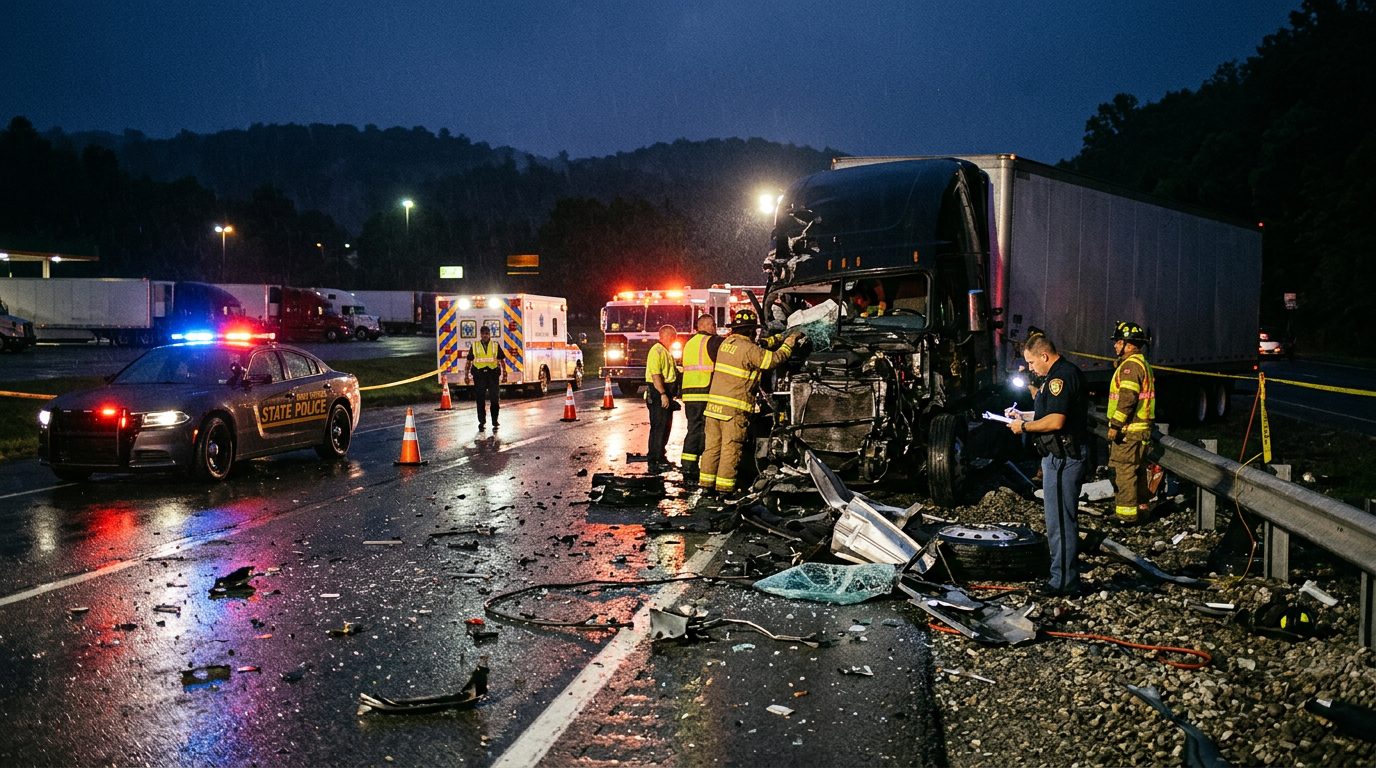
Truck Crashes Across West Virginia
Truck Driver Logbooks and ELD Data: What They Can Show After a Serious Crash
After a truck crash, the records held by the driver and trucking company can reveal what happened on the road. Big Bubba Injury Law helps West Virginia families understand what to look for.
Published October 27, 2026
Why Trucking Company Records Matter After a Serious Crash
After a serious truck crash, the trucking company and the driver usually hold most of the records that show what happened. A truck crash leaves a trail of paperwork and data that a car crash often does not. That trail can include driving time logs, engine data, maintenance files and dispatch notes.
Many families do not know these records exist. They often learn about them only after a loved one is hurt or killed and the questions start piling up. Knowing what the records are, and how they can change, helps you ask better questions early.
These records can help show what happened before, during and after a crash. They can show how long the driver had been on the road, how the truck was moving and whether it had been inspected and repaired. They can also show whether the driver’s paperwork matched the truck’s actual movements.
This matters most when injuries are catastrophic. Brain injury, spinal cord injury and wrongful death cases may involve details about the trip itself. The catastrophic injuries page explains the kinds of harm that can follow a serious crash.
The firm handles truck accidents, commercial vehicle accidents, catastrophic injuries and wrongful death claims. We serve injury victims across West Virginia, including Charleston and Huntington.
If a truck crash left someone you love hurt or gone, the firm can help you understand which records may exist. Reach out for a free case review, with no obligation to continue. Talk it through with Big Bubba — the first case review is free, confidential, and carries no obligation.

Key Terms: HOS, RODS, ELD, ECM and FMCSA Explained
Five short terms come up again and again in truck crash records. Knowing them makes the rest much easier to follow.
FMCSA stands for the Federal Motor Carrier Safety Administration. It is the federal agency that sets many safety rules for trucking companies and their drivers.
HOS means hours of service. These are the federal limits on how long a commercial driver may drive and stay on duty before taking a required break.
RODS means record of duty status. It is the official log of a driver’s time, split into off duty, sleeper berth, driving and on-duty not driving. Federal rules require motor carriers to require each driver to record duty status for each 24-hour period, except for a private motor carrier of passengers (nonbusiness) (49 C.F.R. § 395.8).
ELD means electronic logging device. It is hardware or an approved app that connects to the truck and records driving time automatically.
ECM means engine control module. It is the truck’s onboard computer that stores engine and vehicle data. People often call it the truck’s black box. It is a separate system from the ELD.
Paper Logs Versus Electronic Logs
Electronic logs record time automatically, while paper logs depended on what the driver wrote down. That difference changes what investigators and families can check. Paper entries came from the driver’s own handwriting, so they had to be compared against other records.
An ELD records many items on its own. These include the date, time, location and engine hours (49 C.F.R. § 395.26). Comparing that data with fuel receipts, toll records or dispatch notes can reveal gaps.
An electronic record is not automatically complete or correct. The driver must review the entries and certify them. Under 49 C.F.R. § 395.30, a driver may edit, enter missing information, and annotate ELD recorded events, subject to the edit limitations of the ELD. The carrier also must not alter or erase the original information. So the original data and the edit history both matter in a review.
How Electronic Logging Devices Work and What They Record
An ELD connects to the truck’s engine and logs each change in duty status. Drivers and carriers must keep these records. The device is designed to capture information the driver cannot easily change on his own.
Under federal rules, an ELD automatically records the date, time, vehicle location, engine hours, vehicle miles, driver identification and vehicle identification. It also records the motor carrier’s identification (49 C.F.R. § 395.26). When a truck is moving and nothing has been logged for an hour, the device records an intermediate entry.
Drivers can make annotations or edits, but each change must be annotated. That edit history is part of what a careful review looks at.
Many people ask whether a phone can work as an ELD. The answer is yes, but only if the app is on FMCSA’s registered ELD list. A carrier required to use an ELD must use only a listed device (49 C.F.R. § 395.22).
Who Must Use an ELD
Most commercial drivers who must keep duty status records use an ELD. The rules have exceptions, so whether a particular truck had to use one depends on the facts. Families should not assume either way without checking the records.
It does not apply to a private motor carrier of passengers who is not operating for business (49 C.F.R. § 395.8). The ELD subpart applies to ELDs used to record hours under that duty status rule. Any ELD used after December 18, 2017 must meet its requirements (49 C.F.R. § 395.20).
Ask which records exist for the trip. Ask who kept them, and whether the device was registered. Those answers help show which rules applied to that truck.
How Hours-of-Service Limits Apply
Hours-of-service limits are concrete federal rules. For property-carrying commercial motor vehicles, a driver may not drive without first taking 10 consecutive hours off duty, except as otherwise provided in § 395.1. A driver may not drive after 14 consecutive hours on duty that began after 10 hours off (49 C.F.R. § 395.3).
Under 49 C.F.R. § 395.3, a driver may drive a total of 11 hours during the period specified in paragraph (a)(2) of this section. Driving also is not allowed after more than 8 hours of driving without a 30-minute break, with limited short-haul exceptions. 49 C.F.R. § 395.3 reads: “Except for drivers who qualify for either of the short-haul exceptions in § 395.1(e)(1) or (2), driving is not permitted if more than 8 hours of driving time have passed without at least a consecutive 30-minute interruption in driving status.”
Tight delivery windows, long hauls and waiting to load or unload can push drivers toward these limits. A violation alone does not prove a crash was caused by tiredness. But hours records show how long the driver had been working before the crash.
Hours also affect damages in West Virginia. Under W. Va. Code § 55-7-32, a limit applies to certain noneconomic damages against an employer defendant. That limit depends on conditions in the statute, including insurance. The statute says it does not apply if an operator or driver is found to have, at the time of the incident, operated a commercial motor vehicle in excess of the hours of operation established under state or federal regulations. It applies only to causes of action arising after July 1, 2024.
Not sure what your next step is?
Talk it through with Big Bubba — the first case review is free, confidential, and carries no obligation.
Black Box and Engine Control Module Data
The engine control module, or ECM, can store engine and driving data that is separate from the ELD log. Depending on the truck, that data may include speed, braking and throttle use for a period before and during a crash.
The kind of data stored, and how long it is kept, depends on the truck’s make, model and settings. ECM data is not the same as an ELD log. The two should be compared, not assumed to match.
Stored engine data can be lost, overwritten or damaged if the truck is repaired, returned to service or salvaged. That is one reason early action matters. Reading this data usually takes proper equipment and methods. That is why it is often handled through formal requests rather than guesswork.
Other Trucking Company Records That Can Matter
Each motor carrier must keep a driver qualification file for every driver it employs (49 C.F.R. § 391.51). That file can include the driver’s employment application, motor vehicle records, road test certificate and medical examiner’s certificate.
Except as provided in paragraph (d) of this section, the carrier must keep that file for as long as the driver is employed and for three years after. This file can show training, medical certification and driving history. It can help show what the carrier knew about the driver.
Other records can matter too. These include dispatch records, bills of lading, fuel receipts, toll records, GPS or telematics data and maintenance and inspection reports. Comparing these with ELD and ECM data can show whether the trip timeline and the driver’s hours line up.
The carrier and the driver hold these records, not the family. That is why families often need help identifying which records exist and asking for them in the right way.
Why Timing Matters: Preserving Trucking Records After a Crash
Records do not last forever. The federal regulation for companies subject to this part states that companies subject to this part shall retain records for the minimum retention periods provided in appendix A to this part. After those periods end, the rules allow records to be destroyed at the company’s discretion (49 C.F.R. § 379.3). The rule also does not excuse compliance with longer requirements from other government bodies.
A motor carrier must keep a back-up copy of ELD records for 6 months, on a separate device from the original data (49 C.F.R. § 395.22).
Timing also matters for claims. Where no other limitation is prescribed, West Virginia requires personal injury actions to be brought within two years after the right to bring them has accrued (W. Va. Code § 55-2-12). A written request asking the carrier to keep its records is a common early step in a case.
You can help by keeping your own records. Write down the police report number, the names of witnesses and any letters from the carrier or its insurer. Save photos, medical bills and notes about symptoms and appointments.

When a Truck Crash Leaves Your Family With Questions
If a truck crash hurt or killed someone you love, you do not have to sort through these records alone. You may be dealing with medical care, time off work and grief all at once. Unfamiliar terms like ELD and ECM can make it harder.
Truck crash records can include ELD logs, engine data and company files. Each one can tell part of the story. Knowing which records to ask about, and when, can help protect them.
The firm handles truck accidents, commercial vehicle accidents, catastrophic injuries and wrongful death cases. We serve families across West Virginia, including Morgantown, Wheeling and Beckley. If you want to talk through what happened and which records may exist, reach out to the firm for a case review. There is no obligation to continue.