
Catastrophic Injuries
Catastrophic Injuries in Morgantown
When a car crash, truck accident, or other incident leaves you with a life-altering injury, you need a firm that understands the full scope of your losses. Big Bubba Injury Law serves Morgantown and all of West Virginia.
Published October 03, 2026
Catastrophic Injuries in Morgantown: What Qualifies & Your Rights
A catastrophic injury permanently changes your ability to work, live independently, or care for yourself. These aren’t injuries that heal in weeks or months. They reshape your entire life—and the lives of your family—for decades to come.
If you’ve suffered a catastrophic injury in a Morgantown car crash, truck accident, or commercial vehicle collision, understanding what that means legally and financially is the first step toward protecting your right to full recovery.
Not sure what your next step is?
Talk it through with our team — the first case review is free, confidential, and carries no obligation.
What Qualifies as a Catastrophic Injury?
A catastrophic injury is one that permanently alters a person’s ability to work, live independently, or perform daily activities—often requiring lifelong medical care, rehabilitation, and assistive equipment.
The key word is permanent. A serious injury that heals—even if recovery takes months—is not catastrophic. A catastrophic injury leaves lasting effects that don’t go away. These injuries require ongoing medical treatment, therapy, home modifications, and often full-time or part-time care assistance for the rest of your life.
Why does this distinction matter? Because catastrophic injury claims demand a different legal strategy. Insurance companies know these cases involve larger damages. They fight harder, hire more experts, and use delay tactics to pressure injured people into accepting far less than they deserve. You need a legal team that understands both the medical complexity and the insurance company playbook.
Examples of Catastrophic Injuries
Catastrophic injuries take many forms. Here are some common types:
Traumatic Brain Injury (TBI)
A blow to the head or violent shaking damages brain tissue. TBI can cause cognitive changes, memory loss, personality shifts, difficulty with concentration, loss of motor function, and seizures. The challenge: many TBI symptoms are invisible. You may look fine while struggling with thinking, mood, balance, or speech. Insurance companies exploit this invisibility, claiming the injury isn’t “real” or isn’t as severe as medical evidence shows.
Spinal Cord Injury (SCI)
Damage to the spinal cord results in partial or complete paralysis and loss of sensation below the injury site. A spinal cord injury means lifelong mobility needs, wheelchair dependence or assisted walking, loss of bowel and bladder control, chronic pain, and the constant need for medical care and home support. These injuries reshape every aspect of daily life.
Severe Multiple Fractures or Crush Injuries
Bones shattered in high-impact crashes may require multiple surgeries, permanent pins or rods, chronic pain, and loss of limb function. Some crush injuries lead to organ damage or amputation.
Permanent Disfigurement or Limb Loss
Severe burns, lacerations, or traumatic amputation alter appearance and function permanently. These injuries carry both physical and psychological weight.
Organ Damage
Blunt-force trauma to the chest, abdomen, or head can damage the heart, lungs, liver, kidneys, or brain. Some organ injuries require transplant, dialysis, or lifelong medication and monitoring.
How Catastrophic Injuries Happen in Morgantown
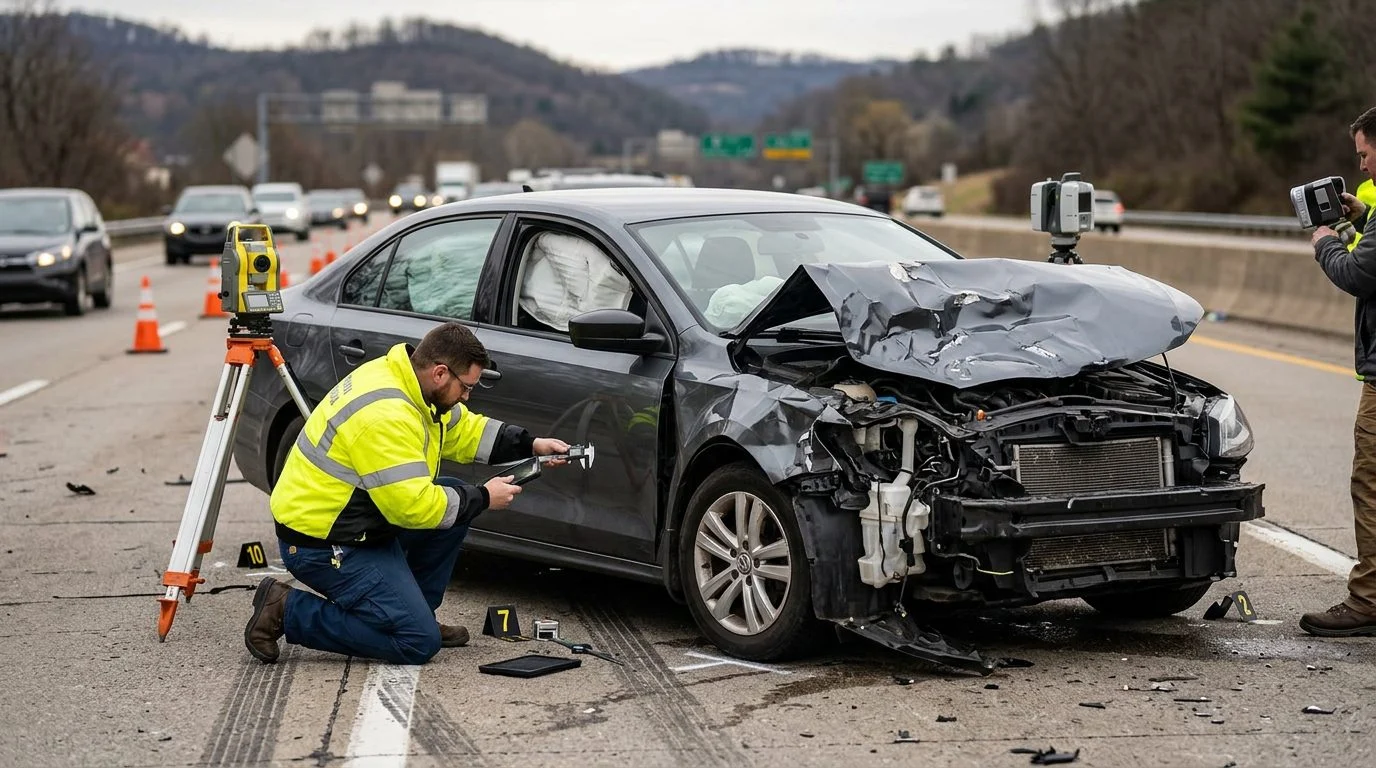
Morgantown sits along the I-79 corridor—a major truck route connecting North and South. High-speed collisions on the interstate, combined with local road traffic, create the conditions for catastrophic injury.
High-impact car accidents on I-79 and local roads often involve speeds that leave little margin for survival or minor injury. Multi-vehicle pileups amplify the force. Drivers and passengers suffer crushing impact, ejection, or rollover trauma.
Commercial truck and tractor-trailer crashes are especially catastrophic. An 80,000-pound loaded truck traveling at highway speed carries enormous kinetic energy. When it strikes a passenger vehicle, the physics are unforgiving. The smaller vehicle absorbs the force, and occupants suffer severe trauma.
Workplace vehicle accidents—delivery vans, construction vehicles, commercial fleets—also cause catastrophic injury when speed, negligence, or mechanical failure is involved.
The point: catastrophic injuries don’t happen by accident. They result from high-impact collisions where speed, weight, or negligence overwhelm the human body’s ability to survive unharmed.
Have questions about what happened?
Ask our team directly. The first conversation is free, confidential, and there is no obligation to continue.
The Lifelong Impact of Catastrophic Injury
When you or a family member suffers a catastrophic injury, the financial and personal impact extends far beyond the emergency room bill.
Medical costs include emergency care, surgery, intensive care, rehabilitation, ongoing therapy (physical, occupational, speech), medications, medical equipment, and monitoring for complications. These costs don’t end after a few months. They continue for decades.
Home modifications may include wheelchair ramps, accessible bathrooms, widened doorways, hospital beds, lifts, and specialized climate control. The cost to retrofit a home can reach tens of thousands of dollars.
Assistive equipment—wheelchairs, walkers, communication devices, monitoring systems—requires regular replacement and maintenance as technology improves and equipment wears out.
Lost wages and lost earning capacity represent the income you can no longer earn because of your injury. If you were 35 years old and earning $50,000 annually when injured, that lost earning potential over a 30-year working life is substantial. Vocational experts calculate this loss based on your age, education, work history, and the functional limitations your injury creates.
Full-time or part-time care assistance may be needed for personal hygiene, meal preparation, medication management, mobility, and medical monitoring. Professional caregiving costs $15–$25 per hour or more, depending on the level of skill required.
Emotional and psychological effects on the injured person and family are real but often undervalued by insurance companies. For the injured person, depression, anxiety, and loss of identity are common and may be part of the damages claimed.
These costs don’t disappear. They accumulate year after year. A life care plan—a detailed projection of future medical and non-medical needs—quantifies this reality for the court and jury.
Why Catastrophic Injury Cases Are Different
Routine car accident claims often settle quickly. The injuries heal, medical bills are paid, and lost wages are compensated. Done.
Catastrophic injury cases are fundamentally different. They demand:
Proof of future medical needs and costs. You can’t just add up past medical bills. You must prove what medical care the injured person will need for the next 50 years and what it will cost. This requires expert testimony from physicians, life care planners, and vocational rehabilitation specialists.
Life care plans. A detailed, evidence-based document that projects future medical, rehabilitation, assistive equipment, and care needs based on the injured person’s age, diagnosis, and prognosis. Insurance companies scrutinize these plans and hire their own experts to challenge them.
Coordination of multiple experts. You need physicians to establish the diagnosis and prognosis, life care planners to project future needs, vocational experts to calculate lost earning capacity, and sometimes economists to account for inflation and the time value of money.
Larger damages claims. Because the damages are substantial—often in the hundreds of thousands or millions—insurance companies deploy aggressive defense tactics. They hire teams of adjusters and lawyers. You need your own team.
Detailed medical documentation. Every test, scan, therapy session, and doctor’s note matters. Gaps in medical records weaken your claim. Insurance companies exploit those gaps, claiming the injury isn’t as severe as you say.
What Is the Hardest Injury to Prove?
Traumatic brain injury can be challenging to prove in a personal injury case.
Why? Because TBI is an invisible injury. Unlike a broken bone on an X-ray or a spinal cord injury visible on an MRI, many TBI symptoms are cognitive, behavioral, or neurological. They don’t show up clearly on standard imaging. A person with severe TBI may walk and talk but struggle with memory, executive function, impulse control, or emotional regulation.
Insurance companies exploit this invisibility. They argue: “If the injury were real, it would show on a scan.” They pressure injured people to accept settlements far below the actual cost of lifelong cognitive rehabilitation and care.
The counter is rigorous medical documentation. Neuropsychological testing, functional MRI, detailed medical records, and expert testimony from neurologists and neuropsychologists establish the injury’s reality and severity. But this documentation must be comprehensive and begin early—ideally within days or weeks of the accident.
Delay weakens your case. Months after the accident, it becomes harder to prove the injury was caused by the crash and not by something else. Insurance companies use that uncertainty as leverage.
Deadlines and Legal Steps You Cannot Miss
In West Virginia, a personal-injury lawsuit generally must be filed within two years after the right to bring the claim accrues. This is the statute of limitations. Miss this deadline, and your claim may be barred—even if it is strong.
Two years sounds like a long time. It isn’t. Here’s why:
Immediate medical documentation matters. The first medical records—from the emergency room, hospital, and early treatment—establish the injury’s severity and causation. Gaps in early treatment weaken your claim.
Early investigation and evidence preservation are critical. Accident scenes change. Witnesses move away. Vehicle wreckage is scrapped. Surveillance video is deleted. The sooner you preserve evidence, the stronger your case.
Insurance companies move fast. They contact witnesses, obtain statements, and begin building their defense within days. If you delay, they’ve already shaped the narrative.
Expert coordination takes time. Life care planners, vocational experts, and medical specialists need time to review records, conduct evaluations, and prepare reports. Rushing this process weakens your case.
The bottom line: don’t wait. Contact an attorney within days or weeks of a catastrophic injury. The statute of limitations is your deadline, but your case is strongest when you act immediately.
Want to know where you stand?
Tell us what happened and our team will walk you through the options available to you, at no cost.
Why You Need Legal Help for a Catastrophic Injury Claim
You might think: “I’ll handle this myself. I’ll talk to the insurance company and settle.”
Here’s the reality: insurance companies have teams of adjusters, nurses, and lawyers. They have financial incentives to minimize your claim. They know catastrophic injury cases are complex. They use that complexity to confuse injured people and pressure them into accepting inadequate settlements.
You need your own advocate—someone who understands the medical complexity, knows the law, and can coordinate the experts your case requires.
Coordinating medical experts, life care planners, and vocational experts is a full-time job. Each expert must review your medical records, conduct evaluations, and prepare reports. They must communicate with each other to ensure consistency. You can’t do this alone while recovering from a catastrophic injury.
Navigating complex damage calculations requires understanding how courts value lost earning capacity, future medical costs, pain and suffering, and loss of enjoyment of life. Insurance companies will lowball every category. An attorney can help assess what these damages may be worth and pursue full compensation on your behalf.
Protecting your right to full compensation means understanding West Virginia’s comparative fault rule. Under West Virginia’s modified comparative fault law, you can still recover damages even if you were partially at fault for the accident—as long as your fault is not greater than the combined fault of all other parties. Insurance companies will try to blame you for the accident to reduce your recovery. An attorney protects your rights.
Preserving evidence and meeting deadlines ensures your claim doesn’t expire and your case isn’t weakened by lost evidence or missed procedural steps.
We serve Morgantown injury victims who’ve suffered catastrophic injuries from car crashes, truck accidents, and commercial vehicle collisions. We understand both the medical and legal complexity these cases demand. We coordinate the full team—physicians, life care planners, vocational experts—that your case requires. And we know the deadlines that can foreclose your claim entirely.

Frequently Asked Questions
How much does a catastrophic injury cost over a lifetime?
Costs vary widely depending on the injury type, age at injury, and care needs. Spinal cord injuries and severe traumatic brain injuries often cost $1 million to $5 million or more over a lifetime when you account for medical care, home modifications, assistive equipment, and lost earning capacity.
What is a life care plan?
A life care plan is a detailed, evidence-based document that projects the injured person’s future medical, rehabilitation, and care needs based on their diagnosis and prognosis. It quantifies the cost of lifetime care and is used in legal claims to prove damages.
Can I recover damages if I was partially at fault for the accident?
Yes. West Virginia’s comparative fault rule allows you to recover damages even if you were partially at fault, as long as your fault is not greater than the combined fault of all other parties.
How long do I have to file a personal injury lawsuit in West Virginia?
Under West Virginia law, you generally have two years after the right to bring the claim accrues to file a personal injury lawsuit. Missing that deadline may bar your claim, and exceptions may apply.
If a catastrophic injury from a crash has changed your life or your family’s future, you don’t have to navigate this alone. People in your situation can reach out to Big Bubba—and we’re ready to listen to what happened, understand your injury, and explain what your claim may be worth. Call us about your case or request a free case review today.
Related practice areas
- Catastrophic Injuries Huntington: What You Need to Know