
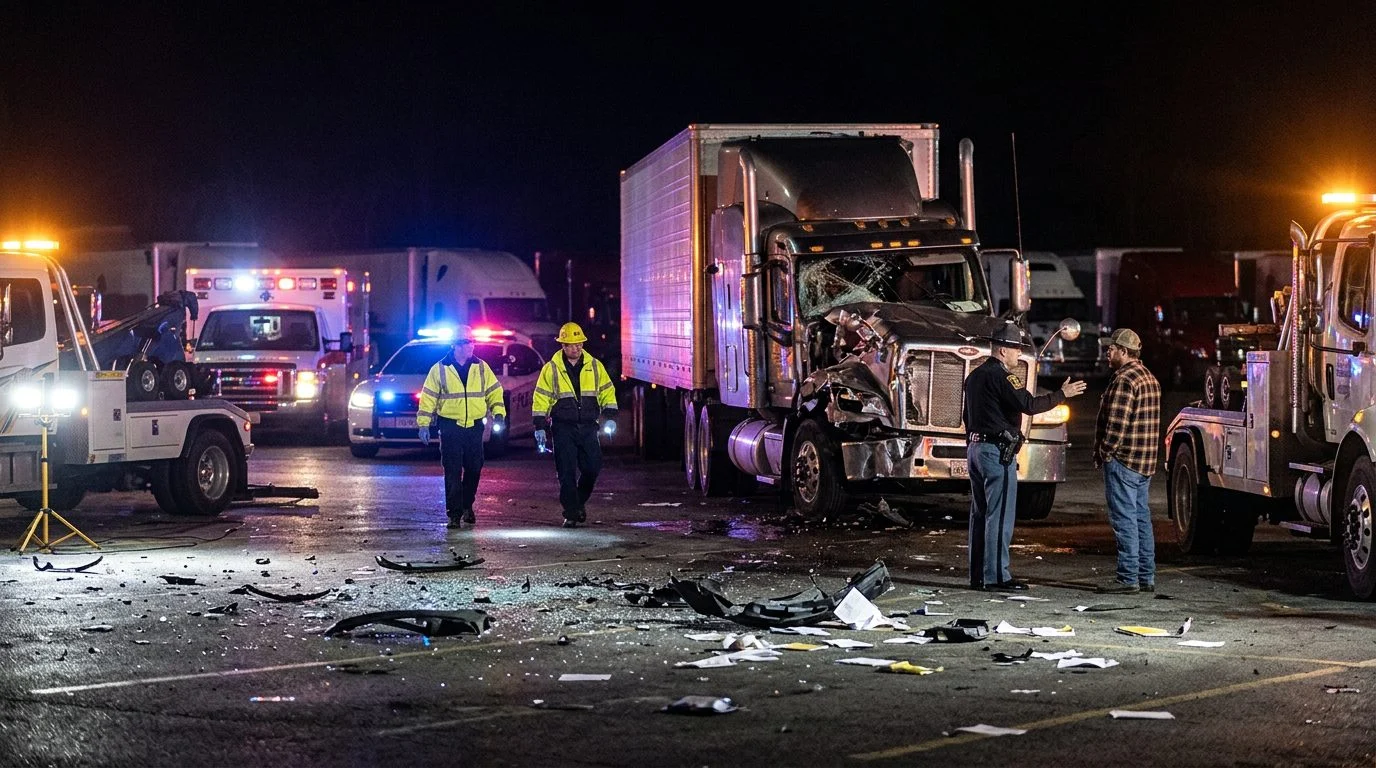
Truck Crash Evidence | West Virginia
Truck Driver Logbooks After a Crash in West Virginia: What They Show
Logbooks can reveal how long a driver was on the road and when rest breaks happened. Learn what these records include and how they may matter in your case.
Published October 28, 2026
Yes, you may be able to request a truck driver’s logbook and drug and alcohol test records after a crash in West Virginia. These records are held by the driver and the trucking company, not by the public. This page explains which records may exist, how long federal rules say they must be kept, and why early action matters.
If you are reading this because you were hurt in a truck crash or lost someone in one, you are likely trying to make sense of something you did not choose. You do not need every answer today.
What Records a Truck Crash Can Generate
A commercial truck crash can leave several separate kinds of records, and different parties hold each one. A driver’s logbook is only one of them.
Federal rules call the logbook a record of duty status. It shows whether a driver was driving, on duty, resting or off duty. Under 49 C.F.R. § 395.8, carriers must keep these records for each driver.
Carriers also keep supporting documents. These include bills of lading, dispatch and trip records, and receipts for expenses like fuel and tolls. The company keeps driver qualification files, maintenance records and inspection reports. Drug and alcohol testing records are kept under a separate federal schedule.
These records are usually not a public file. A police report may be public, but company dispatch messages and test results generally reach a claim through a written request, a preservation demand or a lawsuit. Knowing who holds each record helps you ask the right party. For a broader overview, see our catastrophic injuries guide.
If you are gathering answers after a truck crash that hurt you or someone you love, you do not have to sort out the records alone. Reach out to us for a free case review. Talk it through with Big Bubba — the first case review is free, confidential, and carries no obligation.

FMCSA Hours of Service Basics
Federal hours-of-service rules limit how long a commercial driver may drive. They also set required rest.
Under 49 C.F.R. § 395.3, a driver of a property-carrying commercial motor vehicle may not drive without first taking 10 consecutive hours off duty. A driver may not drive after a period of 14 consecutive hours after coming on duty following that 10-hour break. Under 49 C.F.R. § 395.3, a driver may drive a total of 11 hours during the period specified in paragraph (a)(2) of this section.
Breaks also apply during the day. Once more than 8 hours of driving time pass, the driver needs at least a 30-minute interruption in driving status. Certain short-haul drivers have limited exceptions.
The rules also set weekly limits. A driver may not drive after 60 hours on duty in 7 consecutive days if the carrier does not operate every day of the week. A driver may not drive after 70 hours on duty in 8 consecutive days if the carrier does operate every day. The FMCSA hours-of-service summary explains these limits in plain terms.
Whether a particular trip falls under these rules depends on the facts of that trip.
Electronic Logs Versus Paper Logs
Most interstate commercial drivers record their duty status on an electronic logging device, or ELD. Under 49 C.F.R. § 395.8, a motor carrier operating commercial motor vehicles must install and require ELDs. The stated compliance date is no later than December 18, 2017.
An ELD records data on its own. Under 49 C.F.R. § 395.26, it automatically records the date, time, vehicle location, engine hours, vehicle miles, driver and vehicle identification, and motor carrier identification data. When a truck is moving and no status change has been logged for an hour, the device adds an intermediate entry.
Paper logs still exist in limited situations. The rule allows manual records only in the circumstances it lists. A handwritten log can differ from GPS or engine data, so the two are often compared.
Records can also be checked against each other. Fuel receipts, toll records and dispatch messages may show where a truck was and when. The same rule bars any false report about duty status, and it bars tampering with an ELD so that it does not record data accurately.
Drug and Alcohol Test Records After a Crash
After certain crashes, federal rules require the employer to test surviving drivers for alcohol and drugs. As soon as practicable following an occurrence involving a commercial motor vehicle operating on a public road in commerce, each employer must test for alcohol each of its surviving drivers in the circumstances listed in 49 C.F.R. § 382.303.
Testing is required when a crash involves a loss of human life, for each surviving driver who was performing safety-sensitive functions with respect to the vehicle. It is also required when the driver receives a citation for a moving violation tied to the crash. Under 49 C.F.R. § 382.303, a driver who receives a citation within 8 hours of the occurrence under State or local law for a moving traffic violation arising from the accident is one of the drivers the employer must test for alcohol, if the accident involved the conditions the section lists. The crash must involve either an injury that needs immediate treatment away from the scene, or a vehicle that must be towed away.
Timing matters. If an alcohol test is not given within 2 hours, the employer must keep a record of the reasons. If it is not given within 8 hours, the employer must stop trying. The rule also says nothing in it requires delaying medical care for injured people.
Retention periods differ. Under 49 C.F.R. § 382.401, alcohol results of 0.02 or greater must be kept for five years. Negative drug test results and alcohol results below 0.02 must be kept for one year. Collection process records must be kept for a minimum of two years, except records of calibration of evidential breath testing devices.
How Logbook Violations May Support a Negligence Claim
A logbook that shows hours over federal limits may be relevant to a negligence claim. It does not prove a claim by itself.
Federal rules say no driver may operate a commercial motor vehicle when fatigue or another cause makes it unsafe to do so, except that in a grave emergency where compliance would increase the hazard, the driver may continue to the nearest place at which that hazard is removed, under 49 C.F.R. § 392.3. Hours-of-service records may bear on whether a driver was too tired to drive safely.
West Virginia uses modified comparative fault, which is shared fault. Each person’s share of fault is set as a percentage. Comparative fault is defined in W. Va. Code § 55-7-13a, which expresses each person’s share of fault as a percentage.
A separate state law limits some damages in certain truck cases. Under W. Va. Code § 55-7-32, in a civil action for personal injury or wrongful death involving the operation of a commercial motor vehicle requiring a commercial driver’s license, the maximum each person injured or killed can recover from an employer defendant as compensatory damages for noneconomic loss may not exceed $5 million for each occurrence, regardless of the number of claims or theories of liability, though the limit is not available to every employer defendant and exceptions may apply. Beginning January 1, 2026, that cap increases each year to account for inflation, based on the Consumer Price Index, but not to exceed 150 percent of the original amounts. The limit is not available to an employer defendant without at least $3 million in commercial motor vehicle insurance per occurrence covering the injury. That limit does not apply, among other exceptions the statute lists, if the operator was found to have exceeded federal or state hours limits at the time of the incident. The statute applies to causes of action arising after July 1, 2024.
A claim is judged on the whole picture. Police reports, witness statements, vehicle data and logs are considered together.
Company Records Can Show Responsibility Beyond the Driver
A trucking company keeps its own files. Those files can matter beyond the driver’s own conduct.
Under 49 C.F.R. § 391.51, a motor carrier keeps a driver qualification file. It includes the driver’s employment application, motor vehicle records, road test documentation and medical examiner’s certificate.
Supporting documents also reveal company practices. These include dispatch records, trip records and delivery itineraries. Each electronic mobile communication for that period counts as one document.
Questions about scheduling, driver supervision or vehicle maintenance may be relevant. Asking them helps show the full picture. They do not assume that any company did something wrong.
Not sure what your next step is?
Talk it through with Big Bubba — the first case review is free, confidential, and carries no obligation.
How These Records Are Obtained After a Crash
These records usually come through three routes: a written preservation request, the claims process, or discovery in a lawsuit. Discovery is the formal exchange of evidence between parties.
Timing is a real concern. Under 49 C.F.R. § 395.8, a motor carrier must keep records of duty status and supporting documents for at least six months from the date of receipt.
Electronic data can also be overwritten as systems change. Because of these windows, early action matters.
Keep what you already have. That includes the crash report number, photos, witness names and any paperwork you received from the carrier or insurer. What can be produced varies by claim and by which records still exist.

Records, Time, and Your Next Step
Preserving truck crash records early matters because federal retention periods are short and electronic data can change.
Wrongful death cases have their own deadline. Under W. Va. Code § 55-7-6, the action must be commenced within two years after the death, subject to the provisions of section eighteen, article two, chapter fifty-five. W. Va. Code § 55-7-6 reads: “The provisions of this section shall not apply to actions brought for the death of any person occurring prior to July 1, 1988.” It must be brought by the duly appointed personal representative of the deceased person.
Families facing these costs may also find our guides on funeral and burial costs in a wrongful death claim helpful. For spinal cord injuries, see our page on home modifications after a spinal cord injury crash. Our West Virginia page covers local injury guidance.
Can I get a truck driver’s logbook after a crash in West Virginia?
Usually, a logbook comes through a claim or a lawsuit rather than from the public. The carrier and driver hold the record.
How long must a trucking company keep logbooks?
Records of duty status and supporting documents must be kept for at least six months from the date of receipt. Test records follow different schedules.
Do truck drivers have to take a drug test after a crash?
If you are gathering answers after a truck crash that hurt you or someone you love, the records involved can be hard to sort through on your own. Serving Charleston and Morgantown injury victims across West Virginia, the firm handles these cases. You can reach out for a free case review to talk through the crash and which records may still exist.