
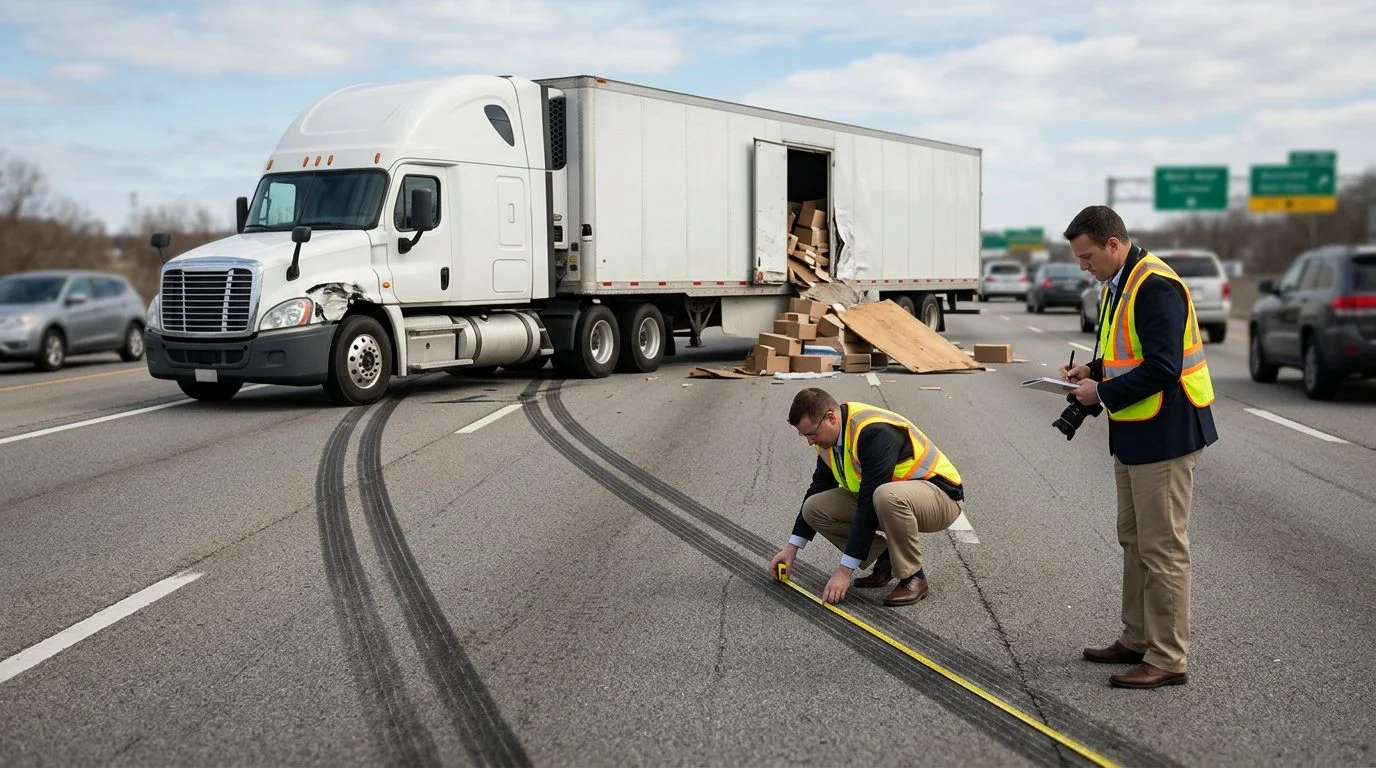
Commercial Vehicle Accidents
Who Is Liable When a Commercial Vehicle Crashes?
In West Virginia, responsibility for a commercial vehicle accident generally may extend beyond the driver, depending on the facts of each case, and exceptions may apply. We help injured people learn about their rights.
Published October 07, 2026
Liability in Commercial Vehicle Accidents: Who Pays in West Virginia?
In a commercial vehicle accident, liability (legal responsibility for damages) generally may extend beyond the driver, depending on the facts of each case. Multiple parties may share fault, and whether a party can be held responsible generally depends on the facts of each case, and exceptions may apply. Identifying who may be liable is one part of reviewing a commercial vehicle accident claim.

Not sure what your next step is?
Talk it through with our team — the first case review is free, confidential, and carries no obligation.
Understanding Liability in Commercial Vehicle Accidents
Liability means legal responsibility for the harm and losses you suffered. In commercial vehicle accidents, multiple parties can share liability because the accident may result from driver error, company negligence, vehicle defects, or unsafe road conditions—or a combination of these.
West Virginia follows comparative negligence law, which means fault can be divided among all parties involved. Under West Virginia’s comparative fault law, your recovery may be reduced by your percentage of fault, and generally, recovery may be barred if your fault is greater than the combined fault of others, depending on the facts of your case and any exceptions that may apply.
The Commercial Vehicle Driver
The driver is often the first party examined for liability. Driver negligence includes speeding, distracted driving, fatigue, improper lane changes, and failure to follow traffic laws.
Commercial drivers owe a heightened duty of care because their vehicles are larger and heavier than passenger cars. The vehicle’s size and weight may mean that even minor driver errors, such as a delayed reaction or a split-second distraction, can contribute to serious collisions, depending on the facts of each case.
In a commercial vehicle accident, evidence such as police reports, witness statements, and driver logbook records may be relevant to whether driver negligence is involved, depending on the facts. Violations of federal hours-of-service regulations may be relevant to whether driver fatigue played a role, though that depends on the facts of each case.
The Trucking or Commercial Company
When a crash involves a driver who was working for a company at the time, more than one party may be involved in what happened, and sorting out those relationships is part of reviewing the case. Whether a company may be liable even if the driver alone caused the accident depends on the facts of each case.
Companies may also be directly liable for their own negligence:
- Negligent hiring: hiring a driver with a poor safety record or disqualifying medical condition
- Inadequate training: failing to train drivers on safety procedures, vehicle operation, or cargo handling
- Failure to maintain vehicles: allowing brakes, tires, steering systems, or other critical components to fall into disrepair
- Violating federal regulations: failing to comply with hours-of-service rules, safety inspections, or driver qualification standards
Commercial drivers and the companies they work for operate under safety rules that govern how trucks are driven and maintained. Depending on the facts of each case, a company’s own safety practices, such as the ones listed above, may be relevant to whether it can be held responsible for a crash, even when the driver’s conduct is also at issue.
Vehicle Manufacturers and Maintenance
A defective part or design flaw may be relevant to a manufacturer’s potential liability, depending on the facts of each case. Brake failure, tire blowouts, steering defects, and coupling failures are examples of issues that may be relevant to product liability claims in some commercial vehicle accidents, depending on the facts.
Poor maintenance by the company or driver can also cause accidents. A company that fails to inspect brakes, replace worn tires, or repair known defects can be held liable. In some cases, the driver’s failure to perform required pre-trip inspections contributes to liability.
Third Parties
Other drivers involved in the accident may share fault. Road maintenance contractors or government entities may be liable if hazardous road conditions—potholes, debris, inadequate signage—contributed to the crash. Cargo loaders may be liable if improper loading caused the vehicle to become unstable or the driver to lose control.
Have questions about what happened?
Ask our team directly. The first conversation is free, confidential, and there is no obligation to continue.
What Happens When a Commercial Vehicle Hits Your Car
Commercial vehicles cause severe injuries because of their size, weight, and momentum. A collision with a commercial truck often results in traumatic brain injuries, spinal cord injuries, broken bones, and internal organ damage. Passengers in smaller vehicles are especially vulnerable.
You may have claims against the driver, the trucking company, the vehicle owner, the manufacturer, and potentially other third parties. Each may carry insurance or have assets. Multiple liable parties mean multiple potential sources of compensation—a significant advantage in your recovery.
How West Virginia Law Determines Liability
West Virginia uses comparative negligence to determine fault (W. Va. Code § 55-7-13c). Evidence of negligence includes police reports, witness statements, vehicle maintenance records, driver logs, and expert investigation.
Federal trucking regulations set standards for safety, maintenance, and driver conduct. Violations of these rules may be evidence of negligence. For example, if a driver exceeded the hours-of-service limit and fell asleep at the wheel, that violation may help show negligence. If a company failed to maintain brakes and brake failure caused the accident, that violation may help show company liability, depending on the facts.
Expert investigation often uncovers company policy violations, driver misconduct, or maintenance failures that police reports alone may not reveal. Accident reconstruction experts, medical professionals, and industry specialists can help establish liability and the full extent of your injuries.
Why Liability Matters for Your Recovery
Identifying all liable parties strengthens your case and increases compensation. Commercial companies carry insurance and have resources to pay claims. Establishing clear liability may lead to faster resolution and a more complete recovery.
Understanding who is liable helps you understand your options and your rights moving forward. You are not alone in facing this situation—people in your circumstances reach out regularly after commercial vehicle accidents.
Next Steps After a Commercial Vehicle Accident
Document the scene: Take photos of vehicle damage, road conditions, traffic signs, and the accident scene from multiple angles.
Gather witness information: Get names, phone numbers, and addresses from anyone who saw the accident.
Preserve evidence: Keep medical records, bills, pay stubs, repair estimates, and all communications with insurance companies.
Seek medical attention: Even if you feel fine, some injuries appear hours or days later. A medical record establishes the link between the accident and your injuries.
Report the accident: File a police report and notify your insurance company promptly.
Consult with a lawyer: A lawyer who handles commercial vehicle accidents can investigate the crash, identify all liable parties, and advise you on your rights and options.
Want to know where you stand?
Tell us what happened and our team will walk you through the options available to you, at no cost.
Frequently Asked Questions
Can I sue both the driver and the trucking company?
In many commercial crashes, both the driver and the company they work for may be part of the picture, and we can look at the roles each one played when we review what happened.
What if I was partly at fault for the accident?
West Virginia’s comparative negligence law generally allows you to recover if your fault is not greater than the combined fault of all other persons responsible, and your recovery is reduced in proportion to your degree of fault (W. Va. Code § 55-7-13c).
How do I know if a company violated federal regulations?
A lawyer can subpoena the driver’s logbooks, maintenance records, and company policies to determine if hours-of-service, maintenance, or safety regulations were violated.
What is the difference between driver liability and company liability?
Driver liability arises from the driver’s negligent conduct (speeding, fatigue, distraction). Company liability arises from the company’s own negligence (hiring, training, maintenance, or regulatory violations).
How much insurance coverage do commercial vehicles carry?
Federal law requires many motor carriers to maintain minimum levels of financial responsibility, and the required amount can vary depending on the type of vehicle and operation (49 U.S.C. § 31139). Coverage amounts vary, but commercial policies are typically far higher than personal auto insurance, creating multiple sources of compensation.
If you were hurt in a commercial vehicle accident in West Virginia, you likely have questions about who’s responsible and what happens next. Reach out to Big Bubba to discuss your case and learn what your situation may mean for your recovery. Our team handles commercial vehicle accidents across West Virginia and can help you understand your rights.
Related practice areas
- Commercial Vehicle Accidents in West Virginia: Your Rights & Next Steps