
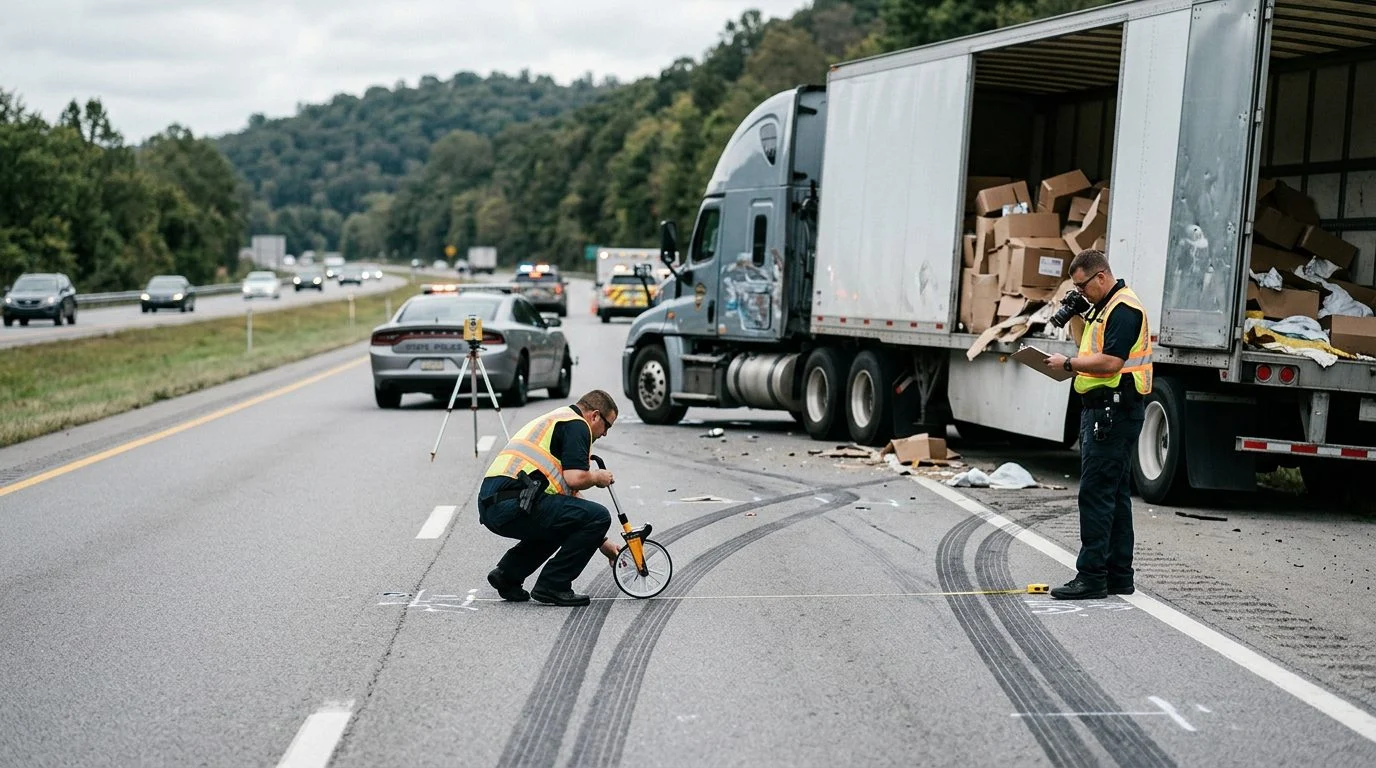
Truck Accident Claims | West Virginia
Asked for a Recorded Statement After a Truck Crash? Pause Before You Respond
A trucking company's insurer may ask you to give a recorded statement soon after a crash. Here is what to consider before you say anything on the record.
Published October 11, 2026
If an insurance company for a trucking business has asked you for a recorded statement after a crash, you may wonder whether you have to say yes. If an adjuster calls, it may help to take some time to gather your thoughts before you respond. Whether and when to talk depends on your injuries, the facts of the crash, and the terms of any policy involved. Exceptions may apply. This page explains what a recorded statement is, why an insurer may ask for one early, and what to weigh before you respond.
What Is a Recorded Statement After a Truck Crash?
A recorded statement is a question-and-answer conversation that an insurance representative records, usually by phone. The representative may ask how the crash happened, where you were, what you saw, and how you were hurt. Generally, the trucking company’s insurer, or someone acting for it, may make this request.
The request may come soon after the crash, while details are fresh and records are still being gathered. Generally, a recorded statement is not a court proceeding. But the recording can be used later when the claim is evaluated, so your words matter. The rules and terms can differ depending on the policies and facts involved.
Many people have never been recorded before. A short call can feel casual and friendly. Still, treat the request as a serious step.
Not sure what your next step is?
Talk it through with our team — the first case review is free, confidential, and carries no obligation.
Are You Required to Give a Recorded Statement?
Before giving a recorded statement to the other side’s insurer, you may want to talk with a lawyer about your options. Exceptions may apply depending on the facts and the policy terms.
West Virginia has a timing rule that matters here. Under W. Va. Code § 55-7-11a, generally, no person may try to negotiate a settlement, seek a release, or obtain a statement for that purpose within twenty days of a personal injury. This applies if the injured person is an inpatient in a hospital or is partially or totally unable to do their usual work. The statute’s exception covers only a statement that someone acting on the injured person’s behalf obtains at the injured person’s express request, so it does not let the other side’s insurer or adjuster take a statement just because the injured person asked. Exceptions may apply depending on the facts.
The same statute says an injured person may generally disavow a settlement, release, or statement obtained in violation of it. That must be done within one hundred eighty days of the injury, by written notice sent to the person who violated the statute. Any payment received generally must be returned. Whether this applies depends on the facts of each case.
Your own insurer’s policy may set different duties than the other side’s insurer. Ask for any request in writing. Write down the adjuster’s name, the company, and the claim number. No single answer fits every crash, so the choice depends on your situation.
Why Insurers May Ask for Statements Early
An insurer may ask for a statement early because the details of a crash are fresh. Early answers may capture the timing, the location, and your injuries before police reports, medical records, or witness accounts are gathered.
Those answers may be used later when the claim is evaluated. A statement is not a determination of fault in any particular case. Whether a statement affects a claim generally depends on what it says and on the facts of the claim.
The reason for any request depends on the facts. Some requests may simply be routine parts of a claim file. Others may be made because the insurer wants an account while memories are fresh. You can always ask what the statement is for. Early answers may also be compared with later records. Differences between them may be raised in some cases, depending on the facts.
Possible Risks of Speaking Before You Know Your Injuries
The main risk is answering questions before you know the full picture of your injuries. Your symptoms may take time to appear or to change. You may not know the extent of your harm on the day of the call.
Medical tests may still be pending when an adjuster calls. Records from doctors and hospitals can take time to collect. A recorded answer given on a day when your condition is unclear may later be compared with those records.
Memory can also be incomplete after a stressful crash. A short answer may not reflect the full sequence of events. These are possibilities that depend on the facts. They are not certainties about your case.
Have questions about what happened?
Ask our team directly. The first conversation is free, confidential, and there is no obligation to continue.
Evidence in Truck Crashes That May Matter
Truck crash claims can involve records kept by the carrier. These records may be potentially relevant, depending on the facts.
An electronic logging device (ELD) records certain data on its own. Under the federal regulation on ELD data, an ELD automatically records data elements that include date, time, CMV geographic location information, engine hours, vehicle miles, driver or authenticated user identification data, vehicle identification data, and motor carrier identification data. Whether these records matter to your claim depends on the facts. You can learn more about electronic logging device records.
Drivers generally must keep duty-status records. Under the federal duty-status recordkeeping rule, with certain exceptions, a motor carrier subject to that rule must require each driver it uses to record the driver’s duty status for each 24-hour period. No driver or motor carrier may make a false report about it.
Post-crash testing is another area. Under the federal post-accident testing rule, as soon as practicable following certain occurrences involving a commercial motor vehicle operating on a public road in commerce, an employer shall test its surviving drivers for alcohol. Whether that rule applies depends on the crash. Records may generally be kept in any technology that accurately reflects the information. Under the federal records-preservation rule, records may be preserved by any technology that accurately reflects all of the information in the record and remains accessible in a form that can be accurately reproduced later for reference.
A written request to preserve evidence is something a lawyer may consider. Which records exist depends on the carrier and the crash. Evidence like this does not, by itself, establish fault or strengthen a claim.
Questions to Consider Before Any Call With an Insurer
Before you answer any recorded questions, check a few basic points:
- Have I received medical care for my injuries?
- Do I know the insurer’s name and the claim number?
- Did the request come in writing?
- Have I talked with a lawyer about my options?
If you are not ready, you can politely say so. You can ask for the request in writing or for a time to call back. Keep a written log of every call. Include the date, the time, the person’s name, and what was said. Save any letters or emails.
Avoid guessing about speed, fault, or how badly you were hurt. Say only what you know. This is general guidance, and your situation may call for different steps.
How a Lawyer Can Help With Insurer Contact
A lawyer may be able to communicate with the insurer for you. A lawyer may also advise on whether and when to respond to a request for a statement. Depending on the facts, that help may include reviewing the request and explaining your options.
Deadlines matter too. Under W. Va. Code § 55-2-12, a personal injury action generally must be brought within two years after the right to bring it has accrued. Exceptions and different accrual rules may apply depending on the facts. Missing a deadline may affect your ability to sue.
West Virginia generally uses modified comparative fault (a shared-fault rule). Under W. Va. Code § 55-7-13c, a plaintiff’s fault generally does not bar recovery unless it is greater than the combined fault of others responsible. Recovery is then reduced in proportion to the plaintiff’s share of fault. How this applies depends on the facts of each case. That is one reason what you say about the crash matters.
Nothing on this page promises a particular result, settlement amount, or timeline. Outcomes depend on the facts of each case. For more on the process, see truck accident claims in West Virginia.
Want to know where you stand?
Tell us what happened and our team will walk you through the options available to you, at no cost.
Related practice areas
- Commercial Vehicle Accidents in West Virginia: Your Rights & Next Steps