
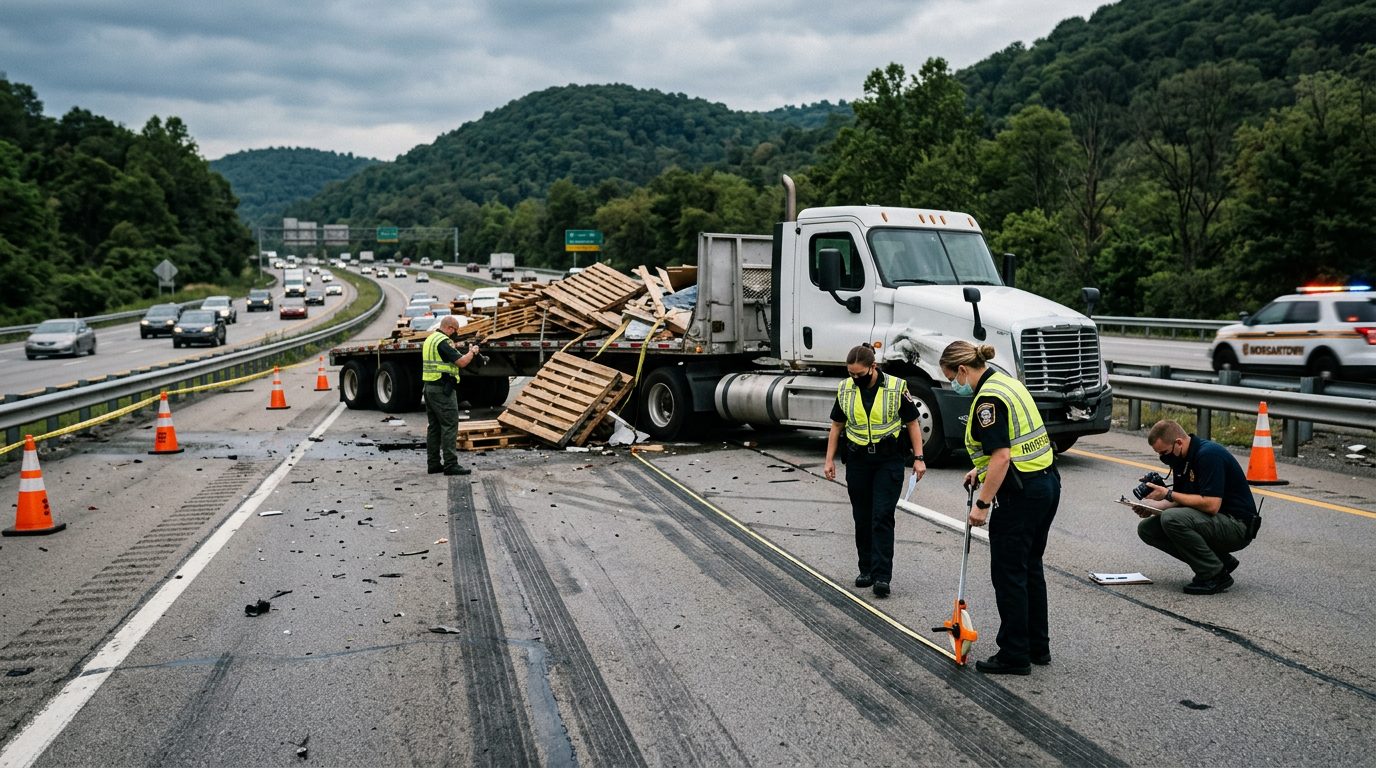
Commercial Vehicle Accidents
Hit by a Commercial Truck or Delivery Vehicle in Morgantown?
When a commercial vehicle causes serious injury, the stakes are higher. Big Bubba fights for people hurt in crashes involving commercial trucks, delivery vehicles, and fleet operators across West Virginia.
Published October 03, 2026
Commercial Vehicle Accidents in Morgantown: What to Do After a Crash
When a commercial vehicle hits your car on I-79 or a Morgantown street, the impact is often catastrophic. Delivery trucks, semi-trucks, and commercial vans weigh far more than passenger cars and cause far more severe injuries. If you’ve been hit by a commercial vehicle in Morgantown or Monongalia County, you need to understand what happened, what your rights are, and what steps to take next.
Not sure what your next step is?
Talk it through with our team — the first case review is free, confidential, and carries no obligation.
Commercial Vehicle Accidents Happen on Morgantown Roads
Morgantown sits on Interstate 79, a major commercial corridor with steep grades, sharp curves, and heavy truck traffic. Delivery trucks, semi-trucks, and commercial vans operate daily through Monongalia County, traveling to and from distribution centers, job sites, and local businesses. These vehicles are heavier, harder to stop, and cause more severe injuries than passenger cars. When a commercial vehicle accident occurs, the consequences are often life-altering—serious brain injury, spinal cord damage, broken bones, internal bleeding, or death.
What Happens When a Commercial Vehicle Hits Your Car
The force of a collision with a commercial vehicle is dramatically different from a crash between two passenger cars. Commercial vehicles carry cargo, passengers, or equipment that adds weight and force to the impact. A semi-truck can weigh 80,000 pounds or more; a delivery truck or commercial van still weighs several times what a passenger vehicle does.
That impact can cause traumatic brain injury, spinal cord injury, broken bones, and internal injuries. Victims often face months or years of recovery, steep medical bills, lost wages, and ongoing care needs. Depending on the facts, the driver who caused the accident—and, in some cases, the company that employs the driver, such as when the driver was acting within the scope of employment—may be legally responsible for those losses.
Why Commercial Vehicle Accidents Are Different
Commercial vehicle accidents are not the same as ordinary car crashes. Here’s why:
Federal and state regulations. Commercial drivers operate under federal hours-of-service rules. Federal law limits commercial drivers to a maximum of 11 hours of driving time within a 14-hour window, and also sets multi-day on-duty limits, such as no driving after 60 hours on duty in any 7 consecutive days. Violations of these rules can show negligence or recklessness. Commercial vehicles are also subject to federal safety regulations under Title 49 of the Code of Federal Regulations, including maintenance, inspection, and driver qualification standards.
Multiple liable parties. In a commercial vehicle accident, more than one party may be legally responsible. The driver, the commercial employer, the vehicle owner, the cargo loader, or the maintenance provider could all share liability. Identifying all liable parties is critical to recovering full compensation.
Different insurance and liability limits. Commercial insurance policies and liability limits differ from personal auto insurance. Understanding what coverage is available and how to access it requires knowledge of commercial insurance law.
Evidence and documentation. Commercial vehicles generate records that passenger cars do not: driver logbooks, maintenance records, dispatch records, dashcam footage, and electronic data recorders. These records are often critical to proving what happened and who is responsible.
Common Causes of Commercial Vehicle Accidents in Morgantown
Commercial vehicle accidents in the Morgantown area often result from:
- Driver fatigue or violations of hours-of-service rules. A tired driver is a dangerous driver. Federal law limits driving time for a reason.
- Inadequate vehicle maintenance or mechanical failure. Brakes, tires, and steering must be in safe working order.
- Improper cargo loading or securing. Unsecured or improperly loaded cargo can shift, causing the vehicle to tip or lose control.
- Speeding or unsafe driving for road and weather conditions. I-79 has steep grades and sharp curves. Snow, ice, rain, and fog are common in winter and early spring.
- Distracted or impaired driving. Cell phones, alcohol, and drugs impair judgment and reaction time.
Have questions about what happened?
Ask our team directly. The first conversation is free, confidential, and there is no obligation to continue.
Steps to Take After a Commercial Vehicle Accident in Morgantown
If you’re in a commercial vehicle accident, your immediate safety and health come first:
- Call 911 if anyone is injured. Get emergency medical care immediately.
- Move to safety if possible. Do not stay in the roadway if you can move.
- Get the driver’s information. Ask for the driver’s name, company name, license plate, and insurance information. Write it down.
- Take photos. Photograph the scene, vehicle damage, road conditions, and any visible injuries.
- Get witness contact information. Ask anyone who saw the accident for their name and phone number.
- Do not admit fault or sign anything except for police or medical personnel.
- Seek medical attention even if you feel okay. Some injuries appear hours or days later.
- Report the accident to your insurance company.
- Keep records of all medical treatment, lost wages, receipts, and expenses.
Injuries from Commercial Vehicle Accidents
Commercial vehicle accidents often cause severe, life-altering injuries:
- Traumatic brain injury (TBI). Concussion, contusion, diffuse axonal injury, loss of consciousness, and long-term cognitive or behavioral changes.
- Spinal cord injury (SCI). Partial or complete paralysis, loss of sensation, chronic pain, and loss of independence.
- Broken bones and fractures. Crush injuries, compound fractures, and injuries requiring surgery and long rehabilitation.
- Internal bleeding and organ damage. Abdominal injuries that may not be immediately obvious but are life-threatening.
- Severe burns. If the vehicle catches fire.
- Wrongful death. When the accident is fatal, a wrongful-death claim may be available. Under W. Va. Code § 55-7-6, the jury’s verdict may include damages for sorrow, mental anguish, and solace; reasonably expected loss of the decedent’s income and of the services, protection, care, and assistance the decedent provided; expenses for the care, treatment, and hospitalization of the decedent incident to the injury; and reasonable funeral expenses.
Why You Need Legal Representation
Commercial vehicle cases are more complex than typical car accidents. Insurance companies and commercial employers have teams of lawyers protecting their interests. You need someone on your side who understands commercial vehicle regulations, liability, and how to investigate these crashes.
A lawyer can:
- Investigate the accident and obtain critical evidence (logbooks, maintenance records, dashcam footage, dispatch records).
- Identify all liable parties and hold them accountable.
- Navigate commercial insurance policies and coverage limits.
- Calculate the true value of your claim, including medical bills, lost wages, pain and suffering, and future care needs.
- Negotiate with insurers or take your case to court if necessary.
Many injured people do not know their rights or how much their case is worth. You deserve fair compensation for your injuries and losses.
West Virginia Law Protects Injured People
West Virginia law may allow you to recover damages even if you were partially at fault in the accident, depending on the facts. Under West Virginia’s modified comparative fault rule, you can recover damages as long as your fault is not greater than the combined fault of all other parties. This means you may still have a claim even if you bear some responsibility for the crash.
You also have a deadline. A personal-injury lawsuit in West Virginia must generally be filed within two years after the right to bring it accrues, and exceptions may apply. If someone died in the accident, a wrongful-death action must generally be brought within two years after the decedent’s death, and exceptions may apply. Do not wait—evidence disappears, memories fade, and deadlines pass.
Want to know where you stand?
Tell us what happened and our team will walk you through the options available to you, at no cost.
Big Bubba Injury Law Serves Morgantown Injury Victims
We serve Morgantown and all of Monongalia County. We handle commercial vehicle accidents, truck accidents, catastrophic injuries, traumatic brain injury, spinal cord injury, and wrongful death. No attorney fee unless we win; clients remain responsible for case costs. Court costs and case expenses are your responsibility, but we handle the investigation, insurance claims, and legal work so you can focus on healing.
We are here to listen to what happened and explain your options in plain language. You do not have to face this alone.
Frequently Asked Questions
What should I do immediately after a commercial vehicle accident?
Call 911 if anyone is injured, move to safety, get the driver’s information and insurance details, take photos, get witness contact information, and seek medical attention. Do not admit fault.
Who is liable in a commercial vehicle accident?
The driver, the commercial employer, the vehicle owner, the cargo loader, or the maintenance provider could all be liable, depending on what caused the accident.
What is the time limit to file a lawsuit?
West Virginia generally allows two years after a personal-injury claim accrues to file a lawsuit (W. Va. Code § 55-2-12), and exceptions may apply. For a wrongful-death action, the general deadline is two years from the date of death (W. Va. Code § 55-7-6), and exceptions may also apply.
Can I recover damages if I was partially at fault?
Yes, under West Virginia’s modified comparative fault rule, you can recover damages as long as your fault is not greater than the combined fault of all other parties (W. Va. Code § 55-7-13c).
What evidence is important in a commercial vehicle accident case?
Driver logbooks, maintenance records, dispatch records, dashcam footage, electronic data recorders, police reports, medical records, and witness statements are all critical.
What injuries are common in commercial vehicle accidents?
Traumatic brain injury, spinal cord injury, broken bones, internal bleeding, organ damage, severe burns, and wrongful death are common outcomes of commercial vehicle crashes.
If you or a family member was hit by a commercial vehicle in Morgantown or Monongalia County, reach out today—people in your situation can contact us to discuss what happened and explore your options.
Related practice areas
- Commercial Vehicle Accidents in West Virginia: Your Rights & Next Steps
- Commercial Vehicle Accidents in Huntington, WV