
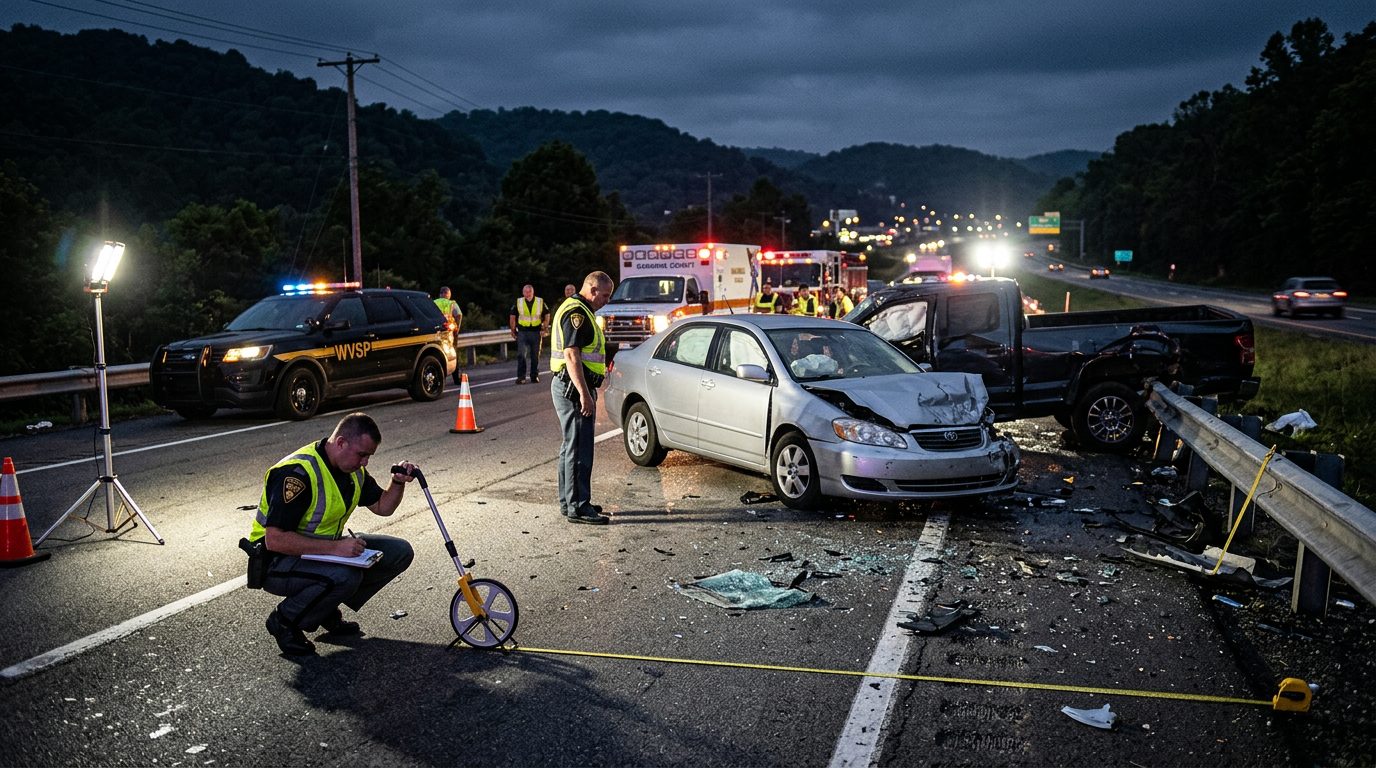
West Virginia Crash Reports
Getting Your Crash Report in West Virginia, Step by Step
Learn where the official record comes from, what to have ready before you ask, and how to handle a report that arrives with mistakes.
Published November 22, 2026
After a crash, many people want the official record of what happened first. You might be the driver, a passenger, or a family member trying to help someone who was hurt.
In most cases, yes. You can request a copy of the crash report from the agency that responded to the scene. The steps below show who can ask, what to gather, and what to do when a report is late or wrong.
What a police report is and why it matters after a crash
A police report is the written record an agency prepares after an officer investigates a crash. West Virginia law requires a report for a crash occurring on the public streets or highways of this state that causes bodily injury or death, or total property damage to an apparent extent of $1,000 or more (W. Va. Code § 17c-4-7). The officer must prepare it within 24 hours after completing the investigation ([W.
The report must give enough detail to show the cause of the crash, the conditions at the time, and the people and vehicles involved (W. Va. Code § 17c-4-9). Expect names, dates, times, locations, vehicle details, and the officer’s summary of the scene.
The officer builds the report from what he or she sees, what drivers and witnesses say, and any other evidence gathered. The report is a starting point, not the whole story. If you were hurt, it can help you and your family understand how the crash happened.
The report is also one record among several. Many people collect photos, witness names, medical records, and insurance details. These records can be useful when a claim is reviewed. One mistake is waiting too long to ask for the report. Ask early, while the names and details are still easy to find.
If a crash left you or someone you love seriously hurt or gone, you don't have to sort out the paperwork alone; you can reach out to the firm for a free case review. Talk it through with Big Bubba — the first case review is free, confidential, and carries no obligation.
Who can request a copy of a police report
Several groups commonly ask for a copy. Each has its own situation and its own limits.
- Drivers, passengers, and vehicle owners. People directly involved in a crash are commonly listed as eligible requesters. If you were hurt, you can ask for the report yourself.
- Insurance companies. Insurers may ask for a copy as part of handling a claim. State law also requires the officer, on request and at no cost, to give each party’s owner, operator, and insurance information to the other parties and their insurance agents within 24 hours of the crash, even if the report isn’t finished ([W.
- Attorneys and representatives. A lawyer or other representative acting for an involved person may request the report for that person.
- Family members. After a serious injury or a death, a family member may be able to request a report, depending on the facts and the agency’s rules.
- Members of the public. Access can depend on the type of report and what the agency chooses to release.
Don’t assume one request covers everyone. Each agency sets its own process, so confirm who it will release a report to before you send anything.
What to have ready before you request the report
Gather the date, time, and exact location of the crash before you contact the agency. The more precise you are, the easier it is for the agency to find the right file.
- Location. Include the road, the mile marker, or the nearest intersection.
- People and vehicles. Write down the names of the drivers and the vehicles involved, with plate numbers if you have them.
- Report or case number. Check any card or paper the officer gave you at the scene.
- The responding agency. For a crash resulting in injury to or death of any person or total property damage to an apparent extent of $1,000 or more inside a municipality, the driver must immediately notify the local police department. Otherwise, for a crash resulting in injury to or death of any person or total property damage to an apparent extent of $1,000 or more, the driver must immediately notify the county sheriff or the nearest State Police office (W. Va. Code § 17c-4-6). Knowing which agency responded tells you where to send the request.
- Your identification. Have a photo ID ready, plus any document the agency asks for.
- Copy fees. Agencies may charge for copies. The Beckley Police Department, for example, lists a $20 copy fee for crash reports (Beckley Police Department crash report information request). Check the current fee with the agency that holds your report.
If you were a driver, state law required you to give the other driver your name, a phone number, your vehicle details, and proof of insurance, if you were physically able (W. Va. Code § 17c-4-3). Keep a copy of what you shared.
How to request a copy from the responding agency
Contact the agency that responded to the crash and ask how it handles report requests. Find out whether it takes requests online, by mail, or in person. Ask what form it needs and what it charges.
Then follow these steps:
- Send the details you gathered, plus your contact information.
- Ask how and when you will be told the report is ready.
- Pay the fee the agency lists, using a method it accepts.
- Save the date you sent the request, the name of the person you spoke with, and any reference number.
West Virginia’s public records guidance explains that records requests go to the record custodian, the person who holds the agency’s records (West Virginia public records and FOIA guidance). If your request stalls, ask who the custodian is.
If the crash happened inside a city, ask whether that city requires drivers to file its own report. State law lets a municipality require that report by ordinance, and the report is kept for the confidential use of the city department (W. Va. Code § 17c-4-15). This step is easy to overlook, so ask directly.
What to do if the report is delayed or contains errors
If an investigation runs longer than 10 days, the officer must file a preliminary report on the 10th day after the crash. The final report is due within 24 hours after the investigation is complete ([W.
Reports may not be ready right away, especially when an investigation is still open. Check back with the agency and ask for a status update rather than waiting in silence. A costly mistake is letting a delay go unchecked.
If the report lists a wrong name, plate number, or location, tell the agency in writing. Ask how corrections or supplemental information are handled, and keep a copy of your letter.
Keep your own file too. Save your notes, photos, medical records, and copies of everything you receive. A full file makes it easier to explain what happened. Some insurers may dispute a claim, so review the report carefully and keep copies of every document.

Next steps when a brain or spinal injury or a loss has changed your life
If a crash caused a serious brain or spinal cord injury, or the death of a family member, the report is only one piece of what you need to sort out. The paperwork can feel like one more weight on top of medical appointments, bills, and hard days.
For background on these injuries, read our guide to traumatic brain injury accidents. Medical records follow their own process. Patients can ask for their own records in writing, and copying fees may apply (WV Board of Medicine guidance on medical records).
The firm handles car accidents, truck accidents, commercial vehicle accidents, catastrophic injuries, and wrongful death claims. We serve families and injury victims across West Virginia.
If you’re still waiting on a report or trying to decide what comes next, you can request a free case review, so the crash report and the facts of your situation can be looked at together.