
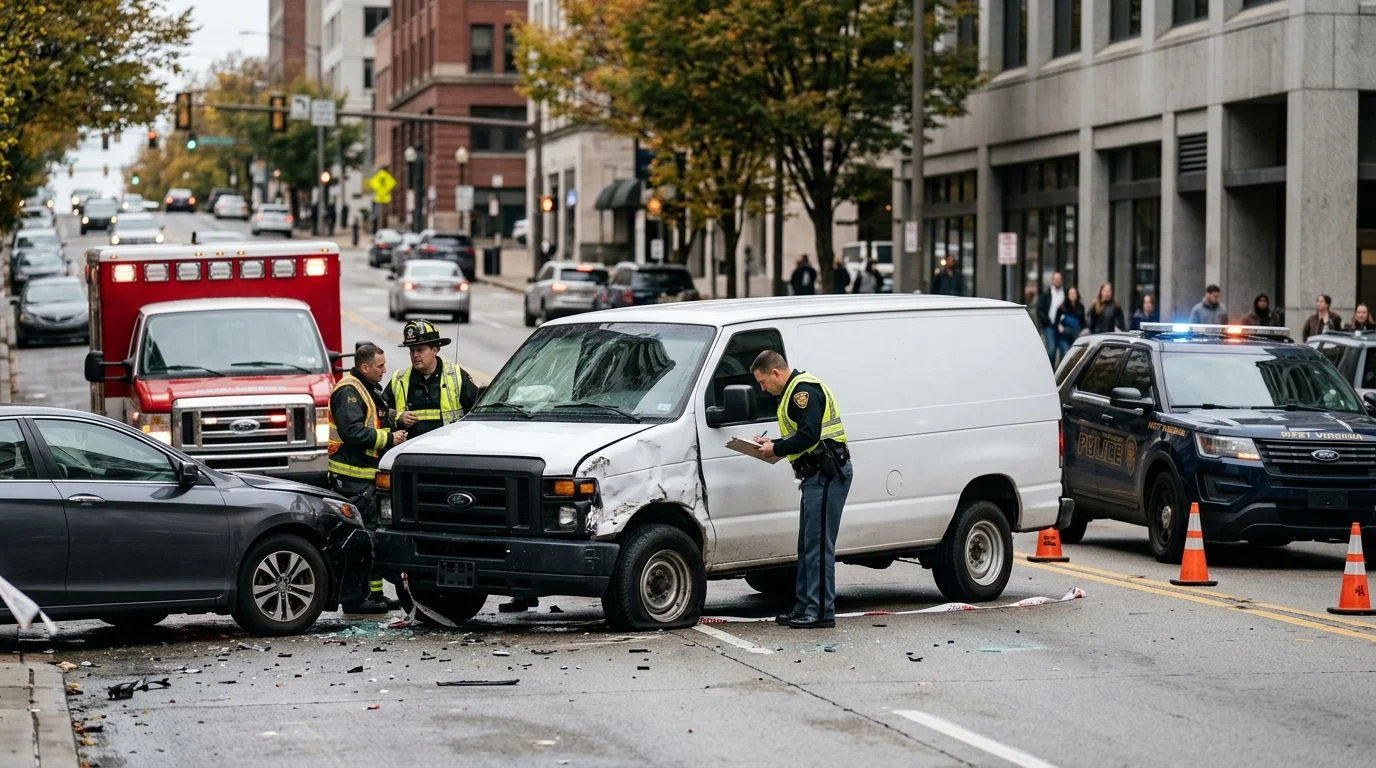
Company Vehicle Accidents | West Virginia
Hurt in a Crash With a Company Vehicle? Find Out Who May Be Responsible
Big Bubba Injury Law represents people injured in crashes involving company vehicles and commercial trucks across West Virginia, including families in wrongful death cases.
Published October 29, 2026
Yes, a company can be responsible when its driver causes a crash in West Virginia. In general, a business may answer for harm caused by an employee doing work, and it may also face claims about how it hired, trained and supervised that driver. This guide explains how these claims work, which records matter and which deadlines apply.
We serve injury victims and families across West Virginia, including Charleston, Huntington, Morgantown, Wheeling, Martinsburg, Parkersburg, Beckley, Clarksburg, Fairmont and Weirton.
Who This Page Is For and What a Company Vehicle Crash Means
A company vehicle crash is a collision involving a car, van, pickup or truck that a business owns, leases or runs for work. This guide is for people hurt in these crashes and for families of people killed or seriously hurt in them.
- Injured drivers and passengers
- Pedestrians and bicyclists struck by a work vehicle
- Spouses, children (including adopted children and stepchildren), brothers, sisters, parents, people who were financially dependent on the person who died, and others who would otherwise be equitably entitled to share may share in the damages after a death, but the claim is brought by and in the name of the decedent’s personal representative.
These cases differ from a typical car accident. More than one party may be involved. Business records, such as logs, maintenance files and dispatch notes, can matter as much as the police report. The rules below are general, and the facts of each crash decide how they apply.
If a work vehicle crash left you or a family member hurt, you may have a claim, and the firm can talk it through in a free case review. Talk it through with Big Bubba — the first case review is free, confidential, and carries no obligation.

When a Business Can Answer for Its Driver’s Crash
In general, a business can be held responsible for harm caused by an employee acting within the scope of their work. Lawyers call this vicarious liability, which means responsibility for another person’s conduct.
Scope of work usually asks a few questions:
- Was the driver doing work for the business at the time?
- Was the driver on a work errand, such as a delivery, service call or sales trip?
- Was the vehicle being used with permission, for the business’s purposes?
Delivery routes, driving between job sites and a vehicle assigned to a worker are common examples. Harder questions come up too. Commuting in a company vehicle, running personal errands during a work day and using a vehicle without permission each raise their own issues. Each one turns on the trip’s purpose and the business’s rules. Dispatch records, schedules and work messages can show what the driver was doing.
Direct Claims Against the Business Itself
Direct claims say the business was careless on its own, not only through its driver. These claims can sit alongside claims based on the driver’s conduct.
- Negligent hiring. Did the business check the driver’s background and qualifications first? Some crash cases raise questions about how an employer screened an employee before hiring them, and whether those questions matter depends on the facts of each case. See McCormick v. Department of Public Safety.
- Negligent training and supervision. Did the driver get adequate training? Did the business know about unsafe habits and ignore them?
- Negligent retention. Did the business keep a driver after prior crashes, violations or complaints? See C.C. v. Harrison County Board of Education.
- Negligent entrustment. Did the business hand a vehicle to a driver it knew, or should have known, was unfit to drive it?
Records help answer these questions. Federal rules require motor carriers to keep a driver qualification file for each driver. That file includes the driver’s application and motor vehicle record, and the carrier must keep it while the driver works there and for three years after. See federal driver qualification file rules.
Commercial Trucks and Other Commercial Vehicles
Commercial trucks usually come with more rules, and those rules create more records to review. Federal rules apply to many interstate trucking operations. State law also treats some commercial vehicles differently.
Records that often matter include:
- Driver qualification files
- See federal logging device rules.
- Maintenance and inspection records
- Dispatch and GPS data
- Load and cargo paperwork
These records show whether the company followed the rules it had to follow. Several businesses can share responsibility in one crash. These include the carrier, a leasing company, a contractor or a maintenance provider.
State law also limits some damages in these cases. Under W. Va. Code § 55-7-32, in a civil action involving a commercial motor vehicle that requires a commercial driver’s license, the most each injured or killed person can recover from an employer defendant for noneconomic loss is $5 million for each occurrence, regardless of the number of claims or theories of liability, but only if that defendant carries at least $3 million in commercial motor vehicle insurance for each occurrence. Under W. Va. Code § 55-7-32, in a civil action for personal injury or wrongful death involving a commercial motor vehicle that requires a commercial driver’s license, the most each person injured or killed can recover against an employer defendant as compensatory damages for noneconomic loss is $5 million for each occurrence. Beginning January 1, 2026, and in each year after that, this limit increases to account for inflation, but not to exceed 150 percent of the amounts specified in the statute. The section applies only to causes of action arising after July 1, 2024. That limit is not available to an employer without at least $3 million in commercial motor vehicle insurance per occurrence. The limit does not apply if the driver was found to have, for example, an alcohol concentration of .04 or more, or acted in willful or wanton disregard for safety.
Injuries and Losses These Claims Can Involve
These claims often involve serious injuries, and some end in death. Catastrophic injuries need long-term medical care or cause lasting limits on work and daily life.
- Traumatic brain injury. Symptoms can appear days or weeks after a crash. Early medical visits and clear records help connect those symptoms to the crash.
- Spinal cord injury. These injuries can cause lasting changes in movement, feeling and independence.
- Fractures and internal injuries. These can require surgery, rehabilitation and time away from work.
In West Virginia, a wrongful death claim must be brought by the personal representative of the person who died. See W. Va. Code § 55-7-6. The statute names several kinds of damages. These include sorrow, mental anguish and solace, which can include companionship and guidance. They also include lost income, lost services, care and assistance, medical and hospital expenses from the injury, and reasonable funeral expenses.
West Virginia law also keeps certain injury claims alive after the injured person dies. See W. Va. Code § 55-7-8a. Medical bills, lost wages, reduced earning ability and pain and suffering are common categories a claim may address. Each one needs its own supporting records.
Steps, Deadlines and Evidence to Protect
The first steps are medical care, records and evidence. Some evidence can disappear quickly, so early action matters.
- Get medical care and keep every record. Follow treatment plans and keep bills, discharge papers and appointment notes.
- Write down what you remember. Note the date, route, weather and anything the driver said. Gather photos, the police report and witness names.
- Be careful with recorded statements. Insurers may ask for one early. State law limits attempts to settle or take a statement in the first 20 days after an injury, when the injured person is in the hospital or unable to work. See W. Va. Code § 55-7-11a.
- Ask that company records be kept. Logs, maintenance files, vehicle data and dash camera footage can be erased or overwritten.
- Review fault and damages. West Virginia uses modified comparative fault. Your fault bars recovery only if it is greater than the combined fault of everyone else responsible. If your fault is less, your recovery is reduced in proportion to your fault. See W. Va. Code § 55-7-13c.
Deadlines matter. Under W. Va. Code § 55-2-12, West Virginia’s general limit for personal injury claims is two years. Other rules may affect timing, so early review helps.
Not sure what your next step is?
Talk it through with Big Bubba — the first case review is free, confidential, and carries no obligation.
How Big Bubba Injury Law Can Help You Take the Next Step
Big Bubba Injury Law handles car accidents, truck accidents, commercial vehicle accidents, catastrophic injuries, traumatic brain injury, spinal cord injury and wrongful death. We serve injury victims and families across West Virginia.
A free case review is a confidential first conversation about what happened, who may be responsible and which records matter. You have no obligation to continue after it. Bring photos, the police report, medical papers and any work paperwork you have.
Frequently asked questions
Can I sue the company if its driver was off the clock?
Possibly. Direct claims about hiring, supervision or entrustment can still apply, so the trip’s purpose matters.
Does a company vehicle always make the company liable?
No. A company vehicle is one fact. The driver’s job, the trip’s purpose and the business’s own conduct also matter.
Do I have to talk to the insurer right away?
Not necessarily. Insurers may ask for a recorded statement early, so take time to understand your rights before you give one.
What if the driver was a contractor?
It can change who may be responsible. Leasing companies, contractors and others can be named when the facts support it.
If a work vehicle crash has you weighing what happened, you don’t have to sort it out alone. Request a free case review and talk through who may be responsible.