
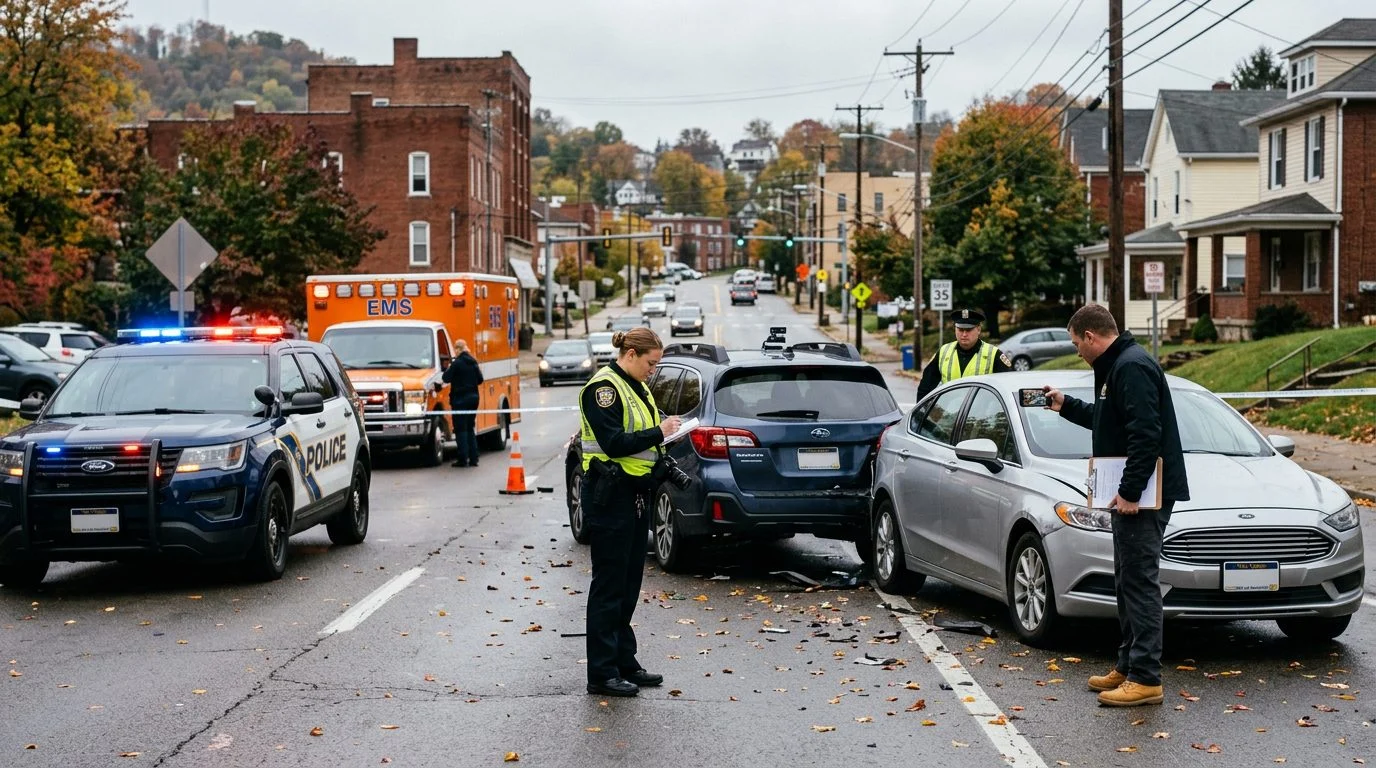
West Virginia Car Accident Guidance
Dashcam and Phone Photos After a Crash: Save Them Before They're Lost
Your camera and phone may hold the clearest record of what happened on the road. Here is how to protect those files while you focus on recovering.
Published November 21, 2026
If you were in a car accident in West Virginia, you may already have dashcam footage or photos on your phone. You may not yet know which ones matter.
Keep everything for now. Save the original files as they are, make a backup, and write down where each file came from. Other recordings, such as traffic camera or police video, may also exist.
What Dashcam Footage and Phone Photos Can Show After a Crash
Dashcam video records what happened while the vehicles were moving. Phone photos capture a still moment at the scene.
Video may show a vehicle drifting across lanes, a driver losing control, or a signal changing. Photos may show where vehicles came to rest, the damage on each car, road conditions and the lighting. What a file shows depends on the camera angle, what was recorded and the facts of the crash.
Clips from a few seconds before impact can matter as much as the crash itself. People often delete short or blurry clips because they look useless. Those clips may still show a lane change or a light color.
Scenes are often cleared soon after a crash. A photo taken in the first few minutes may be the only picture of where the vehicles stopped. So keep everything at first, and decide later with help.
Not sure what your next step is?
Talk it through with Big Bubba — the first case review is free, confidential, and carries no obligation.

Save the Original Files, Not Only Copies
Keep the original video and image files exactly as your device saved them. Do not crop, trim, filter or edit them. Editing can remove details that matter.
Original files carry metadata. Metadata is hidden information, such as the date, the time and sometimes the location where the file was made. This information may help show when and where a recording was made.
Make at least one backup on a second device or in a cloud account. Confirm the copy opens and plays before you delete anything. Write down which device made each file.
Federal records rules allow records to be kept with any technology that accurately reflects all of the information and stays accessible for later reference, per 49 C.F.R. § 379.7. A copy that loses data is not a full copy. Keep the full file.
Do not delete files from your phone to free up space until the originals are backed up.
Phone Photos to Take at the Scene and Afterward
Take photos only when it is safe. Start with the vehicles and the road.
- All vehicles, from several angles
- License plates
- Damage to each vehicle
- Where the vehicles came to rest
- Skid marks or debris on the road
- Traffic signs, signals and lane markings
- Weather and lighting
If the other driver agrees, or it is safe, photograph their insurance card and registration. West Virginia law requires a driver of any vehicle involved in a crash resulting in injury to or death of any person or damage to any vehicle to give proof of insurance if physically able, under W. Va. Code § 17c-4-3. Ask for the other driver’s name and phone number too.
Photograph visible injuries at the scene. Then take new photos over several days. Bruising and swelling can change, and later photos may show how an injury developed. Some injuries are not visible right away, so keep notes of symptoms too.
Photos taken after vehicles were moved still help. The scene may look different, so say so in your notes.
Dashcam Footage From Your Vehicle or Another Driver’s Vehicle
If your dashcam recorded the crash, save that file before anything else.
A dashcam may record the moments before, during and after a collision. It may show another car, a bad driver, or a vehicle that loses control. Many dashcams record over older footage on their own. A memory card left in the camera can be overwritten, so remove the card or save the clip soon after the crash.
Do not post clips on social media or send them in group chats before you save the original. Posts can be copied and shared by people you do not know. Captions and edits can also change how a clip looks.
If another person’s dashcam recorded the crash, ask them to keep the original file. Ask them to send the original, not a screenshot, and not to edit it. Write down their name, phone number and where they were when they recorded it.
Traffic Cameras, Police Video and Commercial Truck Cameras
Other recordings may exist, but they are not always saved.
Some roads, bridges and intersections have traffic cameras run by state or local agencies. Footage from them may or may not have been saved. Many camera systems record over older footage on a set schedule, so timing matters. Ask the agency soon after the crash whether footage exists.
Police vehicles may have dash or body cameras. Ask the investigating agency whether recordings exist for the crash.
West Virginia law requires a driver to give immediate notice of a crash with injury, death or $1,000 or more in total property damage. The notice goes to local police, the county sheriff or the nearest State Police office, under W. Va. Code § 17c-4-6. The officer must prepare a crash report within 24 hours after finishing the investigation, under W. Va. Code § 17c-4-7.
Commercial trucks and buses may have forward-facing or driver-facing cameras. How long a trucking company keeps that footage depends on its own policies. Federal rules require motor carriers to keep an accident register for three years, according to a Colorado State Patrol summary of federal rules. A request to preserve truck footage may be relevant.
Keeping the Paperwork and Witness Details With the Evidence
Keep your notes, the crash report and witness details together in one folder.
Write down the date, time, location and direction of travel as soon as you can. Note the weather and traffic. Memory fades, and early notes often hold details that are easy to forget later.
Get the names and phone numbers of any witnesses. Ask the investigating agency for a copy of the crash report. The agency may charge its own copy fee. Under West Virginia law, the officer must provide owner, operator and insurance information on request, at no cost, within 24 hours, per [W.
Keep social media posts private. Avoid posting about fault or injuries, since others can see, save and share posts.
Be careful with recorded statements. West Virginia law generally bars any person from negotiating a settlement, obtaining a release, or obtaining a statement for use in a settlement from an injured person who is an inpatient in any hospital or partially or totally unable to engage in his or her usual trade, profession or occupation, within twenty days of the injury. That bar does not apply if a person acting or intending to act for the injured person obtains a statement upon the injured person’s express request. An injured person may disavow a settlement, release or statement obtained in violation of that law within one hundred eighty days from the date of the injury by sending a written statement of disavowal to the person who violated it. Under that law, the settlement, release or statement may not be admissible in evidence in any court or other proceeding relating to the injury, but only if any money paid for the settlement or release is repaid or returned to the person who paid it when the copy is forwarded, as set out in W. Va. Code § 55-7-11a.
Not sure what your next step is?
Talk it through with Big Bubba — the first case review is free, confidential, and carries no obligation.

If Someone You Care About Was Badly Hurt
If you are gathering this for a family member, you may also be handling medical visits and paperwork. That is a lot at once.
A brain injury or spinal cord injury may affect what the injured person remembers about the crash. The files and notes you keep may help fill in that picture.
Deadlines matter. West Virginia generally allows two years to bring a personal injury claim, under W. Va. Code § 55-2-12. A wrongful death action is generally brought by the personal representative of the estate and generally must start within two years after the death, under W. Va. Code § 55-7-6. Exceptions may apply, so review timing early.
Should I delete a photo that looks bad? Keep it. Let someone decide later whether it matters.
The firm handles car accident, truck accident, commercial vehicle, traumatic brain injury, spinal cord injury and wrongful death matters. We serve injury victims across West Virginia, including Charleston, Huntington and Morgantown.
If you have files, photos or witness names from a crash that changed someone’s life, contact the firm to ask for a free case review of what you have kept. You can also read our traumatic brain injury guide for more background.