
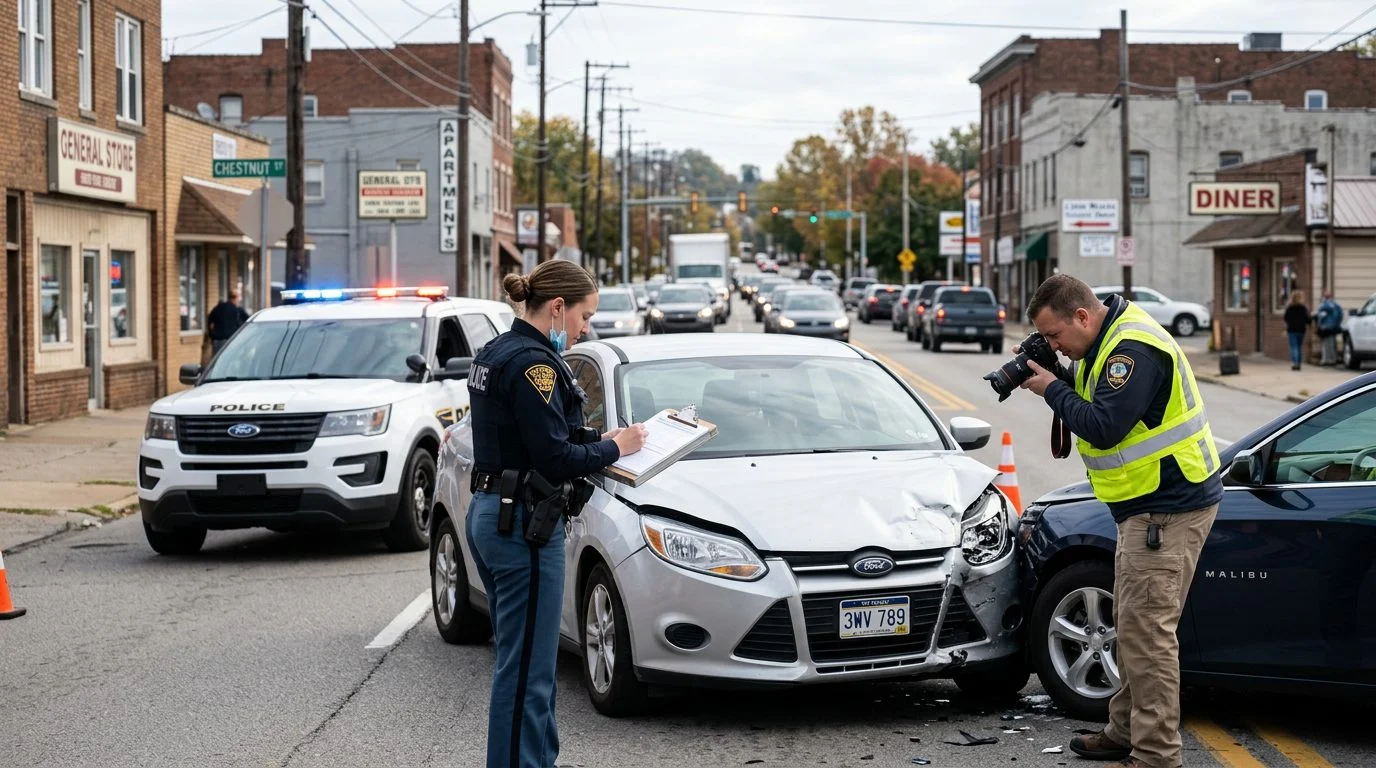
West Virginia Car Accidents
Getting Your Car Accident Report Copy in West Virginia
A clear, step-by-step guide to finding the right agency, preparing your request, and knowing what to expect from the process.
Published November 19, 2026
After a crash, you may need a copy of the police report for an insurance claim, a medical bill, or a decision about legal help. Knowing who wrote the report makes the request much easier.
The agency that investigated the crash usually holds the report. You ask that agency for a copy, and it may charge a copy fee that it sets.
Who Usually Holds a West Virginia Car Accident Report
The investigating agency usually keeps the report, so that is the first place to ask. Under state law, an officer who investigates a crash on a public street or highway in West Virginia that causes injury, death, or total property damage that appears to be $1,000 or more must prepare a report within 24 hours after finishing the investigation (W. Va. Code § 17c-4-7).
Which agency responded follows the crash location. A crash inside a city usually brings the city police department. Elsewhere, the county sheriff’s office or the West Virginia State Police usually responds. Drivers must immediately, by the quickest means of communication, notify the local police for a crash inside a municipality, and otherwise the sheriff or the nearest State Police office, when the crash results in injury to or death of any person or total property damage to an apparent extent of $1,000 or more (W. Va. Code § 17c-4-6).
To find the right agency, check the paperwork you got at the scene. Look for an agency name, a case or report number, or the officer’s name and badge number. If the card lists a city department, start there. Calling the wrong office is a common mistake, and it costs time you may need later.
If you were hurt or lost a loved one in a car or truck crash, tell us what happened and we can talk through your next steps together. Talk it through with Big Bubba — the first case review is free, confidential, and carries no obligation.

Steps to Request Your Crash Report
Start by contacting the agency that investigated the crash and asking for its report. Have these details ready:
- The date and time of the crash
- The location, such as the road or intersection
- The names of the drivers involved
- Any report or case number you received
Each agency sets its own request process. Some take requests in person, some accept mail, and some offer an online portal. Ask the agency which options it offers before you go or send anything.
An agency may list a copy fee for crash reports. The agency sets the fee and the payment method, so ask about both when you make the request.
Reports may take time to become available. The agency can explain its own processing steps when you ask.
You also have a separate right to insurance details. Within 24 hours of a crash, the investigating officer must give each involved party the owner, operator, and insurance information on request, at no cost. This applies even if the full report isn’t finished (W. Va. Code § 17c-4-7).
Is West Virginia a Public Records State?
Many people ask this question, and the answer turns on the record and the agency that holds it. Crash reports do not all follow the same path.
State law sets the form and content of crash reports. The Division of Highways prepares the forms that agencies use (W. Va. Code § 17c-4-9).
Some cities pass an ordinance requiring drivers to file their own crash report with a city department. Those reports are for that department’s confidential use (W. Va. Code § 17c-4-15). A report held by a city department may not be handled the same way as a police report.
Ask the agency which report it holds and what it can release to you. If a request is turned down, ask the agency to explain the reason in writing. That record can help you decide your next step.
What a Crash Report Typically Records and How It May Help
A crash report typically records how the crash happened, the conditions at the time, and the people and vehicles involved. State law requires the report format to disclose the cause, the conditions then existing, and the persons and vehicles involved (W. Va. Code § 17c-4-9).
Most reports list the date, time, and location. They also list the vehicles and drivers, and any passengers or witnesses recorded. Officers often note road and weather conditions, and many include a written narrative and a diagram.
A report may help document how the crash happened. It may be relevant to a claim, based on the details of your case. It is one record among many. Medical records, photographs, and witness statements matter too. A report does not, by itself, decide who was responsible.
For families, the report can be part of a wrongful death matter. West Virginia generally allows two years after the death to bring that action, and exceptions may apply (W. Va. Code § 55-7-6). For people with a traumatic brain or spinal cord injury, an accurate account of the crash helps tell the full story of what happened.
What to Do If the Report Has Errors or Says You Caused the Crash
If the report has a factual error, ask the agency that wrote it to correct it. Common errors include wrong vehicle details, misspelled names, and an incorrect location. Put your request in writing and keep a copy of what you send.
Some reports also include an officer’s opinion about fault. A fault label is not the final word. In any tort or other action seeking damages for personal injury, property damage, or wrongful death, West Virginia allocates fault by percentage among the people who proximately caused the damages, so a single label may not settle the question (W. Va. Code § 55-7-13a).
If you worry the report points at you, read more about police reports that name you at fault. If a family member drove a car you own, or someone else drove your vehicle, read about when a family member drove the car.
Ask for corrections early, while the details are still fresh. Early requests are easier to follow up on than requests made months later.
Tell Us What Happened or Request a Free Case Review
If you were hurt, or lost a family member, in a car or commercial vehicle crash, the crash report may be only one of several decisions ahead of you. Gathering the report number, the names of everyone involved, and any photos you have is a useful place to start.
We handle car accidents, truck accidents, commercial vehicle accidents, catastrophic injuries, traumatic brain injury, spinal cord injury, and wrongful death claims. We serve injury victims across West Virginia. For an overview of brain injuries after a crash, see our traumatic brain injury overview.
If you’re trying to decide what to do next, tell the firm what happened. You can also request a free case review, which is confidential, with no obligation to continue.
Related practice areas
- Whose Fault Is It If I Get Rear-Ended? A West Virginia Guide