
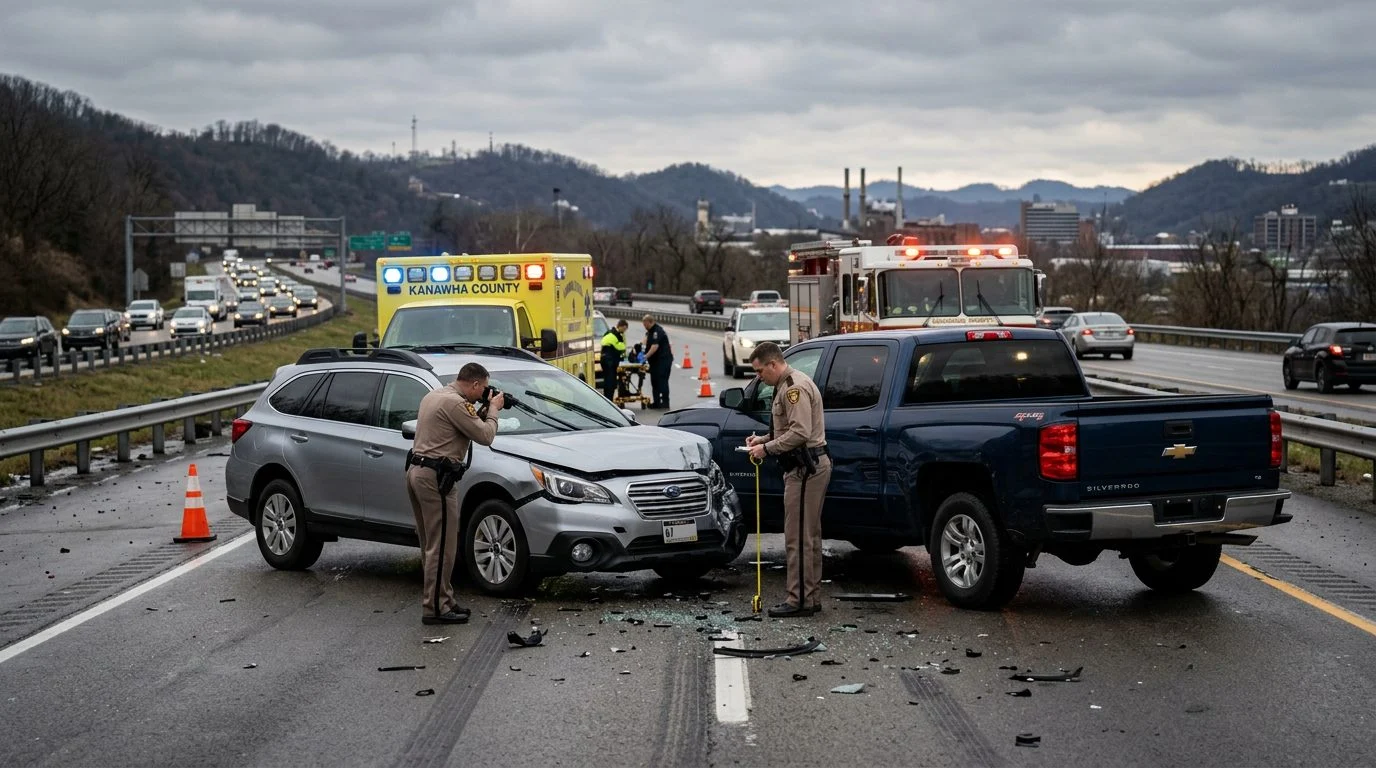
Car accidents on I-79 | West Virginia
Hurt on I-79? Know your next steps.
A crash on a busy interstate can bring injuries, time away from work, and hard questions about what happened. Here is how to protect your health and your options.
Published November 21, 2026
If you were hurt in an I-79 car accident, the first days can feel like a blur. Here’s the short answer to what to do next: stop, protect yourself, get checked by a medical provider, report the crash, keep records, and learn which deadlines may apply.
This page walks through those steps in order, in general terms.
Why Crashes on Interstate 79 Can Be Especially Serious
An I-79 crash can be serious because the highway mixes fast passenger vehicles with heavy commercial trucks. Interstate 79 runs through several regions we serve, including Charleston, Clarksburg, Fairmont, and Morgantown.
On a limited-access highway, one collision can involve more than two vehicles. A truck that brakes suddenly or swerves can start a chain reaction. Drivers may have little room to stop when traffic slows fast.
Some injuries, including brain injuries and spinal cord injuries, are not obvious right away. Shock and adrenaline can hide symptoms for a while. That is why the steps below matter even when the crash seemed minor.
If you were hurt on I-79 and symptoms are still developing, you don't have to work out the next steps alone, and we can talk through what happened. Talk it through with Big Bubba — the first case review is free, confidential, and carries no obligation.

Immediate Safety Steps at the Crash Scene
Your first job is to protect yourself and everyone else. If it is safe, move out of active lanes, turn on your hazard lights, and check on every person in every vehicle. Call 911 so medical responders and law enforcement are sent to the scene.
Avoid moving anyone who may have a neck or back injury unless they are in immediate danger. Let responders make that call when they arrive. Moving someone with a spinal injury can make the injury worse.
West Virginia law generally requires a driver in a crash with injuries to stop at the scene and stay until the required duties are met (W. Va. Code § 17C-4-1). Those duties include giving your name, a valid phone number, your vehicle details, and proof of insurance (W. Va. Code § 17C-4-3).
If anyone was injured, a driver generally must also give reasonable help. That can include arranging transport to a doctor or hospital when treatment is apparent or requested (W. Va. Code § 17C-4-3).
Do not admit fault or guess at what caused the crash. Stick to plain facts. If another driver was at fault, the police report and other evidence can help show it.
Getting a Medical Evaluation, Even When Symptoms Seem Mild
See a medical provider the same day if you can, even if you feel fine. Some symptoms of a concussion or soft-tissue injury can show up hours or days after a crash.
Tell every provider about every symptom. Include headaches, dizziness, confusion, numbness, tingling, trouble sleeping, and changes in mood or memory. Describe how the crash happened, in plain words.
Keep copies of every record, test result, prescription, and follow-up plan. These papers show the injury and the care that followed. Gaps in treatment can make it harder to connect later symptoms to the crash, so keep your follow-up visits when they are recommended.
If pain or other symptoms start weeks or months later, our guide on pain that develops months after a car accident explains delayed symptoms in general terms.
Obtaining the Police Crash Report
The investigating officer writes a crash report for a motor vehicle crash on the public streets or highways of West Virginia that results in bodily injury to, or death of, any person or total property damage to an apparent extent of $1,000 or more. It records the parties, the vehicles, and the conditions at the scene. Ask the responding agency for the report number, and ask how to request a copy.
State law requires the investigating officer to prepare the report within 24 hours after finishing the investigation for crashes on public roads that result in bodily injury to, or death of, any person or total property damage to an apparent extent of $1,000 or more (W. Va. Code § 17C-4-7). If the investigation takes longer than 10 days, a preliminary report goes to the Division of Highways on the tenth day. Within 24 hours of the crash, the officer must also share owner, operator, and insurance information with the other parties on request, at no cost.
When you get the report, read it closely. Check names, insurance details, vehicle information, and the description of what happened. Write down any errors and ask for corrections. For more detail, see our guide on requesting West Virginia State Police traffic records.
Preserving Evidence and Keeping Careful Records
Evidence can disappear quickly. Cars get repaired or towed, and skid marks fade. Photograph vehicle damage, the roadway, lane markings, the weather, and any visible injuries from several angles while the scene is still open.
Write down witness names and phone numbers. Record what each person said as soon as you can, while memories are fresh.
Start a daily journal. Note symptoms, missed work, medications, and everyday tasks that the injuries make hard. A journal can show how the crash changed your daily life. Save damaged property, text messages, and photos from the day of the crash.
Some insurers may dispute a claim or ask for a recorded statement. West Virginia law restricts some settlement talks and statements in the first 20 days after an injury, in certain situations (W. Va. Code § 55-7-11a). Before you give a statement to anyone about your injury, you can contact the firm to request a free case review.
Understanding That Filing Deadlines Apply
West Virginia generally allows two years to file a personal injury lawsuit, and exceptions may apply. That period comes from W. Va. Code § 55-2-12, which covers personal injury and property damage claims.
Claims against a government body can follow different rules. Actions against a political subdivision, such as a county or city, generally must be brought within two years, with some exceptions (W. Va. Code § 29-12a-6).
Wrongful death claims have their own timing. A wrongful death action generally must be started within two years after the death, and the personal representative of the deceased person’s estate brings it (W. Va. Code § 55-7-6).
Waiting can shrink the time you have to collect records, locate witnesses, and preserve evidence. Early action gives you more room to make informed decisions.
Not sure what your next step is?
Talk it through with Big Bubba — the first case review is free, confidential, and carries no obligation.

Next Steps After an I-79 Crash Involving a Truck or Serious Injury
When a commercial truck is involved, the trucking company’s records can matter. Federal rules generally require post-accident alcohol and drug testing for surviving drivers in certain crashes involving a commercial motor vehicle on a public road (49 C.F.R. § 382.303). If an alcohol test is not given within two hours, the employer must keep a record of the reason.
West Virginia law defines an “employer defendant” broadly. It can include the owner of a commercial motor vehicle, the operator’s employer, and others who hold legal control over the vehicle or driver (W. Va. Code § 55-7-32). That means more than one company may be involved in a single truck crash.
Under West Virginia Code § 55-7-6, a wrongful death action shall be brought by and in the name of the personal representative of the deceased person who has been duly appointed, and the section does not apply to deaths that occurred before July 1, 1988.
We serve injury victims across West Virginia, and we handle car, truck, commercial vehicle, catastrophic injury, and wrongful death matters. If you were hurt on I-79, especially in a truck crash or with symptoms still developing, you don’t have to sort out the next steps alone. You can contact the firm to request a free case review and talk through what happened.
Common Questions
Should I see a doctor if I feel fine after a crash?
Getting checked is generally a good idea, because some symptoms appear later. Your medical records also document your condition from the start.
Does the police report decide who was at fault?
Not by itself. The report records what the officer saw and was told, and other evidence may also matter.