
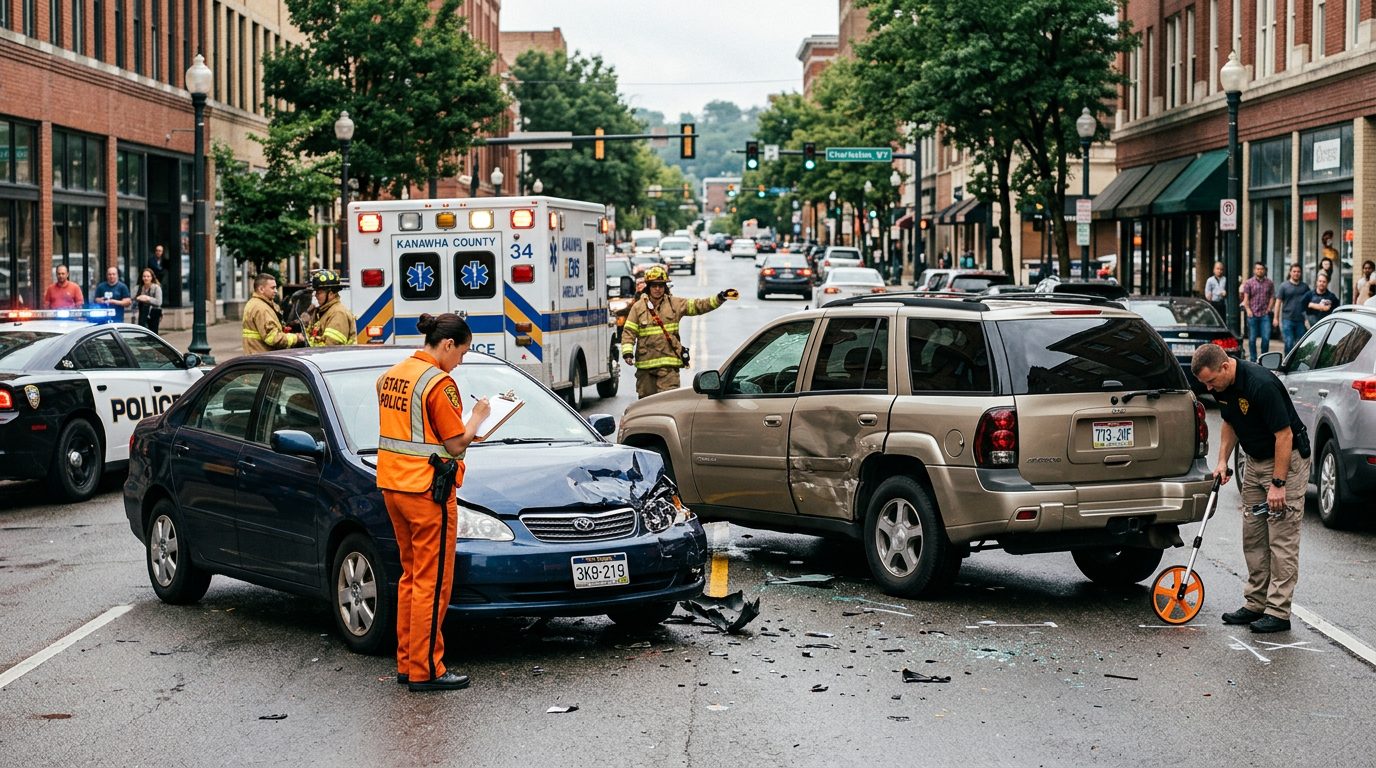
West Virginia Car Accidents
Hurt by an Out-of-State Driver in West Virginia? Know Who May Pay.
When the driver who hit you lives in another state, the questions get harder. Big Bubba Injury Law helps injured people and families across West Virginia understand their options after a crash.
Published October 28, 2026
Fault and insurance decide who pays after a crash with a driver from another state. The driver’s home address does not settle the question by itself. This guide covers the out of state driver car accident West Virginia questions people ask most: who may pay, how fault works, and what the claim process looks like. It is written for injured people and for family members trying to make sense of a crash nobody chose.
What Happens When an Out-of-State Driver Causes a West Virginia Crash
A crash on a West Virginia road is a West Virginia injury claim, even when the other driver lives elsewhere. The first questions are who caused the crash and how badly the injured person was hurt. Those answers shape every later step.
We serve injury victims across West Virginia, including Charleston, Huntington, Morgantown, Wheeling, Martinsburg, Parkersburg, Beckley, Clarksburg, Fairmont and Weirton. The firm handles car accidents, truck and commercial vehicle accidents, catastrophic injuries, traumatic brain injury, spinal cord injury, and wrongful death.
Time matters. Police records, vehicle damage, and witness memories change quickly, so early evidence is worth protecting.
If a driver from another state hurt you or someone you love, you may have a claim, and the firm can review it with you. Talk it through with Big Bubba — the first case review is free, confidential, and carries no obligation.
Who Pays: Insurance Across State Lines
Under West Virginia law, proof of financial responsibility for motor vehicles is defined in W. Va. Code § 17d-4-2.
The required amounts are minimums. Under W. Va. Code § 17d-4-2, proof of financial responsibility means $25,000 for one person’s injury or death in one accident, $50,000 for two or more people in one accident (subject to the one-person limit), and $25,000 for injury to or destruction of others’ property in one accident; a policy in effect on December 31, 2015 in the minimum amounts required in subdivision (a) of this section continues to provide adequate proof until the policy expires or is renewed.
Minimum limits can be far below the losses in a serious injury case. That gap is why other coverage sources matter.
- Commercial vehicles. The vehicle’s owner, carrier, or employer may hold coverage and may be part of the claim.
The firm looks at every available coverage source when it reviews a case.
How Fault Is Decided in West Virginia
West Virginia uses modified comparative fault, so each person’s share of fault affects the recovery (W. Va. Code § 55-7-13c).
Under W. Va. Code § 55-7-13c, your fault does not bar recovery unless it is greater than the combined fault of everyone else responsible. If your share is smaller, your recovery is reduced by your percentage of fault. Under W. Va. Code § 55-7-13c, if the plaintiff’s fault is less than the combined fault of all other persons, the plaintiff’s recovery shall be reduced in proportion to the plaintiff’s degree of fault.
The person who claims another driver was at fault must allege and prove that fault. See W. Va. Code § 55-7-13d.
Common proof includes traffic citations, witness statements, photos, vehicle damage, and the crash report. A driver’s home state is one fact among many. The crash location, the people involved, and the insurance all shape how the claim is analyzed.
Hit-and-Run and Reckless Driving Cases
A hit-and-run driver does not end a claim, but it may shift the claim toward your own insurance.
- Finding the driver. Police work, nearby cameras, vehicle damage, and witnesses can help identify a driver who left the scene.
- Uninsured coverage. If the driver is never found, or has no insurance, uninsured motorist coverage under W. Va. Code § 33-6-31 may be an important source of recovery, subject to the conditions in that section.
- Impaired driving. Under W. Va. Code § 55-7-13c, a driver whose conduct is driving under the influence, and is a proximate cause of the damage, is jointly and severally liable. Most defendants pay only their own share, so this rule matters.
- Commercial drivers. Under W. Va. Code § 55-7-32, the cap on noneconomic damages has listed exceptions, one of which applies when a commercial driver is found to have acted in willful or wanton disregard for safety.
Evidence of how the driver was operating, including reckless or impaired driving, can be central to the claim. Tell the investigating officer about any driver who left the scene.
Police Reports, State Police Records, and Medical Evidence
A police crash report and your medical records are two of the most important early records in these claims.
- The report. Local police, a county sheriff, or the West Virginia State Police may respond. Ask the agency that responded for a copy of the crash report.
- Errors. Check the report for wrong details, such as vehicles, lanes, or witnesses. Note any mistakes early.
- Medical care. Get checked even if you feel mostly fine. Some brain and spinal cord injuries show symptoms later. Keep records of emergency care, imaging, follow-up visits, and missed work.
Insurance adjusters may call early. Under W. Va. Code § 55-7-11a, for twenty days from the date of a personal injury, no person may negotiate a settlement, seek a release, or obtain a statement from the injured person while that person is an inpatient in any hospital or partially or totally unable to engage in his or her usual trade, profession or occupation. Requests for settlement statements are restricted too during that same twenty-day period, unless a person acting or intending to act for and on behalf of the injured person obtains the statement upon the express request of the injured person. An injured person may disavow a settlement or statement obtained in violation within one hundred eighty days from the date of the personal injury, by executing a written statement of disavowal and thereupon forwarding a copy of the same to the person violating this section; the settlement, release or statement then may not be admissible in evidence if any consideration paid is repaid or returned to the person who paid it at the time the copy is forwarded.
The Claim Process and Timeline, Step by Step
In any out of state driver car accident West Virginia claim, the stages are usually the same: medical care, records, insurer notice, investigation, demand, and, when needed, a lawsuit.
- Get medical care and keep records. Start with care, even when symptoms seem minor.
- Collect the crash details. Get the report number and the other driver’s insurance information. For commercial drivers, federal rules address drug and alcohol testing after an accident, as described in the FMCSA testing rules.
- Identify every party and insurer. Under W. Va. Code § 55-7-32, an employer defendant can include the vehicle’s owner, the operator’s employer, or anyone who controls the vehicle or driver.
- Investigate. Gather records, photos, witness statements, and medical opinions where the injury calls for them.
- Demand, negotiate, and file if needed. A demand goes to the insurer. If talks do not resolve the claim, a lawsuit may be filed in the proper court.
Deadlines matter. Personal injury claims generally must be brought within two years under W. Va. Code § 55-2-12. Under W. Va. Code § 55-7-6, a wrongful death action shall be brought by and in the name of the personal representative of the deceased person, and it shall be commenced within two years after the death of such deceased person, subject to the provisions of section eighteen, article two, chapter fifty-five. W. Va. Code § 55-7-6 reads: “The provisions of this section shall not apply to actions brought for the death of any person occurring prior to July 1, 1988.” Earlier steps often take months, and timing varies by case.
Not sure what your next step is?
Talk it through with Big Bubba — the first case review is free, confidential, and carries no obligation.
Frequently Asked Questions About Out-of-State Driver Crashes
Can I make an out of state driver car accident West Virginia claim against someone who lives elsewhere?
A claim can involve a driver from another state. The crash facts, including where it happened and who was involved, shape the details.
What if I was partly at fault?
Partial fault does not automatically end a claim. Your recovery is reduced by your share of fault, and it is barred only if your fault is greater than everyone else’s combined.
What if the other insurer denies the claim?
A denial does not end your options. Under W. Va. Code § 33-6-31, uninsured motorist coverage is part of the liability insurance policies that the statute governs, so your own uninsured motorist coverage may still apply. Whether your underinsured motorist coverage applies depends on your policy.
How long do I have to file?
Personal injury claims generally must be filed within two years (W. Va. Code § 55-2-12). A wrongful death claim must start within two years after the death, subject to the provisions of section eighteen, article two, chapter fifty-five (W. Va. Code § 55-7-6). The statute’s exception for deaths occurring before July 1, 1988 does not cover deaths occurring after that date.
Do I have to talk to the other driver’s adjuster right away?
Early statements can affect a claim, so take time before you answer. Under certain conditions, the law limits settlement negotiations, release requests and statement requests during the first twenty days after an injury (W. Va. Code § 55-7-11a), and an exception applies to statements taken on the injured person’s behalf at the injured person’s express request.

Questions to Consider After a Crash
If you are still recovering and unsure who pays, you are not alone in that position. Start by writing down what you remember while it is fresh: the time, the road, the other vehicle, and any witnesses. Keep the report number and every medical record together.
If another driver’s choices left you hurt or grieving, request a free case review or tell Bubba what happened.