
Truck Accidents | West Virginia
Protect the Proof After a West Virginia Truck Crash
Trucks leave a trail of records, and some of it can be lost quickly. Here is how to start saving it.
Published November 20, 2026
If a tractor-trailer hit you or someone you love in West Virginia, the proof of what happened may be the first thing to go. To preserve evidence after a truck accident, act early. Photograph the scene, get the police report, write down witness details, and send a written preservation request to the trucking company and its insurer.
Trucks create far more records and data than a typical car crash. Much of it sits on schedules set by the company. Some of it can be changed, repaired, or erased. Here is what matters, who usually holds it, and why timing counts.
Why Evidence in a Truck Crash Can Disappear Quickly
Evidence in a truck crash can be lost through normal business routines, so early action matters. A tractor-trailer is a working asset. After a crash, the truck may be towed, repaired, and back on the road within days. Damaged parts may be thrown away. Electronic data stored on the truck may be overwritten as the vehicle keeps running.
How fast this happens depends on the company, the type of record, and the facts of the crash. Large carriers and small carriers may keep records differently. Some data is stored for a short time. Other records may last longer. Nobody can say in advance which items will survive. Your first steps are simple: note the truck’s identifying details, keep your own records, and put every request in writing so there is a clear record of what you asked for and when.
If a semi truck crash left you or someone you love hurt, the truck's records may be at risk, and you don't have to sort that out alone. Reach out to us for a free case review. Talk it through with Big Bubba — the first case review is free, confidential, and carries no obligation.

The Truck and Its Electronic Data
Most modern trucks store crash-related data electronically. The engine control module may record speed, throttle, and braking data around the time of a crash. The NHTSA on event data recorders guidance explains that these recorders may preserve pre-crash, crash, and driver-input information.
Electronic logging devices, or ELDs, may show a driver’s hours of service and duty status. Federal rules generally say a motor carrier must not alter or erase, or permit or require alteration or erasure of, the original hours-of-service information, the source data streams used to provide that information, or information contained in any ELD that uses the original information and HOS source data. You can read the federal ELD record rules directly.
Dash cameras may capture a crash. Some systems save footage only when a collision triggers them. Others may overwrite older footage unless someone saves it. Ask for the footage in your written request, and ask the company to save it.
The truck itself may matter, too. Brakes, tires, lights, and damaged parts may show their condition at the time of the crash. Where possible, ask that the truck and damaged parts not be repaired, sold, or scrapped until they can be inspected. Put that request in writing.
Trucking Company and Driver Records
Several kinds of records may matter. These include driver qualification files, hiring and training records, prior violations, maintenance and inspection logs, and dispatch and trip records. Federal rules set minimum keep times for some of them. A driver qualification file generally must be kept while the driver works for the carrier and for three years after, under the federal driver file rules. Records of duty status must be kept at least six months from the date of receipt, under the federal duty status rules.
These are minimums, not promises. For companies subject to the federal records retention rules, records may be destroyed at the discretion of company management after the retention periods those rules set, but those rules do not excuse a company from following any other government body’s lawful requirements to keep records longer, as the federal records retention rules explain. A written request puts the company on notice that a record matters to your claim.
The federal post-accident testing rules list the conditions that trigger testing. If an alcohol test is not given within two hours following the accident, or a controlled substances test within 32 hours, the employer must keep a written record of the reasons. The FMCSA testing requirements page covers when testing may be required.
Some insurers may dispute a claim, so requesting these records early can matter.
The Crash Scene, the Police Report, and Witnesses
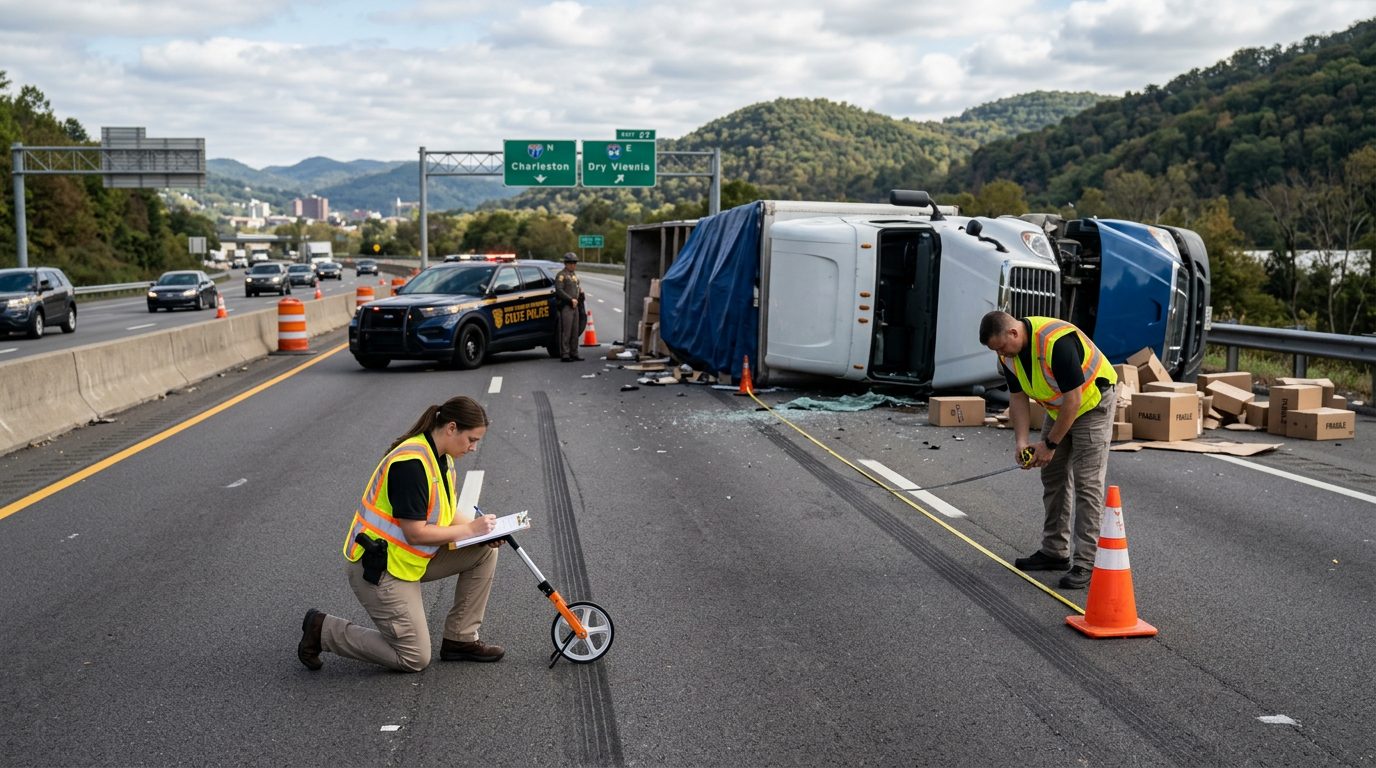
The scene holds some of the most useful evidence, and the police report is often the first document to request. If you can do so safely, photograph vehicle positions, skid marks, debris, road conditions, and signs. Photograph the truck’s company name, unit number, and license plate.
West Virginia law requires a driver in a crash resulting in injury, death, or damage to any vehicle driven or attended by any person to give their name, a valid telephone number, the year, make, model and last four digits of the vehicle identification number, and proof of security and financial responsibility, when physically able. The driver must also help an injured person get medical care, if able. See the West Virginia crash duty rules.
Under the West Virginia crash report law, an investigating officer must prepare a report within 24 hours after finishing the investigation. This applies to crashes occurring on the public streets or highways of this state involving bodily injury, death, or total property damage to an apparent extent of $1,000 or more. Within 24 hours of a motor vehicle crash, the investigating officer must provide the owner, operator, and insurance information, upon request, to each of the other involved parties and to each party’s insurance agents, at no cost. Asking the investigating agency for a copy is a common first step.
Witness names and phone numbers can be hard to find later, especially after people go home. Write them down early, with a short note about what each person saw.
Your Own Evidence: Photos, Medical Records, and Daily Records
Keep everything that shows your injuries, losses, and treatment. Photograph injuries as they heal, vehicle damage, and damaged personal property. Save receipts for medical care, prescriptions, rides to appointments, and repairs. Keep originals and copies in one folder.
Medical records document diagnosis and treatment over time. Early tests may not show the full picture, especially with brain and spinal cord injuries. Follow-up records may matter because they show how symptoms changed and what care followed. Keep every discharge summary, appointment note, and bill.
A simple daily journal helps, too. Note symptoms, pain levels, tasks you could not finish at work or home, and missed appointments. Write dated entries by hand or on your phone. Memory fades, and a dated note can show what daily life looked like.
Sending a Written Preservation Request
A written preservation request asks the trucking company and its insurer to keep the truck, its records, and its data. Some people call it a litigation hold or a spoliation letter. A strong request usually lists the truck and trailer identification numbers, the driver’s name, the date and place of the crash, and the categories of records and data.
Ask the company to keep electronic logging data, engine module data, dash camera footage, maintenance logs, driver files, testing records, dispatch records, and damaged parts. Keep a copy of the letter and proof of delivery.
If evidence is lost, a court may look at what happened. How a court handles lost evidence depends on the facts.
Timing matters. Electronic data and paper records can be overwritten or discarded on their own schedules. A request sent after the truck has been repaired may reach a record that has already changed. Sending it early protects more of what you need.
Not sure what your next step is?
Talk it through with Big Bubba — the first case review is free, confidential, and carries no obligation.

Time Limits and Your Next Step
West Virginia generally allows two years to file a personal injury claim under W. Va. Code § 55-2-12. Exceptions may apply, so timing should be reviewed promptly.
Under W. Va. Code § 55-7-6, it must be commenced within two years after the death, subject to the provisions of section eighteen, article two, chapter fifty-five. W. Va. Code § 55-7-6 reads: “The provisions of this section shall not apply to actions brought for the death of any person occurring prior to July 1, 1988.”
Evidence has its own clock. Company records can be discarded on schedule, and truck data can be overwritten. Acting early keeps more options open while the truck and records still exist.
If your crash involved a truck that may be repaired soon, or records that may be discarded, the firm can talk through what to request and how to request it. We serve injury victims across West Virginia, including Morgantown and Charleston. Request a free case review to start that conversation.
Related practice areas
- Traumatic Brain Injury from Car and Truck Accidents in West Virginia
- Can You Sue a Trucking Firm After a Crash in West Virginia?