
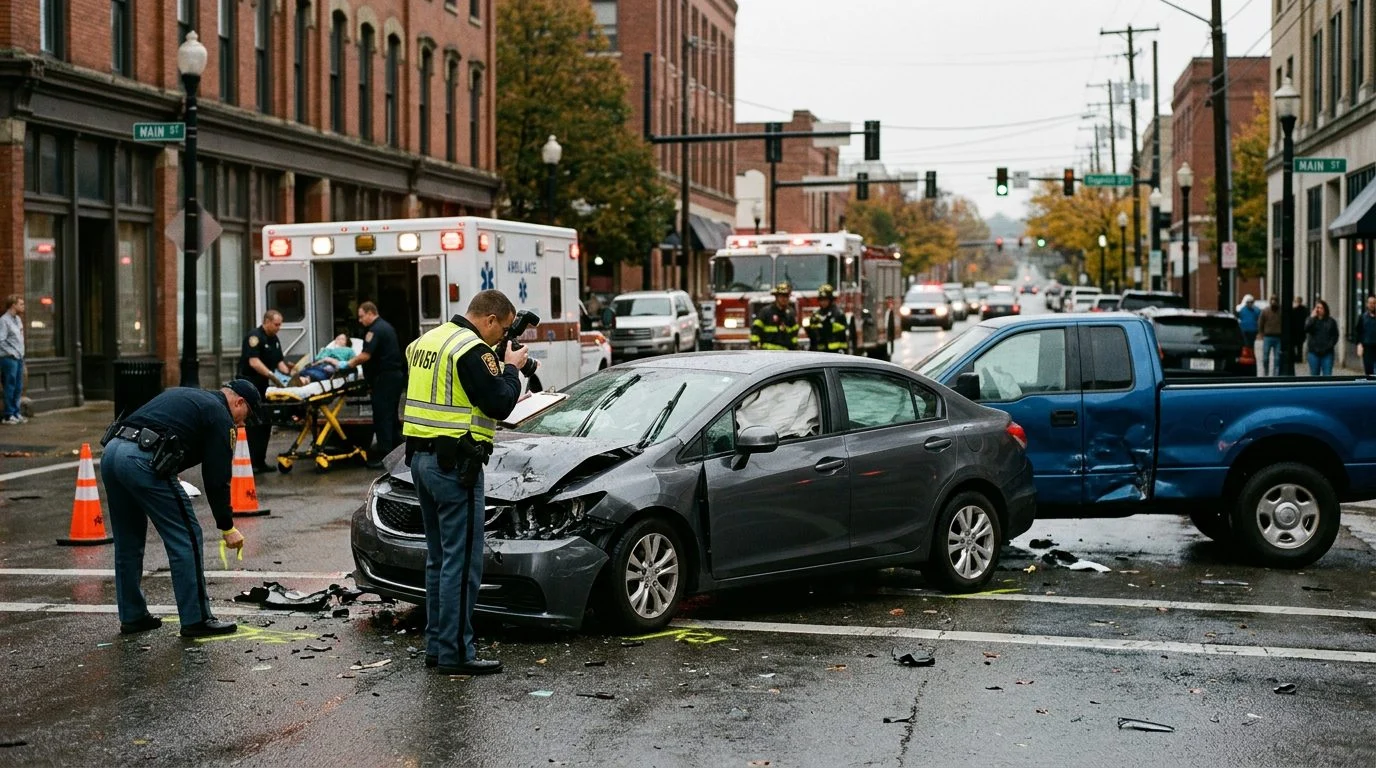
West Virginia Car Accident Claims
When the At-Fault Driver's Insurance Isn't Enough
Underinsured motorist coverage may help injured people in West Virginia when the other driver's policy limits fall short. Learn how it works and what to consider after a crash.
Published November 3, 2026
Underinsured motorist (UIM) coverage is part of your own auto insurance. It may pay your injury losses when the at-fault driver had insurance, but the limits were not enough. This guide explains how the coverage works in West Virginia, what to check on your policy, and which records matter most.
What Underinsured Motorist Coverage Is and How It Differs From Uninsured Coverage
Underinsured motorist coverage is a part of your own policy that may pay what the at-fault driver’s insurance does not. When the owner or operator of a vehicle that caused bodily injury or property damage is unknown, the statute permits, under the conditions it sets out, a suit naming that unknown owner or operator as “John Doe” in the county where the accident took place or in another county where the action would be proper (W. Va. Code § 33-6-31). Subsection (c) of § 33-6-31 sets out when a vehicle counts as uninsured: where the required bodily injury and property damage liability coverage is absent, where the insurer writing the policy denies coverage, or where no certificate of self-insurance exists. A vehicle is likewise treated as uninsured when its owner or operator is unknown. Under W. Va. Code § 33-6-31, a motor vehicle is underinsured when liability insurance applies to it at the time of the accident, but the limits of that insurance are less than the limits the insured carried for underinsured motorists’ coverage, or have been reduced by payments to others injured in the accident to less than those limits. The limits may also be lower because payments went to others hurt in the same crash.
That point is worth bringing into any review.
Uninsured motorist (UM) coverage works differently. It applies when the at-fault driver’s vehicle is uninsured under the statute’s definition: the required bodily injury and property damage liability coverage is absent, its insurer denies coverage, or it has no self-insurance certificate; a vehicle is also treated as uninsured if its owner or operator is unknown. W. Va. Code § 33-6-31 defines an underinsured motor vehicle as one with liability insurance applicable at the time of the accident, but whose limits are either less than the limits the insured carried for underinsured motorists’ coverage or have been reduced by payments to others injured in the accident to limits less than those the insured carried. Many policies list both coverages together. How each one applies may depend on the wording of your policy.
Not sure what your next step is?
Talk it through with Big Bubba — the first case review is free, confidential, and carries no obligation.
When the At-Fault Driver’s Limits May Fall Short
Liability limits are the most an at-fault driver’s insurer will pay for injuries and property damage. Serious crashes can produce losses above those limits. The gap can be large.
Losses that may exceed a low limit include emergency care, hospital stays, surgery, rehabilitation, lost income, and ongoing care. A traumatic brain injury or spinal cord injury can bring long-term needs, and recovery may take time. The West Virginia Offices of the Insurance Commissioner lists minimum bodily injury limits of $25,000 per person and $50,000 per accident. A driver who carries only the minimum may leave a serious injury underfunded.
Commercial vehicles can carry different coverage. Federal rules set minimum financial responsibility levels for some for-hire carriers. The schedule of limits in 49 C.F.R. § 387.9 lists $750,000 for certain nonhazardous property carriers in interstate commerce. Those figures are minimums. The coverage on a particular truck depends on its carrier.
When the other insurer offers less than your losses, your own policy may be worth reviewing, depending on the facts.
Checking Your Own Policy for UIM Coverage
Start with your declarations page. This summary lists your coverages and limits. The full policy then explains the definitions and conditions.
Look for these items:
- Whether UIM or UM coverage appears on the policy, and at what limits.
- Any written offer or rejection of UIM coverage your insurer sent you.
- The definitions of an underinsured or uninsured vehicle, since the exact wording matters.
- Any endorsements or changes made at renewal.
Two policies can read differently, even when they look alike at first glance. Keep copies of the full policy, the declarations page, and every letter from your insurer in one folder. Do this early, before the claim gets busy.
Filing a UIM Claim: What the Process Generally Involves
A UIM claim generally starts with notice to your own insurer. You then share the crash details, your medical information, and what you know about the at-fault driver’s coverage and limits.
The claim may involve negotiation. Disagreements can come up about the value of your injuries, the care you need, or what the policy covers. The timing of each step varies. It depends on the facts and the insurers involved.
West Virginia also limits some early settlement contact. W. Va. Code § 55-7-11a restricts certain settlement talks, releases, and statements for 20 days after a personal injury. The restriction applies while the injured person is in the hospital or unable to work. Under W. Va. Code § 55-7-11a, a settlement, release of liability or statement entered into, obtained or made in violation of that section may be disavowed by the injured person at any time within one hundred eighty days from the date of the personal injury, by executing a written statement of disavowal and forwarding a copy to the person who violated the section; the settlement, release or statement may not be admissible in evidence if any consideration paid is repaid or returned to the person who paid it at the time the copy is forwarded.
Respond promptly to requests from your insurer. Keep a log of every call, letter, and email, with dates and the names of the people you spoke with.
Do Insurance Companies Go After Underinsured Drivers?
An insurer that pays a claim may sometimes try to recover that money from the at-fault driver. Lawyers call this subrogation. The insurer steps into the injured person’s rights against the other driver for the amount it paid.
Some insurers may dispute a claim. The at-fault driver may also have limited personal assets. Either can affect how recovery is pursued. Whether an insurer goes after a driver depends on the policy terms and the facts of the crash.
Your own claim and any insurer’s recovery effort are separate steps. Each can raise its own questions. Keep your records clear, so your side of the story stays accurate. These questions can be part of a review of your claim.
Suing the At-Fault Driver Directly
A person hurt in a crash may be able to sue the at-fault driver directly, depending on the facts. A lawsuit can run alongside an insurance claim, or come after one.
West Virginia generally allows two years to file a personal injury lawsuit, and exceptions may apply. See W. Va. Code § 55-2-12. Waiting can shorten the time you have to act.
Fault can be shared. West Virginia allocates fault by percentage among everyone who contributed to the harm. See W. Va. Code § 55-7-13a. A finding that you were partly at fault can change what you recover.
Commercial truck cases can involve more parties. See McCormick v. W. Va. Dep’t of Pub. Safety.
Wrongful death follows its own rules. It generally must be started within two years after the death, under W. Va. Code § 55-7-6. The damages and distribution rules differ from an injury claim.
Not sure what your next step is?
Talk it through with Big Bubba — the first case review is free, confidential, and carries no obligation.
Records That Support an Underinsured Motorist Claim
Records gathered early often shape how a claim is documented. Keep the crash report, photos, witness names and contact details, and any video you can find. Save every medical record, bill, and receipt. Keep proof of missed work and pay records that show lost income.
Symptoms of a brain or spinal cord injury can appear or worsen days after a crash. Follow-up care and written notes from each visit help show that timeline. Our page on injuries that worsen after a car accident covers this in more detail.
Surgery records and imaging help show the extent of an injury. Our page on car accident surgery and medical records explains what to keep.
For commercial truck crashes, the records differ. A motor carrier must keep records of duty status for at least 6 months from the date of receipt. See 49 C.F.R. § 395.8. Federal rules may also require drug and alcohol testing after some commercial vehicle crashes, according to the FMCSA.
For broader information on these injuries, see our traumatic brain injury accidents page.

Talking With the Firm About Your Underinsured Coverage Question
Your question often comes down to two things. One is the at-fault driver’s limits. The other is the wording of your own policy. The firm handles car accident, commercial vehicle, and truck accident claims for people across West Virginia, including questions about UIM coverage.
Picture this. The other driver’s insurer has made an offer. Your medical care is still going on. You are not sure whether your own UIM coverage applies.
Common Questions
What is underinsured motorist coverage?
It is part of your own auto policy that may pay when the at-fault driver’s insurance limits are too low. West Virginia’s framework is in W. Va. Code § 33-6-31.
Can my own insurance pay if the other driver’s policy is not enough?
It may, depending on whether your policy includes UIM coverage and how that coverage is worded.
If the other driver’s insurance may not cover your medical bills and lost wages, your own policy may still apply. The firm can look at your crash details and your policy together in a free case review, and explain possible options depending on the facts.