
West Virginia Car and Truck Crash Claims
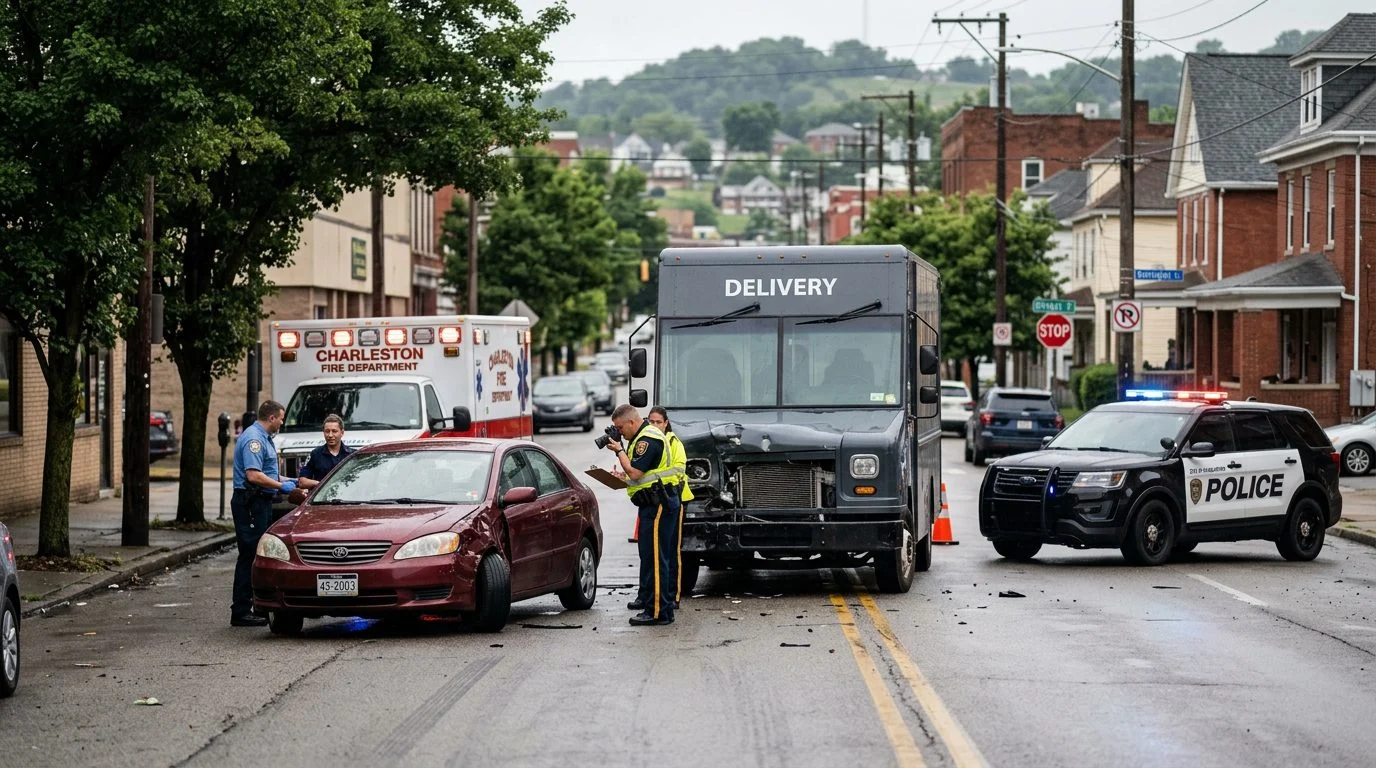
Company Vehicle Hit Me in West Virginia? Who May Be Liable
Plain-language answers for injured people and families across West Virginia, from the first days after a crash to the questions that come after.
Published November 20, 2026
If a company vehicle hit you in West Virginia, you may be hurt, your car may be damaged, and an insurance adjuster may already be calling. That is a lot to handle at once.
In many cases, the company that employs the driver may be liable, and other parties may be too. This page explains, in plain language, some of the questions people ask after a commercial truck crash.
When the Driver Was Working: How an Employer May Be Responsible
In many cases, the employer may be responsible when its driver was doing the job.
It is a common law idea that an employer may answer for an employee’s negligent driving when the employee was acting within the scope of employment.
West Virginia’s commercial vehicle statute uses broad terms.
Work driving that may fall within the scope of the job includes deliveries, service calls, travel between job sites, and errands the employer directed. A driver who was doing any of these tasks may have been on the company’s business at the time of the crash.
The driver may also be personally responsible. In a single case, the company and the driver may both be named. Under W. Va. Code § 55-7-13d, nothing in the fault statute stops a person from being held liable for fault assigned to an agent or servant who was acting for that person.
If a company vehicle hit you or someone you love, we're glad to talk through who may be responsible in a free case review. Talk it through with Big Bubba — the first case review is free, confidential, and carries no obligation.

When the Driver Was Off the Clock: Scope of Work and Personal Trips
A personal errand in a work vehicle raises a harder question: was the driver still doing the job?
Courts and insurers often look at a set of facts. These include the purpose of the trip, whether the driver had permission to use the vehicle, whether the driver was on the clock, and the route taken. A short detour can look very different from a long trip made for personal reasons.
A personal trip does not always end the company’s role. The answer turns on the specific facts, and some companies still carry insurance that may respond.
Start writing things down as soon as you can. Note what the driver said about where they were going, the time, and who else was in the vehicle. Also record the company name and any vehicle number on the door or bumper. Details are easiest to recall while they’re fresh.
A common mistake is assuming a personal errand ends the claim. Another is accepting a verbal explanation without checking it. Neither assumption is safe to rely on.
Direct Claims Against the Company: Hiring, Training, Supervision, and Maintenance
Some claims target the company’s own choices, not only the driver’s conduct.
Training and supervision may also come up in these claims.
Maintenance can matter too. Federal rules require motor carriers to systematically inspect, repair, and maintain the vehicles they control. See 49 C.F.R. § 396.3. Those rules also set minimum retention periods for maintenance records, including one year.
Under 49 C.F.R. § 391.51, a motor carrier keeps a driver qualification file for each driver, and that file generally must be kept while the driver works for the carrier and for three years after. These records can show what the company knew, so ask for them early and in writing.
Other Parties Who May Share Responsibility
Other parties may share responsibility, including those who owned, repaired, loaded, or arranged the trip.
Under W. Va. Code § 55-7-13c, each defendant’s liability for compensatory damages is generally several only. That means each defendant is generally liable for its own share of fault. Joint liability may be imposed in narrow situations, such as when two or more defendants consciously conspire and deliberately pursue a common plan or design to commit a tortious act or omission.
The vehicle owner or leasing company may be a different entity from the employer. It may have its own role in the claim.
A repair shop or maintenance contractor may be a party if its work may have contributed to a mechanical failure. A loading company or equipment provider may be a party if a load was not properly secured or a part was defective.
A freight broker that chose the carrier may also be a party. See Montgomery v. Caribe Transport II.
Insurance That May Apply After a Company Vehicle Crash
More than one insurance policy may respond after a company vehicle crash.
A company vehicle is often covered by a commercial auto policy. These policies may carry different limits and claim steps than a personal auto policy. The driver’s personal policy may also respond in some situations, and so may your own coverage.
Your own policy may matter more than you expect. West Virginia law generally requires motor vehicle policies to include uninsured motorist coverage, and drivers may buy underinsured motorist coverage. See W. Va. Code § 33-6-31. That coverage may apply when the at-fault driver has no insurance or too little.
Some insurers may dispute a claim or ask for a recorded statement. It may help to speak carefully, write down what was said, and keep copies of everything you receive.
How Fault Is Generally Proven in West Virginia
Who acted carelessly, and did that carelessness cause the harm?
West Virginia uses modified comparative fault. Under W. Va. Code § 55-7-13c, a plaintiff’s own fault does not bar recovery unless it is greater than the combined fault of all other persons responsible. Otherwise, the recovery is reduced in proportion to the plaintiff’s fault.
Several kinds of evidence may bear on fault. Police crash reports, photographs, witness statements, vehicle data, and driver logs are common examples. A citation or crash report may be relevant, depending on the facts.
Some injuries need prompt medical evaluation, including numbness, weakness, severe headaches, or bleeding. Getting care early also creates a record that connects the injury to the crash. Your doctor can explain what your own recovery may look like.
Not sure what your next step is?
Talk it through with Big Bubba — the first case review is free, confidential, and carries no obligation.
Deadlines and Steps to Take Now
West Virginia generally allows two years to file a personal injury lawsuit, and exceptions may apply. See W. Va. Code § 55-2-12. That statute applies to personal actions where no other limit is set.
If a government entity was involved, a different rule may apply. Under W. Va. Code § 29-12a-6, actions against a political subdivision generally must be brought within two years after the claim arose or after the injury was discovered or reasonably should have been discovered, whichever is later, unless a shorter period applies, and special rules apply to young children. A city or county vehicle is one example.
Take these steps now. Get medical care and keep every bill, letter, and receipt. Photograph the scene, both vehicles, and any company name or phone number on the door. Save texts, emails, and photos. Write down what you remember while it is fresh.

Reviewing Your Situation With the Firm
If a company vehicle hit you or someone you love, you may be dealing with pain, a damaged car, and an adjuster’s calls all at once. You do not have to sort out who may be responsible on your own.
Big Bubba Injury Law handles car accident, truck accident, and commercial vehicle claims across West Virginia. We serve Charleston injury victims, Huntington injury victims, and families throughout the state. We also handle catastrophic injuries, traumatic brain injury, spinal cord injury, and wrongful death cases.