
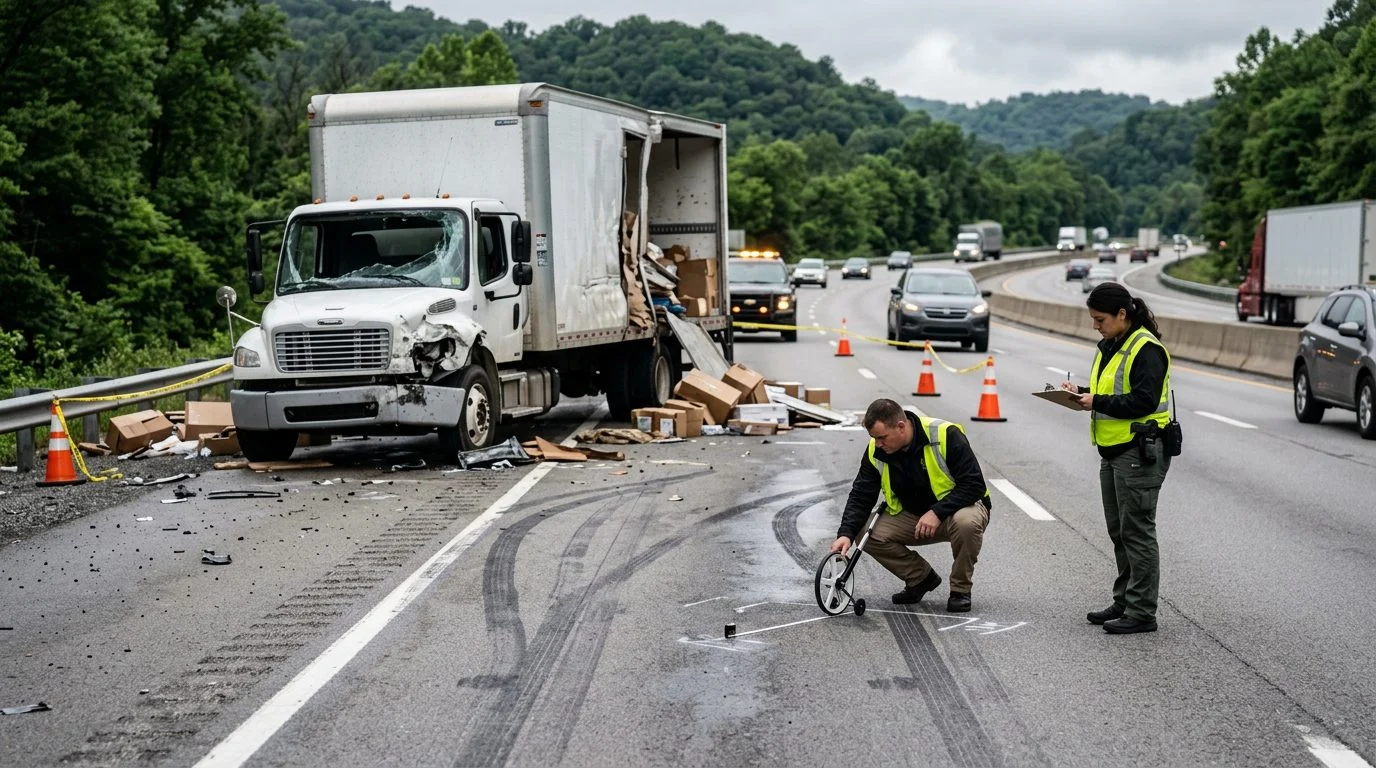
Delivery Truck Accidents | West Virginia
Hurt in a Delivery Truck Crash? Talk With Our Firm About What Happened
Big Bubba Injury Law represents people seriously injured in car and commercial truck crashes, and families in wrongful death cases, across West Virginia. Start with a free case review.
Published October 31, 2026
A delivery truck accident lawyer in West Virginia helps people hurt by box trucks, step vans and cargo vans on local roads. If one of these vehicles hit you or a family member, the firm can review what happened and who may be responsible. Big Bubba Injury Law represents people seriously hurt in car and commercial truck crashes, people with catastrophic brain and spinal cord injuries, and families in wrongful death cases. We serve injured people in all 55 West Virginia counties, including Charleston, Huntington, Morgantown, Wheeling, Martinsburg, Parkersburg, Beckley, Clarksburg, Fairmont and Weirton.
What a Delivery Truck Accident Involves on West Virginia Local Routes
A delivery truck accident is a crash involving a box truck, step van, cargo van or similar commercial vehicle. These crashes happen on city streets, neighborhood roads and rural routes, where the truck stops again and again.
Why local routes carry extra risk
- Frequent stops. Trucks pull to curbs, driveways and loading zones many times a day.
- Backing up. Drivers back into tight spaces where pedestrians and cyclists can be hard to see.
- Tight turns. Sharp turns on neighborhood streets leave little room for error.
- Blocked lanes. Double-parked vehicles push traffic into the wrong lane.
- Schedule pressure. A full route can push a driver to rush.
Who gets hurt
People in passenger cars, pedestrians, cyclists, the delivery driver and bystanders can all be injured. Many of these crashes involve a company, not only one driver. That changes who the claim is against, and it changes how the claim is built.
If a delivery truck hit you or someone you love on a West Virginia street, you may have a claim. The firm can review the crash with you during a free case review. Talk it through with Big Bubba — the first case review is free, confidential, and carries no obligation.

Who Can Be Held Responsible in a Delivery Truck Crash
More than one person or company can be responsible in a single crash. West Virginia law defines an “employer defendant” to include the owner of a commercial motor vehicle, the driver’s employer, and any entity that leases, rents or otherwise holds legal control over the vehicle or driver (W. Va. Code § 55-7-32). That definition matters when a delivery company uses leased trucks or contract drivers.
In most cases, each defendant pays only its own share of fault. The statute makes exceptions: joint liability may apply to two or more defendants who consciously conspire and deliberately pursue a common plan or design to commit a tortious act or omission, and a defendant whose DUI, criminal conduct, or illegal hazardous waste disposal was a proximate cause of the plaintiff’s damages is jointly and severally liable. That is why finding every responsible party early matters. Fault is assigned by percentage, and the injured person’s share is counted too (W. Va. Code § 55-7-13a).
West Virginia limits noneconomic damages in certain actions involving a commercial motor vehicle that requires a commercial driver’s license, and only for causes of action arising after July 1, 2024. Under W. Va. Code § 55-7-32, subsection (b) sets a maximum of $5 million for each occurrence on compensatory damages for noneconomic loss recoverable by each person injured or killed against an employer defendant in a civil action for personal injury or wrongful death involving the operation of a commercial motor vehicle requiring a commercial driver’s license. Under subsection (e), beginning January 1, 2026, that limitation increases to account for inflation by an amount equal to the Consumer Price Index published by the United States Department of Labor, not to exceed 150 percent of the amounts specified in subsection (b). It is not available if the employer lacks at least $3 million in commercial motor vehicle insurance for each occurrence, and it has other exceptions (W. Va. Code § 55-7-32). Under subsection (d) of W. Va. Code § 55-7-32, the section, including its limit on noneconomic damages, does not apply when a commercial motor vehicle case arises from an incident in which the operator or driver is found, among other circumstances the statute lists, to have operated the vehicle with an alcohol concentration of .04 or more, refused required testing after the incident, operated it in willful or wanton disregard for the safety of persons or property, operated it loaded beyond the maximum gross vehicle weight rating (except when legally operating under a permit issued under § 17C-17-11), or engaged in distracted driving at the time of the incident.
Injuries and Claims the Firm Handles Across West Virginia
A delivery truck accident lawyer in West Virginia can handle more than one type of claim. We handle car accidents, truck accidents, commercial vehicle accidents, catastrophic injuries, traumatic brain injury, spinal cord injury and wrongful death.
Brain injuries can affect memory, speech, work and daily life. Spinal cord injuries can lead to long-term care, therapy and equipment needs. Early medical records that show how the injury began can matter a great deal later.
A delivery truck crash that causes a death may give rise to a legal claim, depending on the facts. Separately, this is a personal injury rule, not a wrongful death rule: West Virginia Code § 55-7-11a provides that if a person sustains a personal injury, no person shall within twenty days from the date of the personal injury, while the injured person is either an inpatient in any hospital or partially or totally unable to engage in his or her usual trade, profession or occupation, negotiate or attempt to negotiate a settlement of any claim for such personal injury with or for and on behalf of the injured person. The law lists damages that can include sorrow, mental anguish and solace, lost income and services, care and treatment expenses, and reasonable funeral expenses (W. Va. Code § 55-7-6).
How a Delivery Truck Claim Works, Step by Step
A delivery truck claim usually starts with medical care and evidence, then moves to a free case review, filing and negotiation. Early steps protect both your health and your proof.
- Get medical care. Follow your treatment plan. Medical records link your injuries to the crash.
- Report the crash. Note the police report number. Write down what you remember while it is fresh.
- Save evidence. Keep photos, witness names, vehicle damage details and the company name on the truck.
- Review the case. The firm looks at the crash details, your injuries and possible parties during a free case review.
- Identify parties and records. The firm requests records and tracks insurance coverage on each side.
- File on time. The firm prepares and files the claim within West Virginia deadlines, covered below.
- Negotiate or try the case. The claim may settle or go to trial. Timing varies with the injuries and the facts.
Evidence That Matters in Delivery Truck Cases
The most useful evidence often comes from the truck’s records, the driver’s logs and post-crash testing. Except for a private motor carrier of passengers (nonbusiness), federal rules require motor carriers to record each driver’s duty status for every 24-hour period. Most drivers must use an electronic logging device (ELD), with some manual-recording exceptions (49 C.F.R. § 395.8). Those logs can show whether a driver had been on the road too long.
Under 49 C.F.R. § 392.3, no driver shall operate a commercial motor vehicle, and a motor carrier shall not require or permit a driver to do so, while the driver’s ability or alertness is so impaired, or so likely to become impaired, through fatigue, illness, or any other cause, as to make it unsafe to begin or continue to operate the commercial motor vehicle. However, in a case of grave emergency where the hazard to occupants of the commercial motor vehicle or other users of the highway would be increased by compliance with this section, the driver may continue to operate the commercial motor vehicle to the nearest place at which that hazard is removed (49 C.F.R. § 392.3).
Testing follows a set timeline. After certain crashes, the employer must test surviving drivers for alcohol as soon as practicable. That applies to a driver who was performing safety-sensitive functions with respect to the vehicle when a crash involves loss of life, or to a driver who receives a moving-violation citation within 8 hours of a crash that caused injury needing treatment away from the scene or a tow-away (49 C.F.R. § 382.303). If a controlled substances test is not given within 32 hours, the employer must stop trying and keep a record of why.
A common mistake is waiting. Phone photos, dashcam video and the company name on the truck are easy to lose. Save them early.
West Virginia Deadlines and Fault Rules to Know
Most personal injury lawsuits in West Virginia must be filed within two years after the right to bring the claim arises (W. Va. Code § 55-2-12). Wrongful death claims must be filed within two years after the death, subject to the provisions of section eighteen, article two, chapter fifty-five (W. Va. Code § 55-7-6). W. Va. Code § 55-7-6 reads: “The provisions of this section shall not apply to actions brought for the death of any person occurring prior to July 1, 1988.” If the injured person dies because of the crash, the claim can continue in the personal representative’s name (W. Va. Code § 55-7-8).
West Virginia uses modified comparative fault (shared fault). Your share of fault does not bar recovery unless it is greater than the combined fault of everyone else responsible. If it is smaller, your recovery shrinks by your share of fault (W. Va. Code § 55-7-13c).
Waiting can leave you with fewer options. The firm checks deadlines during every free case review.
Not sure what your next step is?
Talk it through with Big Bubba — the first case review is free, confidential, and carries no obligation.

Questions About Delivery Truck Crashes, Answered
Most questions come down to who is responsible, how fault is shared, and when to act.
Can I bring a claim if the delivery driver worked for a contractor?
Often, the company that owns, leases or controls the truck may be a party. The firm reviews those relationships in a free case review.
What if I was partly at fault?
West Virginia can still allow recovery unless your fault is greater than everyone else’s combined. Any recovery is reduced by your share of fault (W. Va. Code § 55-7-13c).
Should I talk to the delivery company’s insurer first?
West Virginia limits settlement talks and statements for 20 days after injury if you are hospitalized or unable to work. A settlement, release of liability or statement obtained in violation of this section may be disavowed by the injured person at any time within one hundred eighty days from the date of the personal injury by executing a written statement of disavowal and forwarding a copy of it to the person violating this section, in which case the statement is not admissible in evidence if any consideration paid is repaid or returned (W. Va. Code § 55-7-11a). Talk with the firm before you give any statement to an insurer.
Who can file a wrongful death claim?
The claim is brought by the personal representative of the person who died (W. Va. Code § 55-7-6). The firm can explain who may serve in that role in your situation.
Do I need a delivery truck accident lawyer in West Virginia right away?
You don’t have to decide today. A free case review is confidential and carries no obligation to continue, but deadlines keep running.
Tell Bubba what happened, and request a free case review with the firm.