
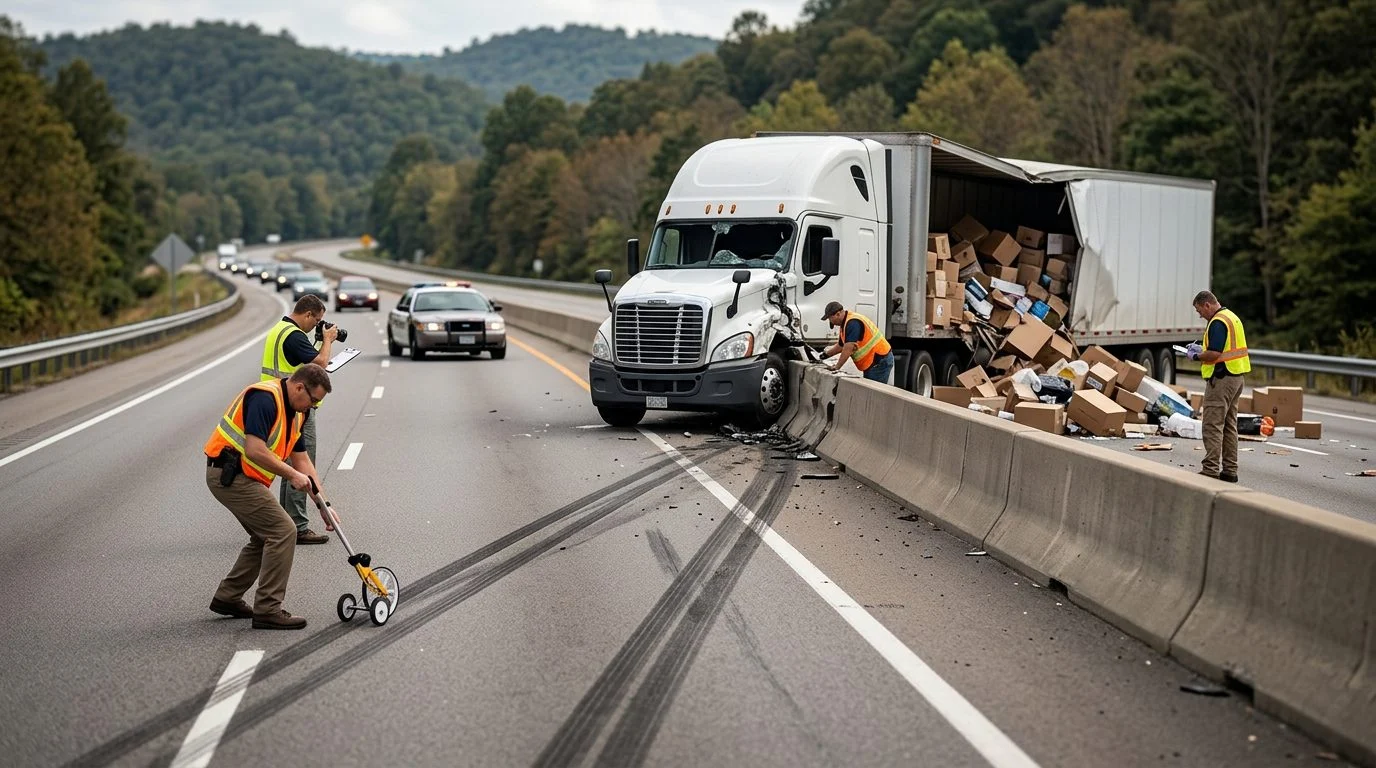
Truck Accidents | West Virginia
Serious Truck Crash? We Help You Recover.
When a commercial truck collision leaves you or a loved one with catastrophic injuries, Big Bubba fights to hold the responsible parties accountable. We focus on truck accidents, catastrophic injuries, and wrongful death across West Virginia.
Published October 01, 2026
Truck Accidents in West Virginia: Your Guide to Claims, Liability, and Recovery
Truck accidents in West Virginia cause injuries far more severe than typical car crashes because of the massive weight and force involved—commercial trucks can weigh over 80,000 pounds, and the impact forces are devastating. If you’ve been hit by a semi-truck, tractor-trailer, or commercial vehicle, you face not only physical recovery but also a complex legal claim involving federal regulations, multiple liable parties, and insurance companies with experienced defense teams. This guide explains what happens after a truck accident, who may be responsible, what injuries qualify for recovery, and why working with an attorney experienced in commercial truck cases matters.

Not sure what your next step is?
Talk it through with our team — the first case review is free, confidential, and carries no obligation.
Truck Accidents in West Virginia: What You Need to Know
Truck accidents are fundamentally different from car accidents because they’re governed by federal safety regulations that don’t apply to ordinary vehicles. The Federal Motor Carrier Safety Regulations (49 CFR) set strict rules for truck driver hours, vehicle maintenance, cargo loading, and equipment inspection, and a violation of these rules may be relevant evidence of negligence, but the violation must still be shown to have caused the harm.
Truck accidents can be caused by driver fatigue (a driver operating beyond the legal hours-of-service limit), improper vehicle maintenance (failed brakes, worn tires, defective coupling systems), unsafe lane changes, overloaded cargo that shifts during transit, and inadequate training. West Virginia’s mountain terrain and winding highways add complexity: steep grades, tight curves, and weather changes create conditions where a truck’s size and weight become especially dangerous.
The first hours after a truck accident are critical. Evidence disappears quickly. Witnesses leave the scene. The truck driver’s employer may already be collecting data from the vehicle’s electronic data recorder (black box). Police reports are filed. Medical records begin. Every decision you make in those initial moments—what you say to insurance companies, whether you document the scene, whether you seek immediate legal advice—affects your claim’s value and strength.
What Happens Immediately After a Truck Accident
Your immediate priority is safety and medical care, not the legal claim.
Get to safety. If you’re able to move, get yourself and passengers away from traffic and the roadway. If you cannot move, stay in your vehicle with seatbelts fastened and hazard lights on.
Call 911. Report the accident to emergency services. Provide your location, the number of vehicles involved, and whether anyone is injured. Police will respond and file an official accident report—this document becomes evidence in your claim.
Seek medical attention immediately, even if you feel okay. Truck accident injuries—especially traumatic brain injuries and spinal cord injuries—may not cause obvious symptoms right away. Internal bleeding, whiplash, and neurological damage develop over hours or days. Medical records created at the scene or shortly after establish the link between the accident and your injuries. This documentation is essential to your claim.
Document the scene if it’s safe to do so. Take photos of the truck, your vehicle, the road conditions, skid marks, debris, and traffic signs. Note the truck’s license plate, company name, and any visible damage. Get the names, phone numbers, and addresses of witnesses—people who saw the crash, not just the truck driver or company employees.
Report to your insurance company. Provide factual information about what happened, but do not speculate about fault or accept an early settlement offer. Insurance adjusters are trained to minimize payouts.
Do not sign anything or give a recorded statement without legal advice. The truck driver’s employer and their insurance company will contact you quickly, often with offers that sound fair but are far below what your claim is worth.
Understanding Liability in Truck Accidents
Liability in a truck accident is rarely simple. Multiple parties may be responsible, and under West Virginia law your own share of fault can reduce your recovery or, if it is large enough, prevent it.
The truck driver may be negligent if they were speeding, fatigued, distracted, impaired, or violated federal safety rules. Violations of 49 CFR—such as exceeding hours-of-service limits or failing to conduct required vehicle inspections—are powerful evidence of negligence.
The trucking company (the driver’s employer) is often liable under a doctrine called vicarious liability: the company is responsible for the driver’s negligent actions performed in the course of employment. Beyond that, the company itself may be negligent if it failed to hire qualified drivers, train drivers adequately, maintain vehicles properly, or enforce safety policies. A truck accident case can involve both driver negligence and corporate negligence.
Third parties may also be liable. A maintenance contractor who failed to repair faulty brakes, a cargo loader who overloaded or improperly secured freight, or a truck manufacturer whose defective part caused the crash can all be sued. Each potential defendant increases the sources from which you may recover damages.
Comparative negligence in West Virginia means that if you were partially at fault—for example, if you were speeding or changed lanes unsafely—your fault does not bar recovery unless it is greater than the combined fault of all other persons responsible for your damages (W. Va. Code § 55-7-13c). This rule makes thorough investigation and expert analysis critical: the insurance company will argue you were more at fault than you were, and a skilled attorney counters that argument with evidence.
Types of Injuries from Truck Accidents
The weight and speed of commercial trucks create impact forces that cause injuries far more severe than typical car crashes.
Traumatic brain injuries (TBI) result from the sudden acceleration, deceleration, or impact that occurs in a truck crash. A TBI can range from a concussion (temporary cognitive disruption, headache, dizziness) to severe closed-head injury (permanent neurological damage, loss of consciousness, coma). According to the National Institute of Neurological Disorders and Stroke (NINDS), TBI can cause long-term cognitive impairment, memory loss, difficulty concentrating, mood changes, and personality changes. Many truck accident survivors struggle with these invisible injuries for years.
Spinal cord injuries (SCI) occur when the force of the crash damages the spine. Depending on the location and severity of the injury, SCI can result in partial or complete paralysis. The National Spinal Cord Injury Statistical Center (NSCISC) documents that spinal cord injuries require lifetime medical care, mobility equipment, home modifications, and vocational retraining. The financial and personal impact is permanent.
Broken bones, internal injuries, and burn injuries are common in truck crashes. Ribs, legs, arms, and pelvis fractures often require surgery and months of rehabilitation. Internal bleeding, organ damage, and crush injuries can be life-threatening. Fires or explosions involving fuel or hazardous cargo cause severe burns.
Psychological trauma and post-traumatic stress disorder (PTSD) develop after surviving a life-threatening accident. Anxiety, depression, nightmares, and flashbacks are real injuries that require mental health treatment.
Catastrophic injuries permanently change your life. Paralysis, severe brain damage, amputation, permanent disfigurement, and loss of bodily function are catastrophic. These injuries require specialized medical care, ongoing therapy, assistive devices, and home care—costs that extend across your lifetime.
Damages You May Recover in a Truck Accident Claim
Damages are the money compensation you can recover from the liable party or their insurance company. West Virginia law recognizes several categories.
Medical expenses include emergency care, hospitalization, surgery, imaging, medications, rehabilitation, therapy, and future medical care. In catastrophic injury cases, lifetime medical costs can reach hundreds of thousands of dollars. Expert medical testimony often calculates these future costs.
Lost wages are the income you lost while recovering from your injuries. If your injuries prevent you from returning to your job, you may recover for loss of earning capacity—the difference between what you would have earned and what you can now earn in a reduced capacity.
Pain and suffering compensates you for the physical pain, emotional distress, and reduced quality of life caused by your injuries. There is no formula; the amount depends on the severity of your injuries and how they affect your daily life.
Permanent disability and disfigurement damages recognize that your injuries have permanently altered your body or function. Scarring, loss of limb, paralysis, and chronic pain all qualify.
Rehabilitation and therapy costs cover physical therapy, occupational therapy, vocational rehabilitation, and counseling necessary to recover function and adapt to your new circumstances.
Wrongful death damages are available to the family of someone killed in a truck accident. These include funeral expenses, loss of the deceased’s financial support, and loss of companionship.
Have questions about what happened?
Ask our team directly. The first conversation is free, confidential, and there is no obligation to continue.
Commercial Truck Accident Claims
Commercial trucking companies operate under a different regulatory framework than individual drivers. Understanding this framework is essential to your claim.
Federal law requires trucking companies to meet minimum levels of financial responsibility (49 U.S.C. § 31139), and records such as driver logs, vehicle maintenance records, inspection reports, and electronic data may be relevant evidence. These records are evidence. They show whether the driver exceeded legal hours-of-service limits, whether the truck was properly maintained, and what the truck was doing at the moment of the crash.
Insurance and regulatory oversight shape commercial truck accident claims—and they also mean the defense is sophisticated. Insurance companies and trucking companies employ experienced attorneys and accident reconstruction experts. They will investigate aggressively and argue liability away if they can.
Preserving evidence is urgent. Trucking companies may destroy or lose records if not formally notified to preserve them. Black box data can be overwritten. Vehicles are repaired or scrapped. Witnesses’ memories fade. An attorney experienced in commercial truck cases knows what evidence to demand and how to preserve it.
The Truck Accident Claim Process
After a truck accident, the claim typically follows this path:
Initial investigation. You (or your attorney) gather police reports, medical records, witness statements, photos, and information about the truck, driver, and company. Experts—accident reconstructionists, medical specialists—are retained to analyze the crash and your injuries.
Demand letter. Your attorney sends a detailed letter to the liable party’s insurance company describing the accident, the injuries, the damages, and the legal basis for liability. This letter opens settlement negotiations.
Settlement negotiations. The insurance company responds with a counteroffer. Back-and-forth negotiation may occur over weeks or months. Many cases settle during this phase.
Litigation. If settlement is not reached, your attorney files a lawsuit in West Virginia state court. Discovery (the exchange of documents and witness testimony) occurs. Depositions are taken. Expert reports are exchanged. The case may settle during litigation or proceed to trial.
Trial. If the case goes to trial, a jury hears evidence and decides liability and damages. The process can take months or years from accident to verdict.
Timeline expectations vary. Simple cases with clear liability may settle in months. Catastrophic injury cases with multiple parties and complex damages often take 1–3 years or longer.
Why You Need an Attorney for a Truck Accident
Truck accident cases are complex. Federal regulations, multiple liable parties, sophisticated insurance defense, and catastrophic injuries require in-depth knowledge.
Insurance companies employ adjusters and attorneys whose job is to minimize what they pay. They will contact you quickly, often within days, with settlement offers that sound reasonable but are far below what your claim is worth. Without an attorney, you may accept an offer that leaves you unable to pay for future medical care or lost income.
Investigating a truck accident requires access to records that aren’t public: driver logs, maintenance records, black box data, training records, and safety violation history. Trucking companies and insurers won’t voluntarily hand over this evidence. An attorney uses legal tools—subpoenas, discovery requests, and court orders—to obtain it.
Calculating damages in a catastrophic injury case requires expert testimony. Doctors, vocational rehabilitation specialists, life-care planners, and economists must testify about your future medical needs, earning capacity, and lifetime costs. Insurance companies will hire their own experts to argue your damages are lower. Your attorney coordinates expert testimony to support your claim.
Negotiating with experienced defense counsel requires knowledge of how similar cases settle, what juries award, and how to present your case persuasively.
Deadlines and Legal Requirements in West Virginia
West Virginia law imposes strict deadlines for filing a truck accident claim.
The statute of limitations for personal injury claims in West Virginia is generally two years from when the right to bring the claim accrues. If you do not file a lawsuit within two years after your right to sue accrues, your claim is generally barred, even if your case is strong, and exceptions may apply (W. Va. Code § 55-2-12). Wrongful death claims also generally have a two-year deadline that runs from the date of death, subject to the provisions of W. Va. Code § 55-2-18 (W. Va. Code § 55-7-6).
This deadline applies even if you’re still receiving medical treatment or haven’t fully recovered. Don’t wait. Consult an attorney well before the deadline approaches.
West Virginia applies comparative negligence: you may recover even if you were partially at fault, but your damages are reduced by your percentage of fault, and recovery is barred if your fault is greater than the combined fault of all other persons responsible (W. Va. Code § 55-7-13c). If you were 20% at fault and your damages total $100,000, you recover $80,000. This rule makes evidence and expert analysis critical—the insurance company will argue you were more at fault than you actually were.
Want to know where you stand?
Tell us what happened and our team will walk you through the options available to you, at no cost.
What to Do Right Now If You’ve Been in a Truck Accident
Seek medical care immediately, even if you feel okay. Truck accident injuries develop over time. Medical records created early establish the link between the accident and your injuries.
Document everything you remember about the crash: the truck’s speed, your speed, the road conditions, the truck’s movements, and what you saw and heard. Write it down while it’s fresh.
Gather contact information from witnesses who saw the crash. Get names, phone numbers, and addresses.
Keep records of all medical treatment and expenses. Photos, receipts, appointment notes, and prescription bottles are all evidence.
Do not accept an early settlement offer without legal advice. Insurance companies make low offers quickly, hoping you’ll accept before you understand your claim’s full value.
Talk with an attorney about your truck accident case. Commercial truck regulations, multiple liable parties, and catastrophic injuries can make these cases complex. An attorney can investigate, preserve evidence, calculate your damages accurately, and negotiate or litigate on your behalf.

Frequently Asked Questions
What is the statute of limitations for a truck accident claim in West Virginia?
Generally, you have two years after your right to sue accrues to file a lawsuit; after that, your claim is generally barred, and exceptions may apply (W. Va. Code § 55-2-12).
Can I sue the trucking company directly, or only the driver?
You can sue both the driver and the trucking company under vicarious liability and corporate negligence theories, as well as any third party whose negligence contributed to the crash.
What evidence is preserved in a truck accident case?
Police reports, medical records, witness statements, photos, the truck’s black box data, driver logs, maintenance records, inspection reports, and safety violation history can all be important evidence, but they are not automatically preserved: federal rules require motor carriers to keep drivers’ records of duty status for only six months, so records can be lost if no one acts to preserve them.
How do federal trucking regulations affect my claim?
Violations of 49 CFR rules—such as exceeding hours-of-service limits or failing to maintain the vehicle—may be relevant evidence of negligence, but they do not by themselves establish liability.
What is comparative negligence?
West Virginia’s comparative negligence rule may allow you to recover even if you were partially at fault, but your damages are reduced by your percentage of fault, and recovery is barred if your fault is greater than the combined fault of all others responsible (W. Va. Code § 55-7-13c).
Why do truck accident cases take longer than car accident cases?
Truck accident cases involve federal regulations, multiple parties, complex damages calculations, and sophisticated defense teams—all of which require more investigation, expert analysis, and negotiation.
If a truck crash has left you or a family member seriously hurt, unable to work, facing months of medical treatment, or grieving the loss of a loved one, you have legal options. You can reach out to us to understand what you may recover and how to move forward. Contact us for a free case review—we’re here to help.
Know Your Timeline
In West Virginia, you have two years from the date of injury to file a lawsuit. After that deadline passes, your right to sue is permanently lost. If a loved one died, a wrongful death action must be commenced within two years after the death (W. Va. Code § 55-7-6).
Who Can Be Held Responsible
The Truck Driver
Negligent operation, speeding, fatigue, or impaired driving are common causes of serious crashes.
The Trucking Company
Employers can be liable for hiring, training, or supervision failures, and for neglecting vehicle maintenance.
Equipment Manufacturers
Defective brakes, tires, coupling systems, or other parts may have caused or worsened the collision.
Third Parties
Cargo loaders, maintenance contractors, or other entities may share responsibility depending on the facts.
Why Choose Big Bubba for Your Truck Accident Claim
Focused on Serious Injury & Wrongful Death
We concentrate on catastrophic cases—traumatic brain injuries, spinal cord damage, and fatal crashes—where the stakes and complexity demand dedicated attention.
We Investigate Thoroughly
Truck crashes often involve federal regulations, electronic data, maintenance records, and multiple liable parties. We dig into the evidence.
Local to West Virginia
We serve truck accident victims across West Virginia, and we stay focused on your case.
No Fees Unless There Is a Recovery
No attorney fee unless we win; clients remain responsible for case costs.
Common Questions About Truck Accident Claims
Can I sue both the driver and the trucking company?
Yes. You can pursue claims against the driver for their own negligence and against the trucking company under vicarious liability and corporate negligence theories, depending on the circumstances.
What if I was partially at fault?
West Virginia applies comparative negligence rules (W. Va. Code § 55-7-13c). Even if you share some responsibility, you may still recover—though your award may be reduced by your percentage of fault.
How long does a truck accident case take?
Every case is different. Some settle within months; others require litigation and take longer. We keep you informed every step of the way.
What damages can I recover?
Medical expenses, lost wages, pain and suffering, disability, and other losses tied to your injury are compensable. In wrongful death cases, family members may recover for their losses too.