
Truck Accident Guide
Truck Accident Documentation Checklist for West Virginia
Protect your rights after a crash. Learn what to document at the scene and in the days that follow.
Published October 08, 2026
How to Document a Truck Accident: A Checklist for West Virginia Crash Victims
After a serious truck accident, what you document at the scene and in the days that follow becomes the foundation of your case. Strong documentation protects your rights, supports your account of what happened, and helps investigators and insurers understand the crash. This checklist walks you through the critical steps.

If you are unsure what to do next or need guidance on your case, reach out for a free case review. Talk it through with our team — the first case review is free, confidential, and carries no obligation.
Why Documenting a Truck Accident Matters
Documentation creates a permanent record while details are fresh and accurate. Photos, witness statements, and scene details support your account of events and help establish what actually happened. Under West Virginia’s comparative fault rule, the percentage of fault assigned to each party directly affects your recovery—accurate documentation helps prove your version of events. Additionally, West Virginia generally allows two years to file a personal injury lawsuit, counted from when the right to bring the action accrued, and exceptions may apply, so collecting evidence early helps protect your legal timeline.
Safety First: Before You Document Anything
Your safety and the safety of others comes before any documentation.
Check for injuries. Ask yourself, passengers, and others involved if anyone is hurt. Do not assume you are unharmed—some injuries appear hours or days later.
Move to safety. If it is safe and possible, move away from traffic. Turn on hazard lights and set up warning triangles if you have them.
Call 911. If anyone is injured or if the crash is serious, call 911 immediately. Do not leave the scene unless emergency responders tell you to.
Wait for police. Stay at the scene and cooperate with law enforcement. The police report becomes a critical piece of evidence.
At the Scene: Information to Collect
Gather details about the truck, driver, and other parties while you are still at the scene. Write this information down or photograph it directly from documents.
From the truck driver: – Full name, phone number, and home address – Driver’s license number and state – Commercial driver’s license (CDL) status and expiration date – Trucking company name and main office address – Insurance company name and policy number
From the truck: – License plate number – Vehicle Identification Number (VIN) – Make, model, and year – Truck number (if assigned by the carrier)
From other drivers and passengers: – Full names, phone numbers, and addresses – Driver’s license numbers and states – Insurance information – Vehicle license plates and VINs
From witnesses: – Names, phone numbers, and addresses of anyone who saw the crash – Their location at the time of the accident – Ask if they are willing to provide a statement later
From police: – Officer’s name and badge number – Police report number – Incident report number
Photographing and Recording the Scene
Photos and video capture details that memory cannot preserve. Take pictures from multiple angles and distances.
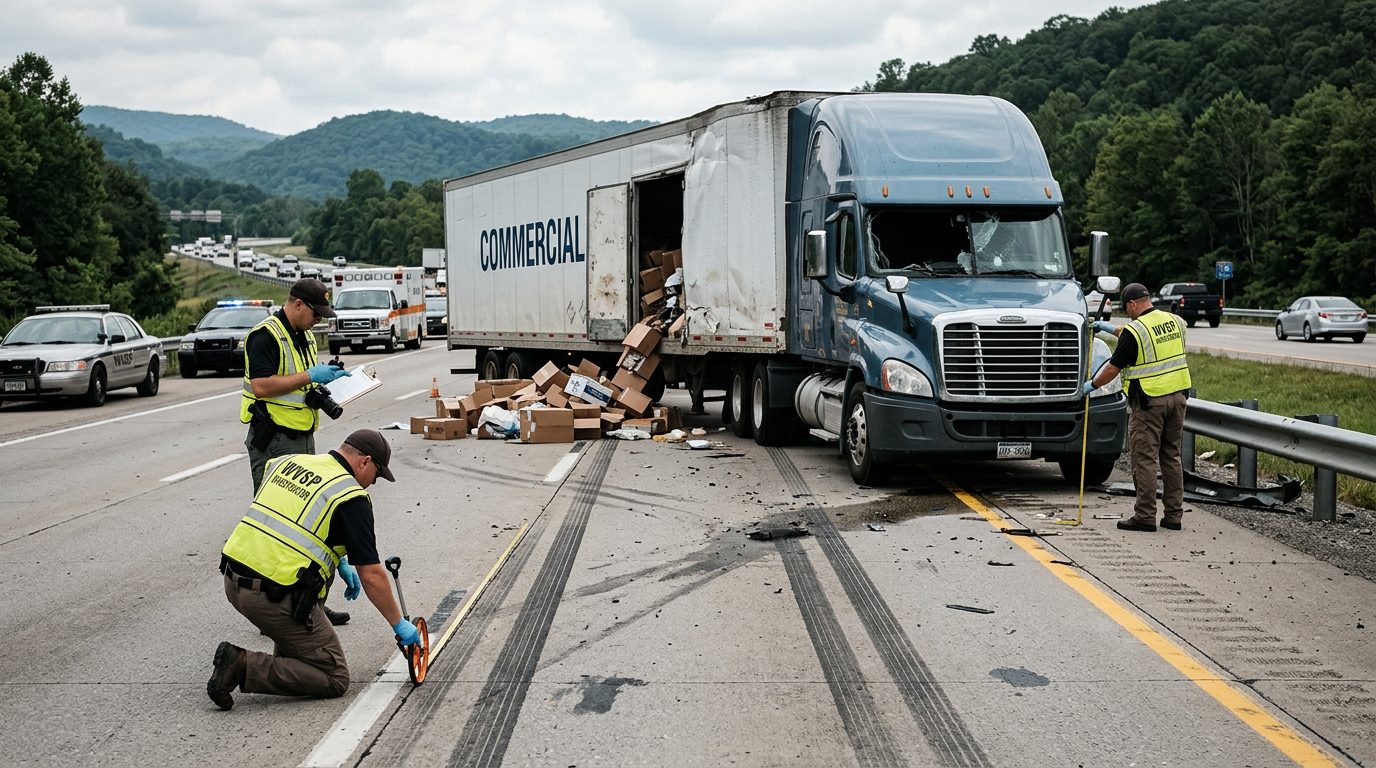
Overall scene: – Wide shots showing the position of all vehicles – Road layout, lane markings, and traffic signs – Weather and lighting conditions – Debris field and skid marks
Vehicle damage: – Close-up photos of all damage to your vehicle – Damage to the truck from multiple angles – Impact points and areas of contact – Interior damage if visible and safe to photograph
Truck-specific evidence: – The truck’s cargo area and load (if accessible and safe) – Truck’s tires, brakes, and visible mechanical condition – License plates and identifying numbers – Any visible defects or maintenance issues
Scene conditions: – Road surface and condition – Weather (rain, snow, fog, clear) – Time of day and lighting – Traffic signs, signals, and lane markings – Distance markers or landmarks to establish location
Record metadata: Note the date, time, and location in your photos or video. Most smartphones automatically tag this information.
What Documentation Needs to Be Completed After an Accident
In the hours and days following the crash, create a written record while your memory is sharp.
Your account of the crash: – Write down what you saw, heard, and felt – Describe your actions immediately before the collision – Explain the truck’s position and actions before impact – Note the point of impact and final positions of vehicles – Include the date, time, and exact location
Scene conditions: – Weather (rain, snow, clear, fog) – Road conditions (wet, dry, icy, pothole) – Lighting (daylight, dusk, night, streetlights) – Traffic volume and speed
Medical information: – Document any visible injuries with photos (if safe and appropriate) – Write down any pain, numbness, or other symptoms – Note any medical treatment you received at the scene – Keep all emergency room and hospital records
Witness statements: – Write down what each witness told you – Record their contact information – Ask if they are willing to speak with your attorney later
Insurance and official documents: – Keep the police report number – Save all insurance correspondence – Preserve claim documents and communications
Not sure what your next step is?
Talk it through with our team — the first case review is free, confidential, and carries no obligation.
Witness Information and Statements
Witnesses are often the most credible evidence. Approach them respectfully and ask for their account.
At the scene, ask: – What did you see before, during, and after the collision? – Where were you standing or positioned? – Did you see the truck’s actions leading up to the crash? – Are you willing to provide a written or recorded statement?
Get their contact information: – Full name, phone number, and email – Home or work address – Employer name and phone number
Do not pressure or make promises. Simply thank them and explain that an attorney may contact them later.
What Not to Tell Your Insurance Company
Insurance adjusters are trained to minimize payouts. Protect your case by being careful with your words.
Do not admit fault. Never say “I’m sorry,” “It was my fault,” or “I should have seen the truck.” Apologizing can be interpreted as an admission of liability.
Do not speculate. Stick to facts you directly observed. Do not guess about what caused the crash or what the driver was doing.
Do not agree to a settlement quickly. You may not yet know the full extent of your injuries. Serious injuries can take weeks or months to fully appear.
Do not sign documents without reading them. Read every document carefully before signing. Ask questions about anything you do not understand.
Do not give a recorded statement without legal advice. If you are seriously injured, consult an attorney before giving a recorded statement to the insurance company.
Stick to the facts. Describe only what you directly saw, heard, or experienced. Leave opinions and assumptions out.
Collecting Medical and Expense Records
Medical records are central to proving your injuries and damages.
Request and save: – Emergency room and hospital discharge records – Doctor visit notes and test results – Physical therapy and rehabilitation records – Prescriptions and medication receipts – Bills for medical treatment and transportation to appointments – Records of time off work and lost wages
Document your condition: – Take photos of visible injuries (bruises, cuts, scars) – Keep a daily journal of symptoms, pain levels, and limitations – Note how the injury affects your ability to work, sleep, or perform daily tasks – Save receipts for any equipment or modifications needed due to your injury
How to Write an Accident Report Example
A clear, factual written account of the accident is valuable evidence. Here is how to structure it:
Start with the basics: – Date, time, and exact location of the crash – Weather and road conditions – Lighting and visibility
Describe what happened: – What you were doing immediately before the collision – The truck’s position, speed, and actions before impact – How the collision occurred and the point of impact – The final resting position of all vehicles
Include observations: – Any injuries or damage you saw – Debris or skid marks at the scene – Traffic signs or signals – Witness names and contact information
Keep it objective: – Write in plain language, not legal jargon – Avoid emotional language or blame – Stick to facts you directly observed – Proofread for accuracy before sharing
Special Considerations for Truck Accidents in West Virginia
Truck accidents involve federal safety regulations and commercial liability that car accidents do not. Understanding these rules helps you recognize important evidence.
Federal regulations require: – Driver qualification files for each driver, including application, motor vehicle record, medical certification, and road test certificate – Driver vehicle inspection reports completed daily, covering safety-critical parts and accessories; carriers must retain these for three months – Records of duty status (logbooks) showing duty status changes, total miles, vehicle identification, and carrier name; carriers must retain these for at least six months
Evidence to request and preserve: – The truck driver’s logbook for the day of the crash – The truck’s maintenance and inspection records – The truck’s black box data (electronic control module recording) – Dashcam footage from the truck or nearby vehicles – The driver’s qualification file – The trucking company’s hiring and training records
Employer liability theories: West Virginia recognizes claims against the trucking company for negligent hiring, negligent retention, and negligent supervision. In some cases, questions may arise about how a company screened, retained, or supervised its drivers. Additionally, a state-law claim that a broker negligently hired an unsafe motor carrier is not preempted by federal law.
Have questions about what happened?
Ask our team directly. The first conversation is free, confidential, and there is no obligation to continue.
Preserving Evidence for Your Case
Evidence can disappear quickly. Take steps to preserve it immediately.
Send a preservation letter: Write to the trucking company and demand that they preserve all evidence related to the crash. Include the date, time, location, and vehicle identification. Request that they not repair, scrap, or alter the truck, and that they preserve all records, logbooks, maintenance files, and black box data.
Protect your documents: – Keep all original documents in a safe place – Back up digital photos and videos to cloud storage – Do not post details about the accident on social media – Avoid discussing the accident with anyone except your attorney and medical providers
Do not allow destruction: – Do not permit the truck to be repaired or scrapped before a thorough inspection – Request that the trucking company preserve all records for at least one year
Next Steps After You Have Documented the Accident
Documentation is the first step. Your health and your legal rights require immediate action.
Seek medical care: – See a doctor even if you feel fine—some injuries appear hours or days later – Follow all medical treatment recommendations – Keep detailed records of all medical visits and expenses
Protect your timeline: – West Virginia generally requires a personal injury lawsuit to be brought within two years after the right to bring the claim accrues, and exceptions may apply – Do not delay in gathering evidence and consulting with an attorney
Do not settle without understanding your injuries: – Do not accept an insurance settlement before you know the full extent of your injuries – Serious injuries can require ongoing treatment and long-term care
Consider legal representation: – An attorney can help you navigate insurance claims, preserve evidence, and protect your rights – Many personal injury attorneys work on a contingency basis—you pay no attorney fee unless they recover compensation for you, though you remain responsible for court costs and case expenses
If you have been hurt in a truck accident in West Virginia, the documentation you gather now—photos, witness statements, medical records, and scene details—can be the difference between a fair outcome and an unfair settlement. Serving injury victims across West Virginia, including Charleston, Huntington, Morgantown, Wheeling, Martinsburg, Parkersburg, Beckley, Clarksburg, Fairmont, and Weirton, Big Bubba Injury Law handles serious truck accidents and catastrophic injuries. If you are unsure what to do next or need guidance on your case, reach out for a free case review.
Related practice areas
- Truck Accident Claims in West Virginia | Big Bubba Legal
- How Long Does a Truck Accident Lawsuit Take in WV?