
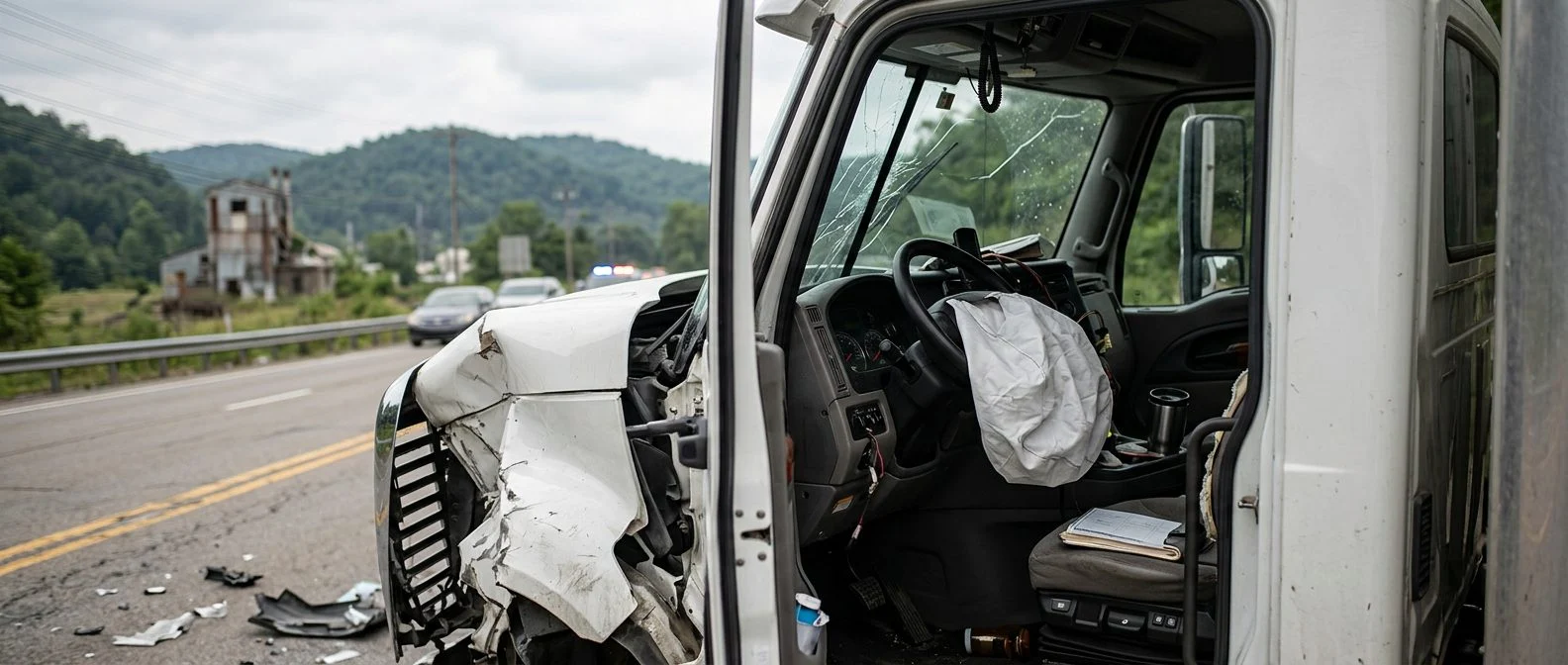
Truck Accidents | West Virginia
Do Federal Trucking Rules Affect Your Truck Claim?
Federal safety rules can shape how a commercial truck crash is investigated. Here is how to think about them after a serious wreck.
Published November 26, 2026
Do Federal Trucking Rules Affect Truck Claims in West Virginia?
You were hurt in a crash with a semi-truck, or you lost someone in one. You may have heard that federal rules govern how truck drivers work, and you want to know whether they matter to your claim.
Federal trucking safety rules may be relevant to a truck crash claim in West Virginia, depending on the facts. The rules cover driving hours, driver qualifications, testing, maintenance and crash records. Those records can show what the driver and the trucking company were required to do.
Not sure what your next step is?
Talk it through with Big Bubba — the first case review is free, confidential, and carries no obligation.

How Federal Trucking Safety Rules Connect to a West Virginia Truck Accident Claim
Federal motor carrier safety rules set standards for how commercial trucks are driven, maintained and documented. The Federal Motor Carrier Safety Administration (FMCSA) oversees these rules and publishes carrier safety data to the public.
A rule violation alone does not decide a claim. The real question is how a rule relates to what happened on the road. Knowing what each type of record is for makes the rest of the claim easier to follow.
State law still controls who may be liable and how fault is divided. See McCormick v. West Virginia Department of Public Safety.
Hours-of-Service Rules and What Driving Logs May Show
Hours-of-service rules limit how long a truck driver may work and drive before resting. Under 49 CFR 395.3, a driver generally may not drive without first taking 10 consecutive hours off duty.
Driving is also limited to 11 hours within a 14-hour period that starts after that rest. Driving generally is not allowed after more than 8 hours of driving time without a 30-minute break. 49 C.F.R. § 395.3 reads: “Except for drivers who qualify for either of the short-haul exceptions in § 395.1(e)(1) or (2), driving is not permitted if more than 8 hours of driving time have passed without at least a consecutive 30-minute interruption in driving status.” Short-haul exceptions may apply to some drivers.
Weekly limits also apply. They are 60 hours on duty in 7 days, or 70 hours in 8 days, based on how the carrier operates.
Carriers must generally record duty status with electronic logging devices (ELDs). Under 49 CFR 395.8, the rules also require total miles driven to be recorded each day. That detail can be compared with fuel receipts, dispatch records and the time of a crash.
The same section covers recordkeeping, driver entries and certification, and record retention. Logs may show compliance, or they may show a problem.
Driver Qualification and Drug and Alcohol Testing Records
Driver qualification and testing records show whether a driver met federal requirements before and after a crash. Under 49 CFR 391.11, a driver generally must be at least 21 years old. The driver must also read and speak English well enough to respond to officials, and hold a valid commercial license.
Each carrier must keep a driver qualification file for each driver it employs. Under 49 CFR 391.51, that file may include the driver’s application, motor vehicle records, road test documents and medical examiner’s certificate. West Virginia’s commercial license rules are described by the West Virginia Division of Motor Vehicles.
After some crashes, the rules require testing of surviving drivers. Under 49 CFR 382.303, testing is generally required as soon as practicable if a crash involves a death. It can also apply if a driver receives a citation for a moving traffic violation tied to a crash in which someone was hurt and immediately received medical treatment away from the scene, or a vehicle was disabled and had to be towed away. For alcohol testing, the citation must come within 8 hours; for a controlled substances test, within 32 hours of the occurrence.
If an alcohol test is not given within two hours, the employer must record the reasons. A missing test record may be relevant. It may not settle the question alone. Some insurers may dispute a claim on these points.
Vehicle Inspection and Maintenance Records
Federal maintenance rules require carriers to keep trucks in safe condition and to document that work. Under 49 CFR 396.3, every motor carrier must systematically inspect, repair and maintain its vehicles. Parts must be in safe operating condition at all times, including suspension, axles, wheels and rims, and steering systems.
Drivers also prepare a written driver vehicle inspection report at the end of each day’s work. Under 49 CFR 396.11, the carrier must repair any defect listed on the driver vehicle inspection report that is likely to affect safe operation before the truck is driven again; these rules do not apply to a carrier operating only one commercial motor vehicle, a driveaway-towaway operation, or a private motor carrier of passengers (nonbusiness).
Repairs made before a crash and repairs made after it answer different questions. Records may show both, and the timeline may matter. Investigators and attorneys may compare inspection reports with the repair history to see whether maintenance was documented. Those records may be relevant to fault questions.
What Counts as a Reportable Crash Under Federal Rules
Under federal rules, carriers keep an accident register for three years after each crash.
Carriers must also keep copies of accident reports that a state or insurer requires.
A truck company’s own register and the police crash report are different documents. Each may hold details the other lacks. Comparing them may show gaps.
Whether a particular crash fits the federal definition of an accident is a question about its details. FMCSA’s public safety data has limits too. A crash listed in a carrier’s record does not, by itself, establish the carrier’s or driver’s role in the crash.
Not sure what your next step is?
Talk it through with Big Bubba — the first case review is free, confidential, and carries no obligation.
How Compliance Records Are Used in a Truck Accident Claim
Compliance records may show that a rule was followed, or that it was broken. Either result may matter to a claim. Logs, qualification files, testing records and maintenance files each tell part of the story.
Records do not always last. Retention periods differ by record type. Under 49 CFR 395.8, logs and supporting documents generally must be kept for at least 6 months from receipt. Early requests for preservation may help protect what still exists.
In West Virginia, the general time limit for a personal injury claim is two years. That comes from W. Va. Code § 55-2-12, and exceptions may apply.
Under W. Va. Code § 55-7-13a, recovery in personal injury, property damage, and wrongful death actions is based on comparative fault, and each person’s liability is allocated in direct proportion to that person’s percentage of fault. Under W. Va. Code § 55-7-13c, an injured person’s own share of fault may reduce a recovery. A claim may be barred only when that person’s fault is greater than the combined fault of all others.
Do federal trucking rules apply to every truck crash?
Not every crash involves a rule that applies. Whether a rule applies may turn on the trip, the driver and how the carrier operates.
Can a missing record prove a violation?
A missing record may be relevant to a claim. It may not settle the question alone.

If Driver Records or Maintenance Files Are Part of Your Crash
If a truck driver’s logs or maintenance file is now in question, the next step is understanding what those records may show. After a crash, the trucking company may hold these records, not the injured person.
Many people in this position are also dealing with medical care, time away from work, or the loss of a family member. The first weeks can feel overwhelming. You do not have to sort out the records on your own.
The firm handles truck accident and commercial vehicle claims for people across West Virginia. We serve Charleston injury victims as well. To request a free case review about your crash, contact us online.