
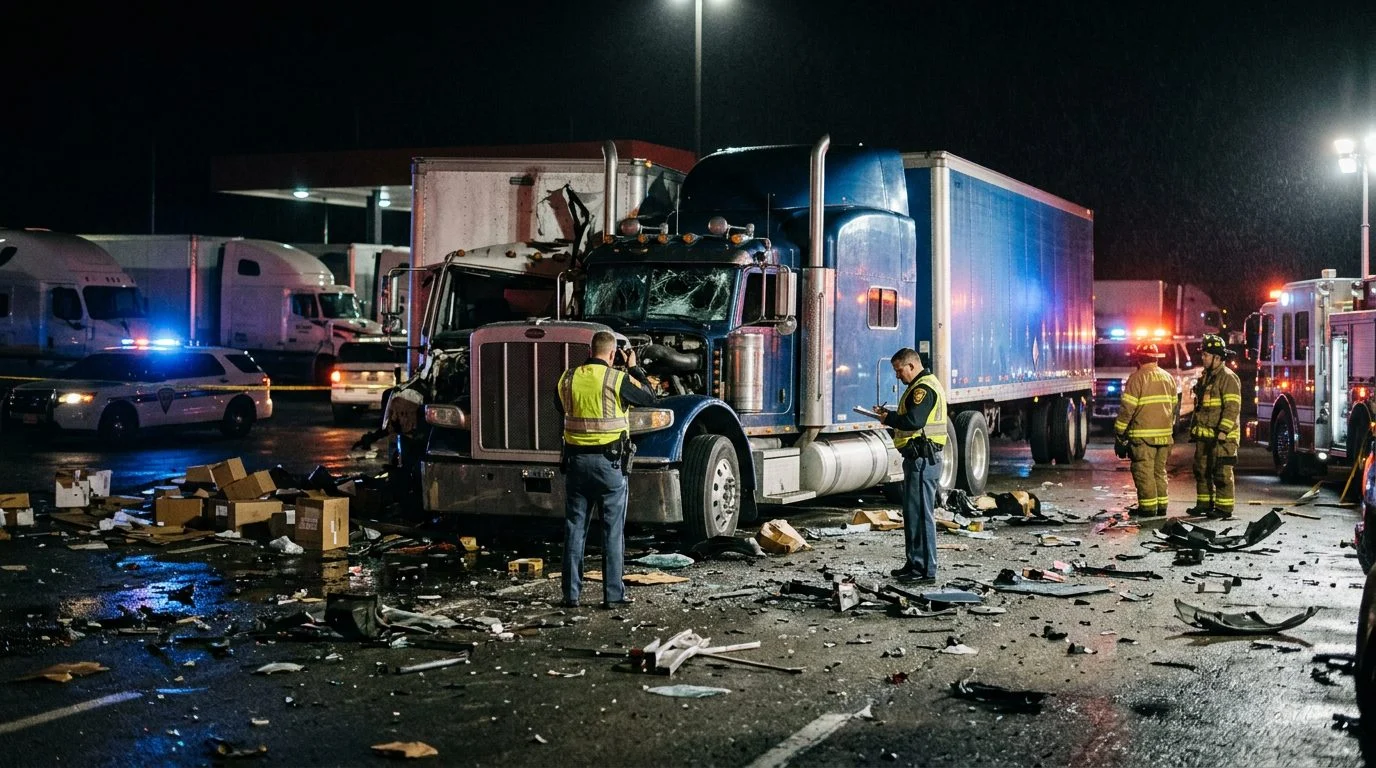
Truck Accidents | Serving West Virginia
Hours of Service Violations in Truck Crashes: Talk to Our West Virginia Team
Federal rules limit how long commercial drivers can stay on the road. When those limits are ignored, the people hurt in the crash often pay the price. Big Bubba Injury Law represents people injured in truck crashes and families in wrongful death cases across West Virginia.
How Hours of Service Issues Fit Into Your Case
Federal Driving Limits
Federal Motor Carrier Safety Administration rules set maximum driving hours and required rest periods for commercial drivers.
Driving Time Records
Driver logs, electronic logging data and trip timelines can show whether a driver was on the road longer than the rules allow.
Company Paperwork
Dispatch records, bills of lading and maintenance files can help show how a trip was scheduled and how long the driver had been working.
Contact the Firm Early
Records like these can be lost or overwritten over time. Reaching out early gives the firm a better chance to request them.
Published October 26, 2026
Federal hours-of-service rules limit how long a commercial truck driver can drive and stay on duty. If a driver broke those limits, or the logs were falsified, that can change a West Virginia truck crash claim. If you are searching for hours of service truck crash lawyer West Virginia help, this page explains the rules, how violations show up, and what happens next. Big Bubba Injury Law handles truck accidents, car accidents, commercial vehicle accidents, catastrophic injuries, traumatic brain injury, spinal cord injury, and wrongful death claims in West Virginia.
What Hours-of-Service Violations Are
An hours-of-service violation happens when a driver works or drives longer than federal rules allow. The Federal Motor Carrier Safety Administration hours-of-service rules cover driving limits, breaks, and rest periods for commercial drivers.
This page is for people hurt in a crash with a tractor-trailer, box truck, or other commercial vehicle. It is also for families who suspect a driver was tired or over the limit. A tired driver may drift across lanes, react slowly, or miss a slowing car.
You don’t have to prove it alone at the scene.
If the truck driver in your crash may have been past the federal hours limit, you may have a claim worth reviewing, so tell Bubba what happened today. Talk it through with Big Bubba — the first case review is free, confidential, and carries no obligation.

The Core Federal Rules Drivers Must Follow
A driver must rest before a shift, and there are firm limits on driving time after that. The main rules are these:
- 14-hour window. A driver may not drive after 14 consecutive hours from coming on duty, following 10 hours off.
- 11 hours of driving. Under 49 C.F.R. § 395.3, a driver may drive a total of 11 hours during the period specified in paragraph (a)(2) of this section.
- Weekly limits. A driver may not drive after 60 hours on duty in 7 days, or 70 hours in 8 days, depending on how the carrier runs its schedule. An off-duty period of 34 or more hours can restart the count.
- Electronic logs. Carriers generally must install electronic logging devices (ELDs) and require drivers to use them (49 C.F.R. § 395.8).
Each rule counts time differently. That is why the trip records matter.
How Log Violations Show Up in a Truck Crash Claim
Log problems usually show up as records that don’t match the trip. Federal rules bar false reports about duty status. They also bar tampering with an ELD so it doesn’t record accurately (49 C.F.R. § 395.8).
Look for these warning signs:
- Off-duty time logged while the truck was moving.
- Logs that don’t match fuel receipts, toll records, bills of lading, or delivery times.
- Dispatch pressure to meet a tight delivery schedule.
- Crash facts that suggest fatigue, such as a late-night crash, a run-off-the-road event, or no braking before impact.
Federal rules also bar driving while fatigue makes the driver unsafe to operate the vehicle (49 C.F.R. § 392.3). A violation alone doesn’t decide a claim. The records must connect to how the crash happened and the harm it caused.
What Records Are Pursued After a Truck Crash
The most useful records show where the truck was, when it was there, and what the driver was doing. Start with duty-status logs, ELD data, and supporting documents for the days before the crash. Federal rules require carriers to keep supporting documents that verify on-duty not driving time, like dispatch records, trip records, and expense receipts (49 C.F.R. § 395.11). Carriers must keep supporting documents in a way that they can be effectively matched to the driver’s duty-status record (49 C.F.R. § 395.11). No carrier or driver may alter or destroy them.
Other records worth asking about include:
- The police crash report and the officer’s notes.
- Driver qualification files, prior violations, and inspection history.
- Maintenance records for the truck.
Timing matters. Carriers must keep records of duty status for at least six months from receipt (49 C.F.R. § 395.8). Early requests help preserve what exists.
How a Truck Crash Claim With HOS Issues Typically Moves Forward
A claim usually starts with a conversation about what happened, followed by record requests and investigation. The steps below show a typical path, not a fixed timeline.
- Describe the crash. Share the date, location, injuries, and what you remember.
- Review the facts. The firm looks at the crash, the medical treatment, and the trucking companies or drivers involved.
- Send preservation requests. Written requests go to the carrier to keep logs, dispatch data, and maintenance records.
- Investigate. This may include the crash scene, the police report, and the records the carrier produces.
- Negotiate or file. Claims may be negotiated or filed in court. Timelines depend on the medical picture, the records, and how the carrier responds.
Deadlines matter. West Virginia generally allows two years from when the right to bring a personal injury claim accrues, and exceptions may apply (W. Va. Code § 55-2-12). A wrongful death action must be commenced within two years after the death, subject to the provisions of section eighteen, article two, chapter fifty-five (W. Va. Code § 55-7-6). W. Va. Code § 55-7-6 reads: “The provisions of this section shall not apply to actions brought for the death of any person occurring prior to July 1, 1988.” A hours of service truck crash lawyer West Virginia claim should be reviewed early so these deadlines are protected.
Who Can Be Responsible in an HOS-Related Crash
Several parties can be responsible, depending on the facts. The driver may be responsible for driving past legal limits or falsifying logs. The motor carrier may be responsible for dispatch practices, scheduling pressure, and its own recordkeeping.
Other parties can also be involved. A broker, shipper, or leasing company may be connected, depending on the contracts.
One damages rule also matters. For a personal injury or wrongful death claim involving the operation of a commercial motor vehicle requiring a commercial driver’s license, W. Va. Code § 55-7-32 limits the maximum noneconomic damages that each person injured or killed can recover against an employer defendant to $5 million for each occurrence, regardless of the number of claims or theories of liability, with the limit increasing for inflation each year starting January 1, 2026 (not to exceed 150 percent of that amount), but that limit is not available to an employer defendant that does not carry commercial motor vehicle insurance in the aggregate amount of at least $3 million for each occurrence covering the personal injury that is the subject of the action. The section applies only to causes of action arising after July 1, 2024, and is subject to the statute’s other conditions and exceptions. W. Va. Code § 55-7-32 states that the section does not apply when the civil action involving a commercial motor vehicle arises from an incident for which an operator or driver is found to have operated the commercial motor vehicle, at the time of the incident, beyond the hours of operation established under state or federal regulations.
The firm handles truck accidents, car accidents, commercial vehicle accidents, catastrophic injuries, traumatic brain injury, spinal cord injury, and wrongful death claims.
Not sure what your next step is?
Talk it through with Big Bubba — the first case review is free, confidential, and carries no obligation.
Questions People Ask About HOS Claims in West Virginia
The short answers below cover the questions people ask most often about these claims.
How long do I have to file?
West Virginia generally gives two years for personal injury claims and two years after death for wrongful death claims.
How soon should I contact a lawyer?
Sooner is better, because records and evidence can be lost over time.
What should I keep right now?
Keep your medical records, photos, and the police report number. Share these details with an hours of service truck crash lawyer West Virginia reviews.

Tell Bubba What Happened and Request a Free Case Review
If a truck driver in your crash may have been past federal hours limits, the firm can review what the records show. The firm offers a free case review, which is confidential and carries no obligation to continue.
We serve injury victims across West Virginia, including Charleston, Huntington, Morgantown, Wheeling, Martinsburg, Parkersburg, Beckley, Clarksburg, Fairmont, and Weirton.
If the truck driver in your crash may have been past the federal hours limit, you may have a claim worth reviewing. Tell Bubba what happened and request a free case review today.