
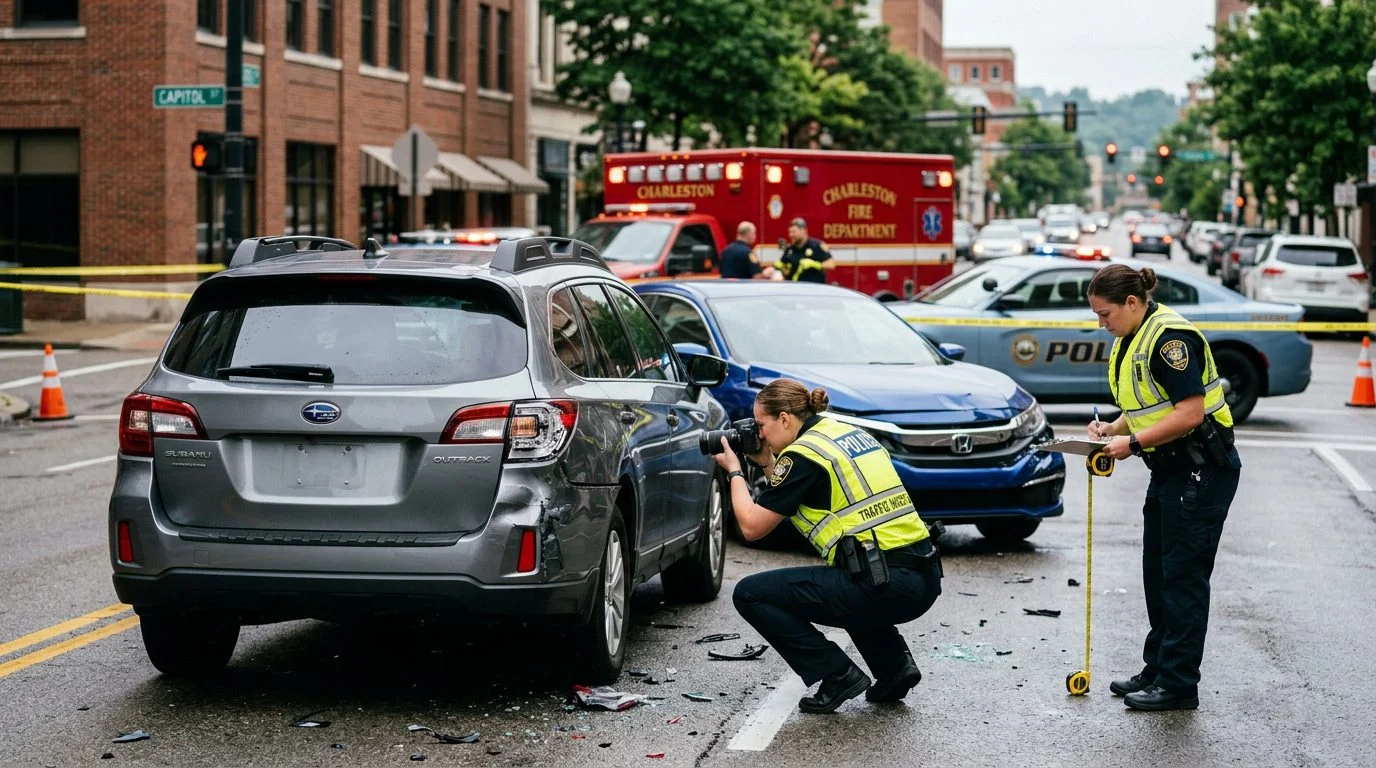
Car, Truck and Injury Claims in West Virginia
Don't Let Report Paperwork Catch You Off Guard
Crash reports, insurance notices and court filings each follow their own schedule. Knowing which record matters, and when, helps you protect your claim.
Published November 9, 2026
Right after a crash, most people want one clear deadline. West Virginia doesn’t have a single reporting clock. A crash can trigger several separate reports, and each one has its own timing.
The details depend on the facts of your crash. Here’s how each step works, so you can see which clock applies to which task.
Short Answer: Different Reports Have Different Deadlines
Each reporting step has its own timing, so handle them as separate tasks. Treat the scene, the state, your insurer, and any trucking company as four different clocks.
| Report | Who files it | When it is generally due |
|---|---|---|
| Scene report | Driver, with police | Right away, as soon as it’s safe |
| Written state report | Driver, to the state | Within the time set by state law |
| Insurer notice | Driver | Promptly, since many policies require it |
| Commercial carrier records | Trucking company | Kept for set periods under federal rules |
The deadline to file a lawsuit runs on a different clock, and it’s covered below.
Not sure what your next step is?
Talk it through with Big Bubba — the first case review is free, confidential, and carries no obligation.

Reporting to Police at the Scene
In practice, that means calling 911 as soon as it’s safe, especially if anyone is hurt.
Officers document the scene while memories are fresh. That record is often the first official account of what happened. If police don’t come to the scene, ask the responding agency how it creates crash reports and how you can request a copy.
The most common mistake is assuming a minor crash needs no report. Small impacts can still cause injuries that show up later. Don’t leave the scene because you feel fine at that moment.
Some injuries are not immediately apparent. A traumatic brain injury research review notes that effects may be long-lasting, may not appear right after an accident, and can be hard to diagnose early. Mention any symptoms you notice, even small ones, in your report.
The Written Crash Report to the State (DMV)
Confirm with the responding agency what it filed before your deadline passes. Keep a copy of anything you send to the state.
Write down the crash date today. Most reporting clocks start from that date, so this one detail can save you trouble later. A state report records facts about the crash and generally does not decide who was at fault.
Commercial Truck and Commercial Vehicle Crashes
Crashes involving commercial vehicles on public roads add federal duties that fall on the trucking company (the employer), not only the driver. Federal rules generally require employers to test surviving drivers who were performing safety-sensitive functions with respect to the vehicle for alcohol and controlled substances after a crash involving a loss of human life (49 C.F.R. § 382.303). Under federal motor carrier accident rules, a carrier must make accident records available to investigators. It must also give them reasonable help with the investigation.
Carriers must keep an accident register for three years after each accident. The accident register must contain at least the date, the nearest city or town and the State where the accident occurred, the driver’s name, the number of injuries and deaths, whether hazardous materials (other than fuel spilled from the fuel tanks) were released, and copies of accident reports required by State or other governmental entities or insurers.
Post-accident drug and alcohol testing is another step. Under federal testing rules, the employer must test surviving drivers as soon as practicable after certain crashes. Under the federal rule at 49 C.F.R. § 382.303, an employer must test a surviving driver for alcohol after a commercial motor vehicle accident that caused a loss of human life if that driver was performing safety-sensitive functions with respect to the vehicle, or after one in which that driver is cited within 8 hours for a moving traffic violation and the accident caused bodily injury needing immediate medical treatment away from the scene or disabling damage requiring a tow. A driver must stay available for testing, but medical care cannot be delayed for it.
You can ask the company in writing for the information you need. Keep a record of when you asked and what you received.
Early documentation helps. Take photos, note the driver’s name, and write down the company name and DOT number if they’re visible. Get witness names and contact details. These details may matter to your account of what happened, depending on the facts.
Notifying Your Insurance Company and the Other Driver’s Insurer
You should generally notify your own insurer promptly. Many auto policies require prompt notice of an accident.
Late notice can create problems under some policies, so don’t wait for a bill or letter. Policies may also set their own rules. W. Va. Code § 33-6-31 describes a notice step within sixty days when the other driver’s identity is unknown. Under the same section, no such policy provision may require anything of the insured except the establishment of legal liability. W. Va. Code § 33-6-31 reads: “(g) No such endorsement or provisions may contain any provision requiring arbitration of any claim arising under any such endorsement or provision, nor may anything be required of the insured except the establishment of legal liability, nor may the insured be restricted or prevented in any manner from employing legal counsel or instituting legal proceedings.”
Notice to your own insurer is different from a claim against the other driver’s insurer. You may be contacted by an adjuster from that company. Some insurers may dispute a claim or ask for a recorded statement.
You can ask for time to review any request before you answer. West Virginia also limits early settlement contact. Under W. Va. Code § 55-7-11a, for twenty days after a personal injury, a person generally may not negotiate a settlement or ask for a statement while the injured person is hospitalized or unable to work. Under W. Va. Code § 55-7-11a, a settlement, release of liability, or statement obtained or made in violation of that section may be disavowed by the injured person at any time within one hundred eighty days from the date of the personal injury, by executing a written statement of disavowal and forwarding a copy to the person who violated the section.
What to Say and What to Avoid When Reporting
Keep your first report short, factual, and limited to what you saw, heard, and felt. Describe the date, the location, the vehicles involved, and what happened in order.
Skip guesses about speed, distance, or what the other driver was thinking. Stick to what you actually observed.
On injuries, say what you feel now and that you’re still being evaluated. Saying you’re fine can be misleading if symptoms appear later.
West Virginia uses comparative fault, which allocates responsibility by each person’s percentage of fault. Under W. Va. Code § 55-7-13a, recovery is based on that allocation, so a claim can involve more than one person.
If another driver was at fault, say what that driver did in plain facts, such as running a red light. Leave conclusions about legal responsibility for later. Before you sign any statement or release, ask for time to read it.
Not sure what your next step is?
Talk it through with Big Bubba — the first case review is free, confidential, and carries no obligation.
What Happens If the Reporting Deadline Has Passed
A late report doesn’t always end a claim, but it can make the timeline harder to explain. The consequences depend on which report was late and on the facts of the crash.
Lawsuit deadlines are a separate clock. West Virginia generally allows two years to file a personal injury action under W. Va. Code § 55-2-12, and exceptions may apply.
For a death caused by a crash, W. Va. Code § 55-7-6 generally requires a wrongful death action within two years after the death. The action is brought by the deceased person’s personal representative, and exceptions may apply.
Write down a timeline. Include the crash date, what you reported and when, and any letters or forms you received. A clear record helps you and anyone helping you keep the facts straight.

Next Steps After a Crash in West Virginia
The practical order is the scene report, the written state report when it applies, insurer notice, and then records. Work through them in that order where you can.
You may be dealing with injuries, a damaged vehicle, paperwork, and calls from insurers all at once. Feeling overwhelmed in that position is common.
Keep one folder with the crash date, the police or agency contact, any state forms, insurer letters, and medical notes.
Common Questions About Reporting a Crash
Should I call my insurance company right away?
Generally, yes. Many policies require prompt notice, so early notice is the safer step.
Is a police report the same as a state report?
Not always. They are separate records, and each can carry its own timing.
How long do I have to file a lawsuit?
West Virginia generally allows two years for personal injury claims, and exceptions may apply.
If you’re still sorting out which reports may be open for your crash, the firm can talk with you about it. You can ask for a free case review to go over your situation.