
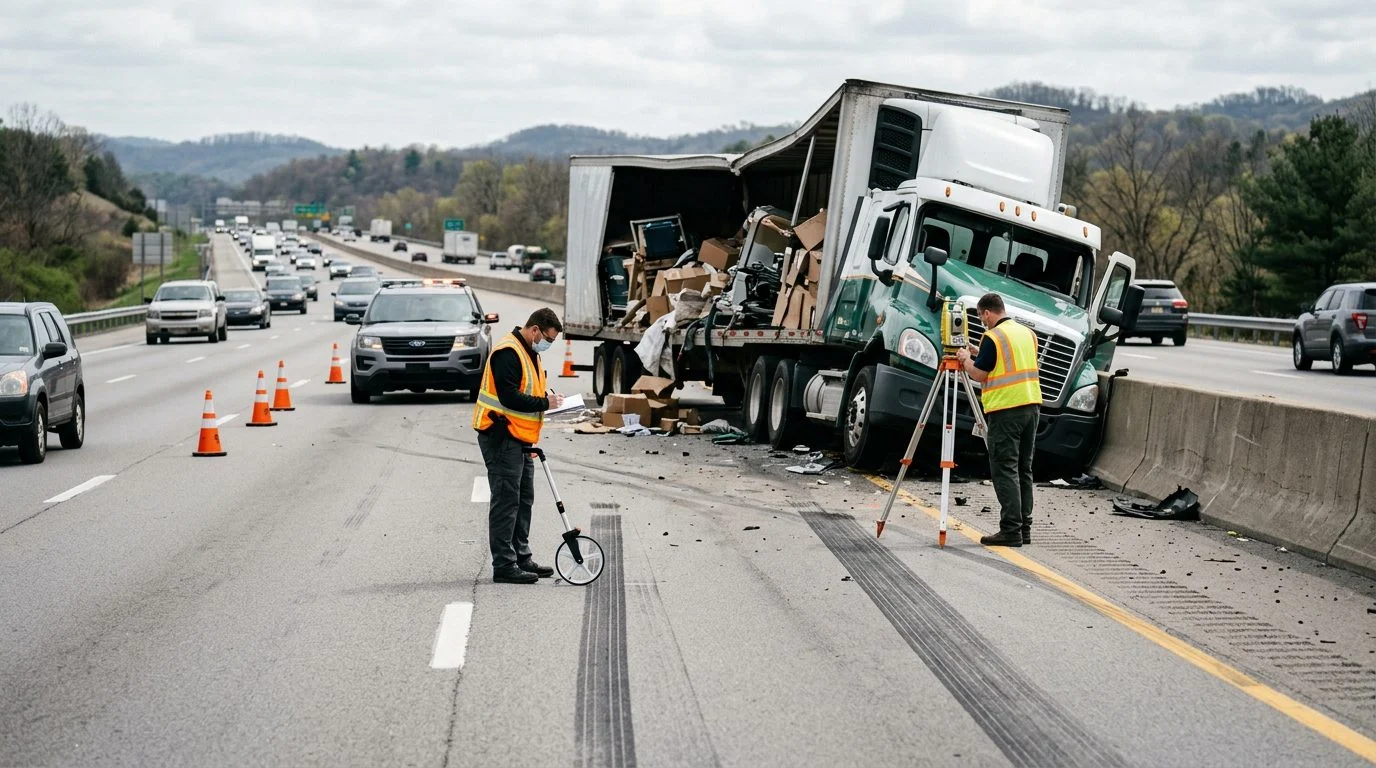
I-70 Truck Accidents | West Virginia
Hurt in an I-70 Truck Crash? Talk to Our Firm About Your Case
Big Bubba Injury Law represents people seriously hurt in car and commercial truck crashes, families in wrongful death cases, and people with catastrophic brain and spinal cord injuries across West Virginia.
Published October 28, 2026
An I-70 truck accident claim seeks compensation for injuries or a death caused by a tractor-trailer or other commercial vehicle on Interstate 70 in West Virginia. This guide covers the I-70 truck accident West Virginia cases the firm handles, in plain language. It explains who may be responsible, which records matter, and how the firm’s free case review works.
What an I-70 truck accident claim covers and who it is for
An I-70 truck accident claim is for people hurt in a crash with a commercial vehicle on the interstate. This page is written for:
- Drivers and passengers in cars hit by a semi or tractor-trailer
- Pedestrians and motorcyclists struck on or near the roadway
- Truck drivers and passengers who were hurt
- Family members of someone killed in a crash
The firm handles car accidents, truck accidents, commercial vehicle accidents, catastrophic injuries, traumatic brain injury, spinal cord injury, and wrongful death. The firm serves injury victims in all 55 West Virginia counties. That includes the Wheeling area, where I-70 crosses Ohio County.
If a truck on I-70 hurt you or someone you love, you may have a claim, and you don't have to sort it out alone. Reach out to the firm for a free case review. Talk it through with Big Bubba — the first case review is free, confidential, and carries no obligation.

Why I-70 truck crashes differ from other highway crashes
I-70 truck crashes often mix heavy trucks with fast passenger traffic in the same lanes. That mix can turn one mistake into a chain of collisions.
- Weight and stopping distance. A loaded tractor-trailer needs far more room to stop than a passenger car. When traffic slows suddenly, that gap closes fast.
- Grades and weather. Steep grades and changing mountain weather can lead to brake trouble, jackknifing, and rollovers.
- Secondary crashes. Local news has reported crashes near Elm Grove and 2-Mile Hill, where lanes closed and traffic backed up. Stopped drivers in those backups can be struck by vehicles that come up too fast.
What injuries and losses are common in I-70 truck crash cases
Injuries in truck crashes are often severe, and some signs appear days later.
- Traumatic brain injury. This can range from a concussion to bleeding inside the skull. Headaches, confusion, or memory trouble may show up after the crash, not right away.
- Spinal cord injury. Damage to the spinal cord can cause partial or complete paralysis. It may require long-term medical care, therapy, and equipment.
- Other catastrophic injuries. These include multiple fractures, internal organ damage, and severe burns.
- Wrongful death. When a crash kills someone, West Virginia law allows a wrongful death action. Damages can include sorrow, mental anguish, and solace, lost income and services, hospital and care costs, and reasonable funeral expenses (W. Va. Code § 55-7-6).
Each case depends on its own medical records and facts. The losses often reach past hospital bills into lost work and changes at home.
Who may be responsible and which records matter
Responsibility can reach past the driver. Company records often shape how a case is proven.
Depending on the facts, potentially responsible parties may include:
- The truck driver
- The motor carrier that employs the driver
- The truck owner, or a company that leases or controls the truck
- A maintenance contractor or cargo loader, if their work played a part
That limit requires the defendant to carry at least $3 million in commercial vehicle insurance. The limit does not apply where the driver is found to have exceeded hours-of-service limits, among other listed conditions (W. Va. Code § 55-7-32).
Federal rules also create records that can matter:
- Duty status records. Drivers must record their duty status for each 24-hour period (49 C.F.R. § 395.8).
- Driver qualification files. Carriers must keep one for each driver.
- Post-accident testing. Federal rules can require drug and alcohol testing after a commercial vehicle crash (FMCSA).
What to do in the first days after an I-70 truck crash
The first steps are medical care, the crash report number, and notes written while memory is fresh.
- Get checked, even if you feel fine. Report headaches, confusion, numbness, or back pain to a doctor.
- Document the scene. If it’s safe, photograph the vehicles and roadway. Write down the crash report number and witness names and phone numbers.
- Keep a simple log. Track treatment, missed work, and out-of-pocket medical costs.
- Expect insurer contact. West Virginia law limits settlement talks, releases, and statements obtained within twenty days of an injury while the injured person is in the hospital or unable to work (W. Va. Code § 55-7-11a).
Talking with the firm before giving any recorded statement is a reasonable step.
How the firm handles an I-70 truck case
The firm starts with a free case review, then moves to evidence, investigation, and options.
- Free case review. This confidential first conversation covers what happened, your injuries, and family concerns. You have no obligation to continue.
- Preserve evidence. Early requests for trucking records and crash data protect information that may not last.
- Investigate. The firm looks at the scene, the vehicles, the driver’s history, and the medical records, and works with treating providers.
- Review options. The firm discusses the losses, the responsible parties, and your options with the injured person or family.
The first weeks usually focus on records and treatment. Later stages depend on the medical picture and the facts.
Timing matters. West Virginia generally allows two years to bring a personal injury claim (W. Va. Code § 55-2-12). A wrongful death action must be commenced within two years after the death of the deceased person, subject to the provisions of section eighteen, article two, chapter fifty-five (W. Va. Code § 55-7-6). W. Va. Code § 55-7-6 reads: “The provisions of this section shall not apply to actions brought for the death of any person occurring prior to July 1, 1988.” West Virginia also uses comparative fault, which allocates each person’s liability in direct proportion to that person’s percentage of fault (W. Va. Code § 55-7-13a). Other rules can change these dates, so early attention helps.
Not sure what your next step is?
Talk it through with Big Bubba — the first case review is free, confidential, and carries no obligation.
Common questions about I-70 truck accident claims
Does the crash have to happen on I-70?
No. The firm handles truck and commercial vehicle crashes across West Virginia, and I-70 is one of many roads.
Can a family bring a claim after a fatal truck crash?
Yes. West Virginia wrongful death actions are brought by the personal representative of the estate, and the firm handles these cases.
What if the truck was registered in another state?
Out-of-state carriers can still be involved. The firm reviews where and how the truck was operated.
Do I need to wait for a criminal charge?
No. A free case review can start at any point, and the crash record can develop over time.
Can the firm help after a crash that involved a car, not a semi?
Yes. The firm handles car accidents along with truck and commercial vehicle crashes.

Talking with the firm about your I-70 crash
If someone you love is still in the hospital, or your vehicle is still in a tow yard, you are carrying a lot right now. Decisions about records and claims can’t wait forever. You may be deciding whether to pursue a claim and which records to request before they disappear.
You don’t have to sort out an I-70 truck case alone. Reach out for a free case review, which is confidential and carries no obligation to continue. Tell the firm what happened, in your own words.