
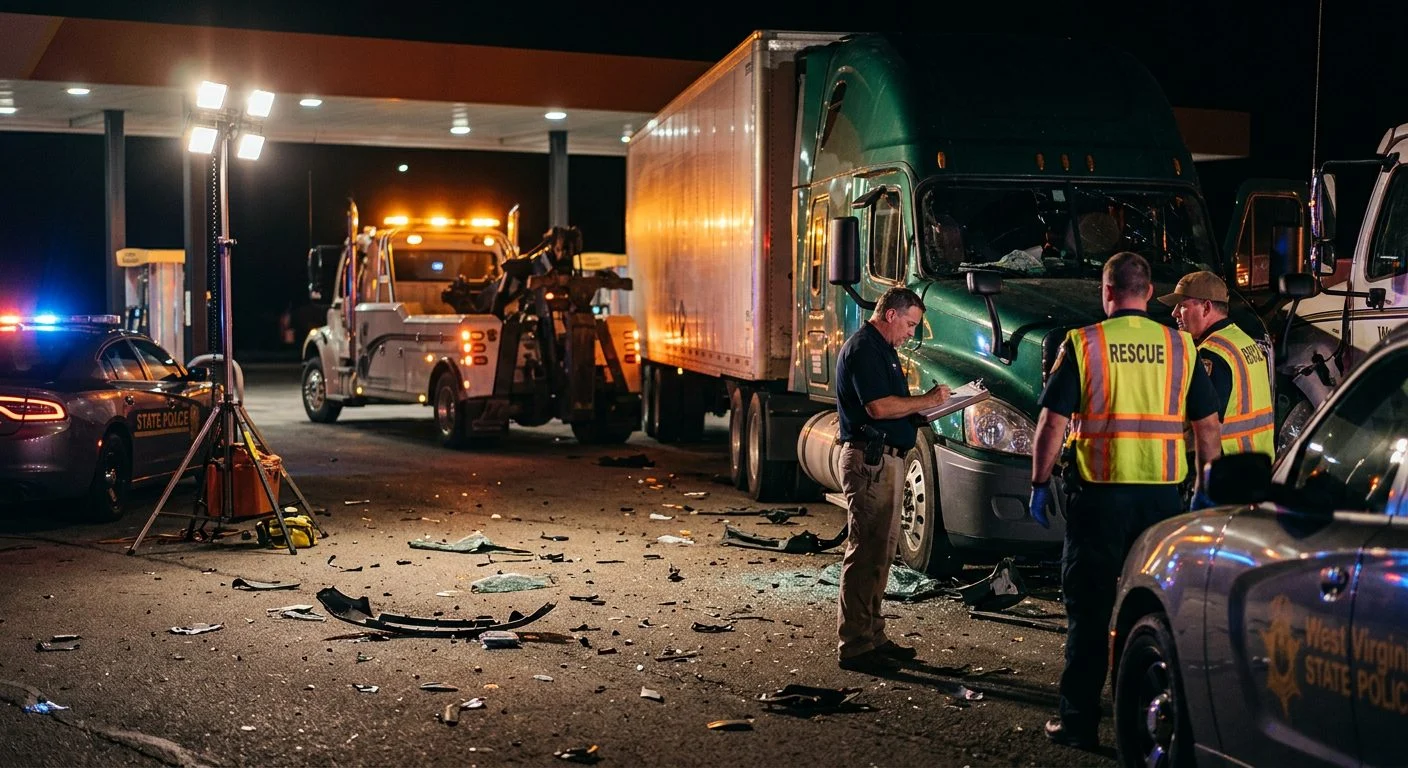
Truck Crash Injury Claims | West Virginia
Hurt in a Truck Crash Involving an Independent Contractor Driver? Start Here.
Big Bubba Injury Law focuses on people seriously hurt in car and commercial truck crashes, serious brain and spinal cord injuries, and families in wrongful death cases. We serve injury victims across West Virginia, including Charleston, Huntington, Morgantown, Wheeling and Beckley.
Published October 25, 2026
A truck driver’s independent contractor status does not automatically decide who pays for your injuries. This page explains a truck driver independent contractor crash injury West Virginia claim in plain words. You’ll learn which facts matter, which records help, and which deadlines apply.
What an Independent Contractor Truck Driver Means for Your Claim
The contractor label does not automatically decide who is responsible. An independent contractor is a driver who runs as a separate business, not as a regular employee.
Many of these drivers are owner-operators. An owner-operator owns or leases one truck and hauls freight under another company’s operating authority, which is often called a carrier.
Some drivers lease their truck to a carrier under a trip lease or a longer lease. That paperwork shows the plan on paper. It does not end the review of who was really in charge of the trip.
This page is for injured drivers, passengers, other motorists, and family members in wrongful death cases. We serve injury victims in Charleston, Huntington, Morgantown, Wheeling, Martinsburg, Parkersburg, Beckley, Clarksburg, Fairmont, Weirton and across all 55 West Virginia counties. For the wider picture, read our truck accident claims overview.
A truck crash with an independent contractor driver may mean you have a claim, and you don't have to work out who controlled the truck alone. Talk it through with Big Bubba — the first case review is free, confidential, and carries no obligation.

When the Trucking Company Can Still Be Held Responsible
A trucking company can still be responsible even when the driver is called a contractor. Questions about who directed the truck and the driver’s work can be important after a crash.
West Virginia defines an “employer defendant” broadly. It includes the owner of a commercial motor vehicle, the driver’s employer, and any entity that holds legal control over the truck or its operator (W. Va. Code § 55-7-32). The definition reaches anyone with legal control, not only the name on a lease.
Facts that often matter include dispatch and routing, required equipment, load assignments, pay structure, and rules the driver must follow. Federal rules say a motor carrier must make sure its drivers follow the driver rules (49 CFR 390.11). Federal lease rules also require a written lease to say who pays fuel, tolls and detention, and who loads and unloads (49 CFR 376.12).
Injured people may also bring claims that a company was careless in hiring, supervising or keeping a driver. A leasing company, broker or maintenance contractor may also be part of some crashes. How a specific crash turns out depends on the facts and the documents available.
Records That Show Who Controlled the Truck
The most useful records show who assigned the load, set the route and tracked the driver’s hours. Start by looking for:
- Leases and trip-lease agreements between the authorized carrier and the owner of the equipment
- Dispatch messages, load assignments and bills of lading
- Electronic logging device data and records of duty status
- Driver qualification files, plus drug and alcohol testing records
- Insurance certificates and proof of financial responsibility
Federal rules require drivers to record duty status for each 24-hour period. They also bar false reports and tampering with an electronic logging device (49 CFR 395.8). Federal hours-of-service rules set driving limits, rest breaks and sleeper-berth rules.
Federal rules at 49 CFR 391.51 generally require a motor carrier to retain each driver’s qualification file for as long as it employs that driver and for three years thereafter. A motor carrier must have the minimum levels of financial responsibility in effect before it operates a motor vehicle (49 CFR 387.7).
Retention periods for driver qualification files are set out in 49 CFR 391.51(c) and (d). That is why early preservation letters to the driver, carrier and other parties matter.
Injuries and Losses These Claims Often Involve
Truck crashes often cause serious injuries, and the losses can last well beyond the first hospital stay. The IIHS state fatality statistics track motor-vehicle crash deaths by state.
Serious injuries can include a traumatic brain injury (a blow or jolt that disrupts how the brain works) or a spinal cord injury (damage to the nerves that carry signals between the brain and body). Economic losses can include medical bills, rehabilitation, lost wages and reduced earning ability. Non-economic losses include pain, suffering and changes to daily life.
For certain commercial truck claims, West Virginia law limits noneconomic damages against an employer defendant. Under W. Va. Code § 55-7-32, the base limit is $5 million per occurrence, it is adjusted for inflation beginning January 1, 2026 up to 150 percent of that amount, and the section applies only to causes of action arising after July 1, 2024. The cap applies only when the truck required a commercial driver’s license and the employer carries at least $3 million in commercial motor vehicle insurance. It does not apply if the case arises from an incident for which the operator or driver is found to have committed one of several listed violations, including operating in excess of hours-of-operation limits (W. Va. Code § 55-7-32).
When a crash causes a death, the personal representative brings the wrongful death claim. Damages may include sorrow, mental anguish and solace, lost income and services, care expenses and reasonable funeral expenses (W. Va. Code § 55-7-6). Underride crashes, where a car slides under a trailer, can be especially severe. Read more about underride truck crash injuries.
Deadlines and How Long a Truck Claim Can Take
West Virginia generally requires personal injury actions to be brought within two years (W. Va. Code § 55-2-12). A wrongful death action must be commenced within two years after the death, subject to the provisions of section eighteen, article two, chapter fifty-five (W. Va. Code § 55-7-6). W. Va. Code § 55-7-6 reads: “The provisions of this section shall not apply to actions brought for the death of any person occurring prior to July 1, 1988.”
Deadlines run from set dates. The wrongful death clock runs from the death, not the injury. Waiting can also weaken evidence, even before the deadline passes.
West Virginia uses comparative fault. Damages are allocated in direct proportion to each person’s percentage of fault (W. Va. Code § 55-7-13a). Your own share of fault can therefore affect what you recover.
A truck claim usually moves through several stages. These include investigation, medical treatment and records, a demand to the insurer, negotiation, and a lawsuit if needed. How long each stage takes varies from case to case.
How the Process Typically Works
A truck claim usually starts with medical care and clear records. The steps below show the usual order.
- Get medical care. Keep records of treatment, bills and missed work.
- Gather the basics. Save photos, the police report number, witness names and any insurance details you have.
- Free case review. This first conversation is confidential and carries no obligation to continue. The firm asks about the crash, the driver and the carrier.
- Preservation letters. Letters go to the driver, carrier and other parties asking them to keep logs, dispatch and maintenance records.
- Investigation. The review covers the crash scene, police reports, vehicle damage, driver history and carrier records.
- Negotiation or suit. The firm works with insurers. If the claim can’t be resolved that way, a lawsuit is filed in the proper West Virginia court.
Not sure what your next step is?
Talk it through with Big Bubba — the first case review is free, confidential, and carries no obligation.
Common Questions About Independent Contractor Truck Crashes
Short answers to common questions about a truck driver independent contractor crash injury West Virginia claim are below.
Can the driver be sued after an independent contractor crash?
Yes. The driver can be a defendant, and the trucking company may be one too.
Can I still recover if I was partly at fault?
Under W. Va. Code § 55-7-13c, fault chargeable to you does not bar recovery unless your fault is greater than the combined fault of all other persons responsible for the damages. If your fault is less than that combined fault, your recovery is reduced in proportion to your degree of fault. Damages are allocated by each person’s percentage of fault.
Does the company’s insurance cover the driver?
Coverage depends on the policies and the relationship between the parties. The firm reviews those records during a free case review.
Should I talk to the trucking company’s insurer?
Statements to an insurer can affect a claim. Reach out to the firm before you give a recorded statement.
What if a family member died in the crash?
A wrongful death claim is brought by the personal representative of the deceased person who has been duly appointed in this state, or in any other state, territory or district of the United States, or in any foreign country. The statute lists damages that may include lost income and funeral expenses, as set out in W. Va. Code § 55-7-6.

Next Steps After a Truck Crash With an Independent Contractor Driver
If you’re dealing with a truck crash now, start with your health and your records. Many people reading this are juggling injuries, missed work or the loss of someone they love. Paperwork and insurer calls can feel overwhelming.
Gather these items now:
- Photos of the scene, the vehicles and your injuries
- The police report number and the names of witnesses
- Medical records, bills and a log of missed work
- Any contact details you have for the driver and the carrier
You don’t have to sort out who controlled that truck alone.