
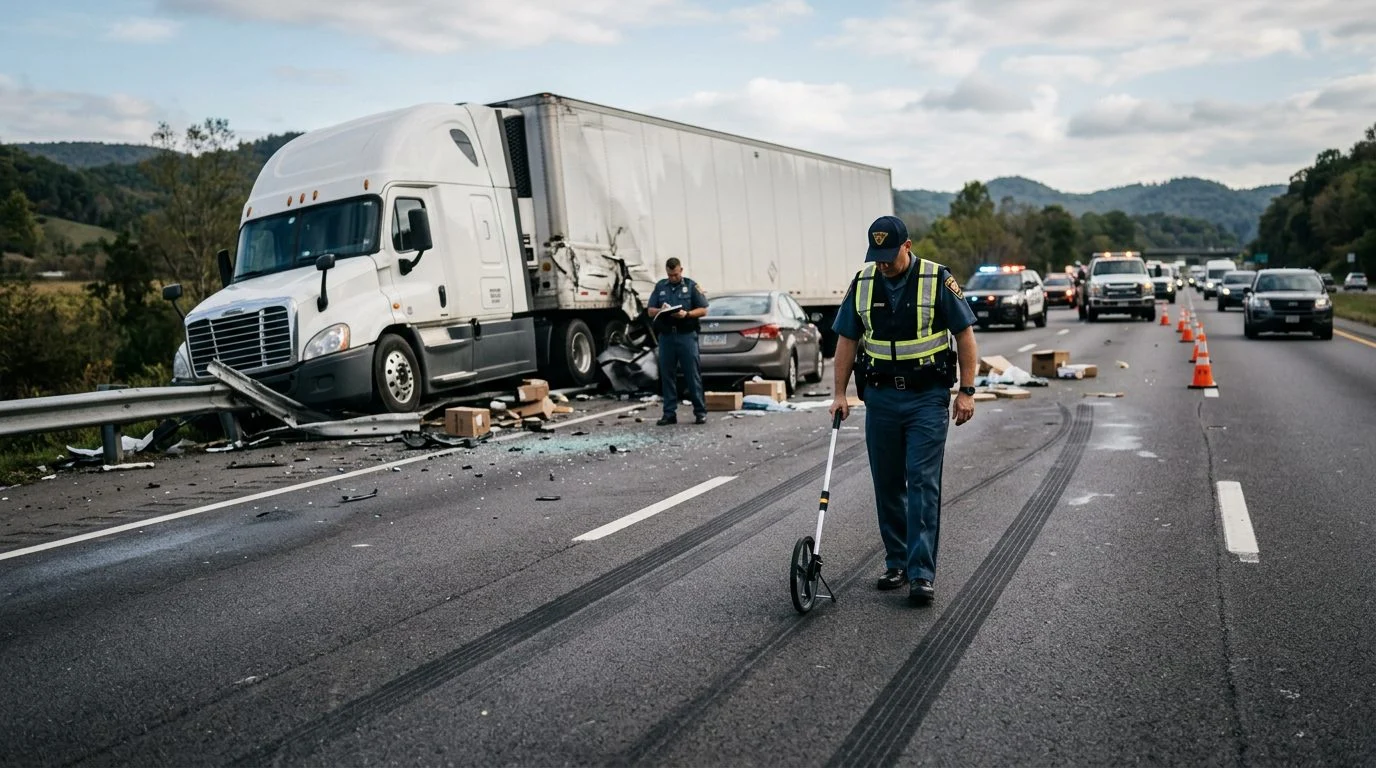
West Virginia Truck Accident Guidance
Truck Accident Police Report in West Virginia: Your Steps
After a truck crash, a police report creates an official record of what happened. Here is what to do at the scene and afterward, and how the firm can help you move forward.
Published October 27, 2026
Do You Have to Report a Truck Accident to Police in West Virginia?
Calling police right away creates the record you will likely need later, so it is the best first step most people can take.
If a truck left the scene or no report was filed, you may have a claim worth reviewing, and we can walk through it with you in a free case review. Talk it through with Big Bubba — the first case review is free, confidential, and carries no obligation.

The Short Answer: When a Truck Crash Must Be Reported to Police
Treat every truck crash as one that needs a police report. Truck crashes often involve heavy damage, injuries, and insurance companies that move quickly. A police report puts the basic facts on record early, before memories fade or stories change.
What West Virginia’s Accident Reporting Law Requires
Calling police at the scene and filing a written report are two different steps. The officer’s call gets help to the scene and starts the paperwork. The written report is a separate record that the investigating agency keeps. Both matter. Many people feel fine at the scene and skip the call. That choice leaves the record thin, and a thin record is hard to build back later.
If you are unsure whether your crash must be reported, do not wait to find out. Call police and let the officer make the record.
Truck and Commercial Vehicle Crashes: What Is Different
Truck crashes come with extra identifying details, and those details matter later. Federal rules require the legal name or a single trade name of the motor carrier operating the self-propelled commercial motor vehicle to be displayed on it, along with its USDOT number. The number must be preceded by the letters “USDOT” (49 C.F.R. § 390.21T). Write down the company name and USDOT number from the door or cab at the scene.
After some truck crashes, the employer must test the surviving driver for alcohol and controlled substances. Testing is required after a crash involving a death. Federal rules state that, as soon as practicable following an occurrence involving a commercial motor vehicle operating on a public road in commerce, each employer shall test for alcohol for each of its surviving drivers who receives a citation within 8 hours of the occurrence under State or local law for a moving traffic violation arising from the accident, if the accident involved bodily injury to any person who, as a result of the injury, immediately receives medical treatment away from the scene of the accident, or one or more motor vehicles incurring disabling damage as a result of the accident, requiring the motor vehicle to be transported away from the scene by a tow truck or other motor vehicle (49 C.F.R. § 382.303). The driver may not use alcohol for eight hours after the crash, or until the test is given, whichever comes first (49 C.F.R. § 382.209).
West Virginia law defines an “employer defendant” broadly. It includes the truck’s owner, the driver’s employer, and any other person or entity that owns, leases, rents, or holds legal control over the truck or its operator (W. Va. Code § 55-7-32). That is why the company name on the truck matters as much as the driver’s name.
Which Police Agency Responds: State Police, Sheriff, or City Police
The agency that responds to the scene is the agency that holds the crash report. Depending on where the crash happened, the responder may be the West Virginia State Police, a county sheriff’s department, or a city or town police department.
Ask the officer for the case or incident number before you leave. Also write down the officer’s name and badge or unit number, and the agency’s name. If you cannot get the number at the scene, note the time, the exact location, and any landmarks nearby. Those details help the agency find your file later.
Keep these notes with your phone photos. Photos of the vehicles, the road, and any skid marks can support the details in the report.
How to Get a Copy of the Crash Report
Ask the responding agency for the crash report. Give the case or incident number, the date of the crash, and the exact location. Requests are usually made in writing or through the agency’s records process. Processing times vary by agency, so ask how long the request will take when you submit it.
A typical crash report lists the drivers and vehicles, the location, a diagram, the officer’s narrative, and any citations issued. Read it closely. Check names, plate numbers, the direction of travel, and the order of events. Errors happen, and a small mistake can change how the crash is understood.
If the report contains an error, bring evidence to the agency. Photos, witness names, and medical records can help show the correct facts. A trucking company also keeps its own records, which are separate from the police report. Those records may need a formal request, so the police report is one piece of the picture, not the whole story.
Not sure what your next step is?
Talk it through with Big Bubba — the first case review is free, confidential, and carries no obligation.
When the Truck Driver Does Not Stop or Does Not Report the Crash
Call 911 right away. Do not follow the truck. Your safety comes first, and the police can use the details you give them.
Then record everything you can:
- The truck’s color, make, and any visible damage
- The company name and USDOT number on the door or cab
- The license plate number
- The direction of travel and the time of the crash
- Names and phone numbers of witnesses
- Nearby cameras, such as those at gas stations or stores, and ask owners to save footage quickly
A driver who leaves does not erase the crash. Police can still take a report from you and any witnesses. You can request a copy of that report later from the agency that responded. Many people make the mistake of waiting for the driver to call in. Do not wait. Make your own record first.
Medical Care Comes First, and Symptoms Can Appear Later
Get medical care first, even if you feel fine at the scene. Serious injuries need prompt evaluation, and a doctor can check for problems you may not notice yet.
Tell the doctor how the crash happened, and list every symptom, including small ones such as headaches, dizziness, numbness, or trouble sleeping. A medical record made soon after the crash helps document what happened. Symptoms can change over the following days, so keep a simple written log of new or worsening problems.
Keep every bill, discharge paper, and appointment note. These records work alongside the police report, not in place of it.
What to Do Next If You Are Unsure About the Report
Gather your medical records, the truck details you wrote down, and the police case number. Then request the crash report from the agency that responded.
Two time rules matter. Under W. Va. Code § 55-2-12, a personal action for which no other limitation is prescribed must be brought within two years after the right to bring it accrues if it is for personal injuries.
A missing or incomplete police report does not decide what happens next on its own. Photos, witness details, and medical records also matter.
We serve injury victims across West Virginia, including Charleston, Huntington, Morgantown, Wheeling, Martinsburg, Parkersburg, Beckley, Clarksburg, Fairmont, and Weirton.
Do I have to call police after a truck accident in West Virginia?
Calling police after a truck crash is the right first step. It creates the record you may need later.
What if the truck driver left the scene?
Call 911 right away and write down the company name, USDOT number, and plate. You can still report the crash and request the report later.
If a truck left the scene and you are unsure which records to gather, you may have a claim worth reviewing. You can request a free case review to talk through the crash, the report, and the steps ahead.