
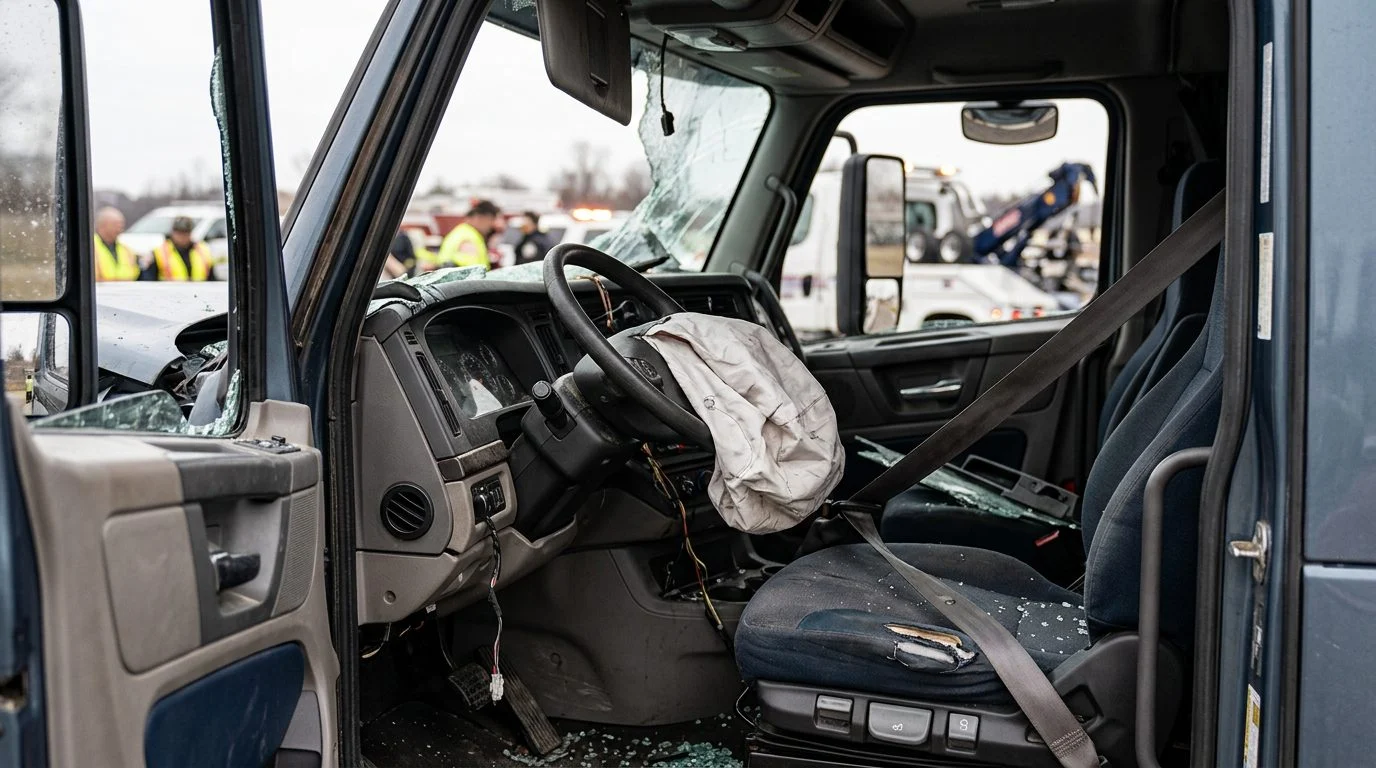
Truck Accidents
Severe Injuries from Commercial Truck Crashes
Broken bones, internal bleeding, and organ damage require immediate legal help. We serve injury victims across West Virginia.
Published October 08, 2026
Truck Accident Injuries: Broken Bones, Ligament Damage, and Internal Injuries
Truck accidents in West Virginia cause far more severe injuries than typical car crashes because of the massive weight and force involved. A fully loaded commercial truck can weigh 80,000 pounds or more—roughly 15 times heavier than a passenger vehicle. When that weight collides with a car at highway speed, the occupants of the smaller vehicle absorb catastrophic force. Broken bones, internal bleeding, organ damage, and spinal injuries are common outcomes.
Understanding the types of injuries that occur in truck accidents helps you recognize the seriousness of your situation and know when legal help may be needed.
Not sure what your next step is?
Talk it through with our team — the first case review is free, confidential, and carries no obligation.
Why Truck Accident Injuries Are Often Severe
The physics of a truck collision are brutal. A commercial truck traveling at 65 mph needs roughly 6 seconds and 525 feet to stop—far longer than a passenger car. If a truck cannot brake in time, the impact delivers enormous crushing force to anything in its path.
Truck accidents also involve multiple impacts. The initial collision may crush the vehicle’s front end. The vehicle then may be pushed sideways, rolled, or struck again by debris or other traffic. Occupants are thrown violently inside the cab, struck by the steering wheel, dashboard, windows, or other objects. This combination of forces causes injuries at the severe end of the spectrum.
In contrast, lower-speed car-to-car accidents often result in whiplash or minor fractures. Truck accidents regularly produce traumatic brain injury, spinal cord damage, amputation, multiple fractures, and death. The injury patterns are different in both type and severity.
Broken Bones in Truck Accidents
Fractures are among the most common injuries in truck collisions. The force of impact can break multiple bones at once, and the breaks are often severe.
Leg fractures are especially frequent. The femur (thighbone), tibia (shinbone), and fibula (smaller bone in the lower leg) break when the vehicle’s frame collapses or when occupants’ legs strike the dashboard or steering column. Leg fractures often require surgery to realign the bones and may involve metal plates, rods, or screws. Recovery takes months, and some people never regain full strength or mobility.
Rib fractures result from the force of the steering wheel, seatbelt, or dashboard pressing into the chest. A single broken rib is painful; multiple broken ribs can puncture the lungs or cause internal bleeding. Rib injuries make breathing difficult and can lead to pneumonia if not managed carefully.
Pelvic fractures occur in frontal and side-impact collisions. The pelvis is the body’s foundation for movement and organ protection. A broken pelvis is a serious injury that often requires hospitalization and can cause long-term pain and disability.
Spinal fractures are catastrophic. A fracture of the vertebrae can damage the spinal cord itself, resulting in partial or complete paralysis. Even fractures that don’t sever the cord can cause chronic pain, nerve damage, and permanent loss of function.
Truck accidents also produce compound fractures (the bone breaks through the skin) and comminuted fractures (the bone shatters into multiple pieces). These injuries require emergency surgery, carry a high risk of infection, and often result in permanent scarring or disability.
Ligament and Soft-Tissue Damage
Not all serious injuries involve broken bones. Ligaments and soft tissues—tendons, muscles, cartilage—can be torn or severely stretched by the violent motion of a truck accident.
Whiplash occurs when the head is thrown forward and backward in rapid succession. This motion tears ligaments in the neck (cervical spine) and can cause chronic pain, headaches, and loss of range of motion. Some people experience whiplash symptoms weeks or months after the accident.
Knee injuries are common when legs are trapped or crushed. Ligament tears (especially the anterior cruciate ligament, or ACL) require surgery and months of physical therapy. Many people with knee injuries develop arthritis years later.
Shoulder and rotator cuff injuries result from the impact throwing the arm violently or from the occupant being crushed against the door or window. Rotator cuff tears often require surgery and can leave lasting weakness.
Ankle and foot injuries occur when the lower leg is trapped in the wreckage. Ligament tears and fractures can make walking painful or impossible without assistance.
Soft-tissue injuries are sometimes dismissed as “minor,” but they can be as disabling as fractures. Chronic pain, limited mobility, and the need for ongoing physical therapy are real consequences. Many people never fully recover.
Have questions about what happened?
Ask our team directly. The first conversation is free, confidential, and there is no obligation to continue.
Internal Injuries from Truck Collisions
The blunt force of a truck accident can damage organs inside the body without any visible wound. These injuries are often life-threatening and require immediate emergency care.
Internal bleeding occurs when blood vessels tear inside the abdomen, chest, or pelvis. The bleeding may be slow at first, with symptoms appearing hours or even days after the accident. Signs include bruising, abdominal pain, dizziness, and shortness of breath. Severe internal bleeding can cause shock and death if not treated in an emergency room.
Organ damage from crushing force can injure the liver, spleen, kidneys, or lungs. A ruptured spleen or liver laceration requires emergency surgery. Kidney damage may not be immediately obvious but can result in long-term kidney disease.
Abdominal injuries are particularly dangerous because symptoms may be delayed. A person may feel relatively fine at the scene, then develop severe pain, nausea, or vomiting hours later. This is why emergency room imaging (CT scans, ultrasound) is essential after any significant truck accident.
Chest injuries can include a collapsed lung (pneumothorax), fluid around the heart (hemopericardium), or damage to the heart itself. These injuries cause difficulty breathing, chest pain, and can be fatal without immediate treatment.
Internal injuries are invisible on the surface, which is why seeking immediate medical evaluation is critical. Do not assume you are uninjured just because you can walk or feel relatively okay at the accident scene.
What Is the Most Common Bone Broken in Truck Accidents?
Leg fractures, particularly of the femur (thighbone), are among the most common serious fractures in truck accidents. The femur is the body’s largest and strongest bone, so a break requires enormous force—exactly the kind of force a truck collision delivers.
Rib fractures are also very common because the steering wheel, dashboard, and seatbelt all apply direct force to the chest during impact.
Pelvic fractures occur frequently in side-impact and rollover accidents. The pelvis absorbs force from multiple directions.
The specific bones broken depend on the angle of impact, the vehicle’s position, and where the occupant was seated. A driver may suffer different injuries than a passenger in the same crash. A side-impact collision breaks different bones than a head-on collision.
What matters is that any fracture from a truck accident is likely to be severe. Compound fractures, comminuted fractures, and fractures involving multiple bones are common. Recovery is long, painful, and often incomplete.
When Injuries Require Immediate Medical Attention
Do not wait to seek medical care after a truck accident. Go to the emergency room immediately if you experience any of these signs:
- Severe pain anywhere in your body
- Inability to move an arm or leg
- Obvious deformity (a limb that looks “wrong”)
- Severe swelling or bruising
- Loss of consciousness or confusion
- Difficulty breathing or chest pain
- Abdominal pain, nausea, or vomiting
- Dizziness or fainting
- Bleeding that won’t stop
Even if you feel fine, seek medical evaluation. Internal injuries, brain injuries, and spinal cord injuries can develop without obvious symptoms. A medical professional can order imaging (X-rays, CT scans, MRI) to detect injuries you cannot feel.
Documentation and Medical Records After a Truck Accident
Your medical records are crucial evidence if you pursue a legal claim. They establish what injuries you suffered, when they were discovered, and how serious they are.
Emergency room records document your condition when you arrived, the imaging performed, and the diagnosis. These records are the foundation of any injury claim.
Follow-up care records from your primary doctor, specialists, and physical therapists show the ongoing nature of your injuries and your treatment needs.
Surgical reports (if you had surgery) describe the procedure, the injury, and the surgeon’s findings.
Imaging reports (X-rays, CT scans, MRI) provide objective evidence of fractures, internal bleeding, or organ damage.
Physical therapy records document your recovery progress and any limitations that persist.
Prompt medical evaluation protects both your health and your legal rights. Delaying care can worsen your injuries and make it harder to prove the connection between the accident and your harm.
In West Virginia, you generally have two years from when your right to bring the action accrues to file a personal injury lawsuit. This deadline is generally strict, and exceptions may apply, so contacting an attorney early is important.
Want to know where you stand?
Tell us what happened and our team will walk you through the options available to you, at no cost.
Next Steps if You or a Family Member Was Injured
If you or someone you care for was hurt in a truck accident in West Virginia:
- Seek immediate medical care. Do not delay, even if you feel okay.
- Preserve evidence. Take photos of vehicle damage, the accident scene, and your injuries. Write down the names and phone numbers of witnesses. Note the date, time, and location.
- Obtain the police report. Call the police non-emergency line or visit the station to get the report number. This document is crucial.
- Contact your insurance company, but be careful. Stick to the facts; do not speculate or admit fault.
- Reach out to a truck accident attorney. You may be entitled to recover damages for medical bills, lost wages, pain and suffering, and other losses. West Virginia law recognizes comparative fault, meaning you can recover even if you were partially at fault—as long as your fault is not greater than the combined fault of all other parties responsible for the accident (W. Va. Code § 55-7-13c).
Truck accidents are catastrophic events that leave lasting physical, emotional, and financial damage. You do not have to face recovery alone.
Serving West Virginia injury victims across all 55 counties, including Charleston, Huntington, Morgantown, Wheeling, Martinsburg, Parkersburg, Beckley, Clarksburg, Fairmont, and Weirton.
Related practice areas
- Truck Accident Claims in West Virginia | Big Bubba Legal