
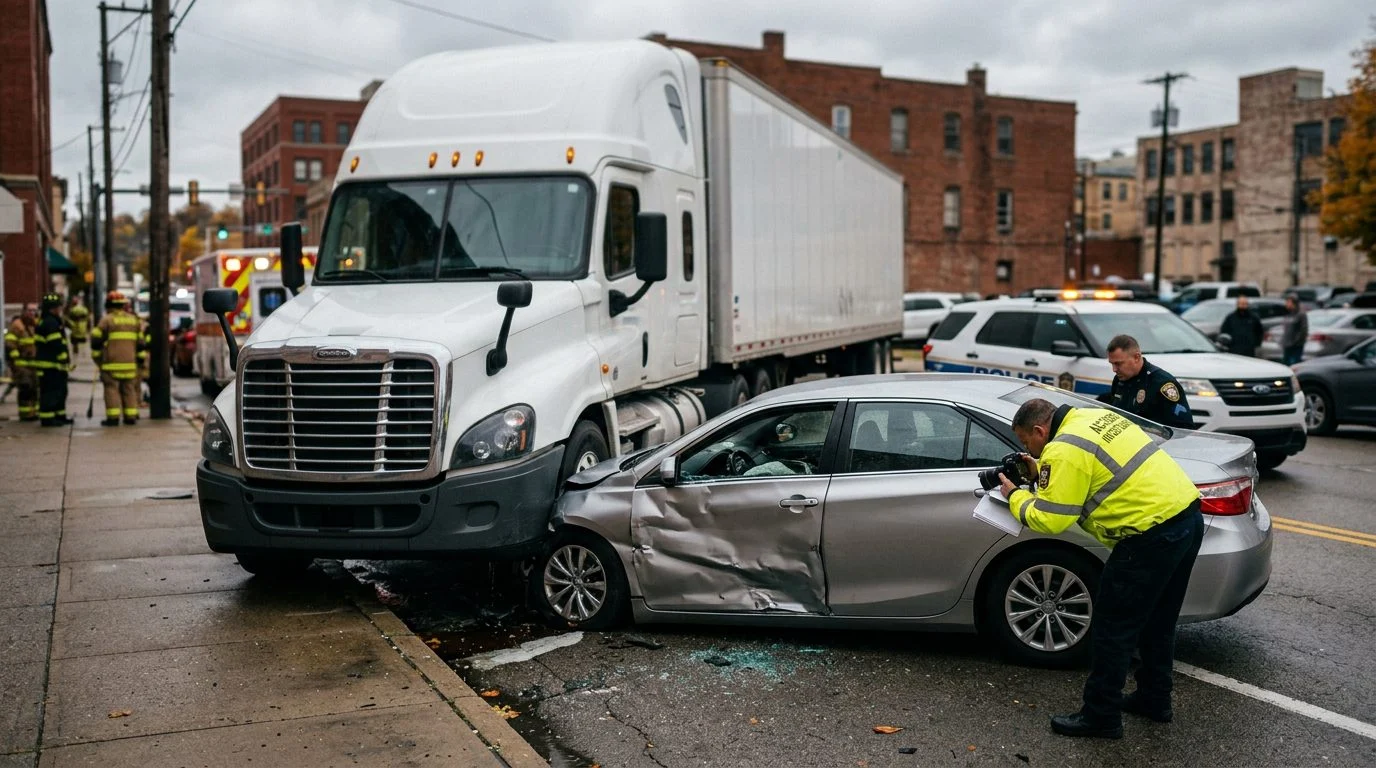
Truck and car accident claims in West Virginia
Truck vs. Car Accident Claims: Understanding How They Can Differ
A commercial truck crash can involve more parties, more records and more questions than a typical car crash. Here is how the two kinds of claims can differ in West Virginia.
Published November 6, 2026
For a truck accident vs car accident claim comparison in West Virginia, start with the vehicles. The vehicles in a crash help decide who may be responsible, what records may exist, and how a claim is organized. Both types of claims generally fall under the same core state rules. The differences come from the parties, the paperwork, and federal rules that may apply to commercial trucks.
This guide walks through those differences in plain language. It is written for adults who were hurt in a crash, or who lost a family member in one, and who are unsure which framework fits.
Why the Type of Vehicle Changes How a Claim Is Built
The type of vehicle involved often shapes a claim as much as how the crash happened. A car claim usually involves passenger vehicles like cars, pickups, and SUVs. A truck or commercial vehicle claim may involve a commercial motor vehicle requiring a commercial driver’s license, such as tractor-trailers.
West Virginia’s commercial vehicle law uses its own definitions, so the label depends on the vehicle’s type and use. W. Va. Code § 55-7-32 sets out those definitions for commercial motor vehicle cases.
Many trucking companies must also follow federal motor carrier rules. Federal rules can create records that a passenger-vehicle crash usually does not produce.
Whether a crash falls under the truck framework turns on the facts. Answering that question early helps you see which records and parties to look for.
If a truck or car crash left you or someone you love seriously hurt, you may have a claim, and we can talk through which framework fits your facts. Talk it through with Big Bubba — the first case review is free, confidential, and carries no obligation.

Side-by-Side: Truck Claims and Car Claims at a Glance
In a truck accident vs car accident claim comparison, truck claims usually involve more parties and more records. Each crash still turns on its own facts and evidence.
| Factor | Car claim | Truck or commercial vehicle claim |
|---|---|---|
| Parties who may be named | The at-fault driver, and sometimes the vehicle owner | The driver, the employer or motor carrier, the vehicle owner, and others who may control the truck |
| Typical evidence | Police report, photos, witness statements, video | Driver logs, maintenance files, driver qualification files, electronic logging data |
| Records that may exist | Crash report and medical records | Federal records that carriers must keep for set periods |
| Injury patterns | Can be serious, including brain and spinal injuries | Heavier vehicles may cause high-energy impacts and serious injuries |
| Insurers | Usually the driver’s insurer | May involve several insurers and the company’s own investigation |
This table describes common patterns, not outcomes. A car crash can produce a complex claim, and a truck crash can produce a simpler one.
Who May Be Involved: Driver, Carrier, and Vehicle Owner
A car claim often centers on the at-fault driver and that driver’s insurer. A truck claim may reach the company behind the driver.
West Virginia’s commercial vehicle law defines an “employer defendant” to include the vehicle’s owner, the operator’s employer, and any other person or entity that owns, leases, rents, or otherwise holds or exercises legal control over the truck or the driver. W. Va. Code § 55-7-32 That definition can add parties beyond the driver.
A truck claim may also involve a cargo loader, a maintenance contractor, or an equipment maker, based on the facts. In 2026, the U.S. Supreme Court held that a state-law negligent-hiring claim against a broker that selected an unsafe motor carrier falls within a federal safety exception. Montgomery v. Caribe Transport II That ruling addresses whether federal law blocks that kind of state claim. It does not decide any particular case.
Naming every potentially responsible party early can help organize a claim.
Evidence That Tends to Matter in Each Type of Claim
Truck crashes often produce more records, and some of them may be kept only for set periods. Early requests can matter for that reason.
Federal rules require many carriers to use an electronic logging device to record driver duty status, subject to listed exceptions. Logs like these may show driving time and hours before a crash.
Carriers must keep a driver qualification file for each driver. Maintenance and inspection records follow a separate schedule under maintenance record rules. Those records are kept for one year where the vehicle is housed, plus six months after it leaves the carrier’s control.
Car crashes usually produce a different set of evidence. That includes the police report, scene and vehicle photos, dashcam or nearby video, witness statements, and medical records. Video can be overwritten and memories fade, so early steps can help.
The relevance of any single item depends on the facts of the crash.
Injury Patterns in Each Type of Crash
Serious injuries can happen in both car and truck crashes. The vehicle type alone does not decide which kind of claim applies.
Heavier vehicles can produce high-energy impacts. Crashes like these may be associated with serious injuries, including traumatic brain injury and spinal cord injury. Car crashes can cause the same kinds of injuries, so severity alone does not sort a claim into one group or the other.
Catastrophic injury and wrongful death claims may need longer medical documentation and more detailed proof of losses. Records of ongoing care, lost work, and help at home can matter over time. A simple daily journal of symptoms and limits can help those records line up with medical notes.
Medical outcomes vary from person to person. Treating providers are the ones who can explain how an injury may progress.
How West Virginia Law Applies to Both Claim Types
West Virginia generally uses the same core fault rules for car and truck claims. Federal rules may add records and standards in truck cases.
Under modified comparative fault, a person’s own share of fault reduces recovery (W. Va. Code § 55-7-13c). Recovery is generally barred only if that person’s fault is greater than the combined fault of all others responsible.
A defending party may name a nonparty it believes was at fault. Under W. Va. Code § 55-7-13d, a defending party may give notice that a nonparty was wholly or partially at fault if the notice is given no later than one hundred eighty days after service of process upon that defendant. It can change how fault is split. W. Va. Code § 55-7-13d
West Virginia generally allows two years to file a personal injury lawsuit, and exceptions may apply. W. Va. Code § 55-2-12
A wrongful death action generally must be brought within two years after the death. A personal representative files it. W. Va. Code § 55-7-6
Economic losses include medical bills and lost income. Non-economic losses include pain and suffering. For wrongful death, the statute lists categories such as sorrow, mental anguish, loss of companionship, and reasonable funeral expenses.
Not sure what your next step is?
Talk it through with Big Bubba — the first case review is free, confidential, and carries no obligation.
Early Steps and Insurer Responses That Affect Both Claims
The first weeks after a crash can shape a claim. Careful early steps matter for both claim types.
Get medical care and keep a record of every visit. Save photos, bills, and documents. Write down what you remember while it is fresh, including the time, place, and weather.
Some insurers may dispute a claim. An early position from an insurer may not reflect the full picture of what happened.
West Virginia law generally limits early settlement contact after an injury. W. Va. Code § 55-7-11a A settlement, release or statement obtained in violation of this section may be disavowed by the injured person at any time within one hundred eighty days from the date of the personal injury by executing a written statement of disavowal and thereupon forwarding a copy of the same to the person violating this section. It then may not be admissible in evidence in any court or other proceeding relating to the personal injury, if any consideration paid for the settlement of or the general release of liability for the personal injury, at the time the copy of the written statement of disavowal is forwarded, is repaid or returned to the person who paid the consideration.
Think carefully before you give a recorded statement or sign a release. Ask what it covers first. A truck crash may involve several insurers and a company’s own investigation, which can make the requests more complex.
Which Situations Point to Which Framework
Two passenger vehicles usually point to a car claim. A tractor-trailer or box truck usually points to a truck or commercial vehicle claim.
Mixed cases need a closer look:
- A passenger vehicle hit by a company van, where the van’s owner or employer may be a party.
- A crash involving a work vehicle, where the business that used it may be involved.
- A multi-vehicle crash with both a car and a truck, where both frameworks may apply.
Wrongful death cases can follow either path. A family may face both types of framework based on who was driving and who owned the vehicle.
We handle truck accident claims and car accident claims for people across West Virginia. We serve Charleston, Huntington, Morgantown, Wheeling, and Beckley, along with surrounding communities.

Taking the Next Step After a Crash
If you are unsure whether your crash is a car claim, a truck claim, or both, the next step is to talk through your facts.
Picture a loaded tractor-trailer that drifted into your lane, or a family member killed in a collision with a commercial truck. Each situation may point to a different set of parties and records. A car crash where the other vehicle’s owner is unclear can raise the same questions.
A free case review gives you a chance to describe what happened. The firm can then discuss which framework and evidence may fit your facts. If a truck or car crash left you or someone you love seriously hurt, you may have a claim. When you are ready, request a free case review.
Is a truck accident claim different from a car accident claim in West Virginia?
Truck claims may add more parties and federal records.
How long do I have to file a claim in West Virginia?
West Virginia generally allows two years for personal injury and wrongful death claims. Exceptions may apply.
Can I recover damages if I was partly at fault?
Under modified comparative fault, you generally may still recover if your fault is not greater than all others combined (W. Va. Code § 55-7-13c). Under W. Va. Code § 55-7-13c, a plaintiff’s recovery may be reduced in proportion to the plaintiff’s own degree of fault, and recovery may be barred if that fault is greater than the combined fault of all other persons responsible.