
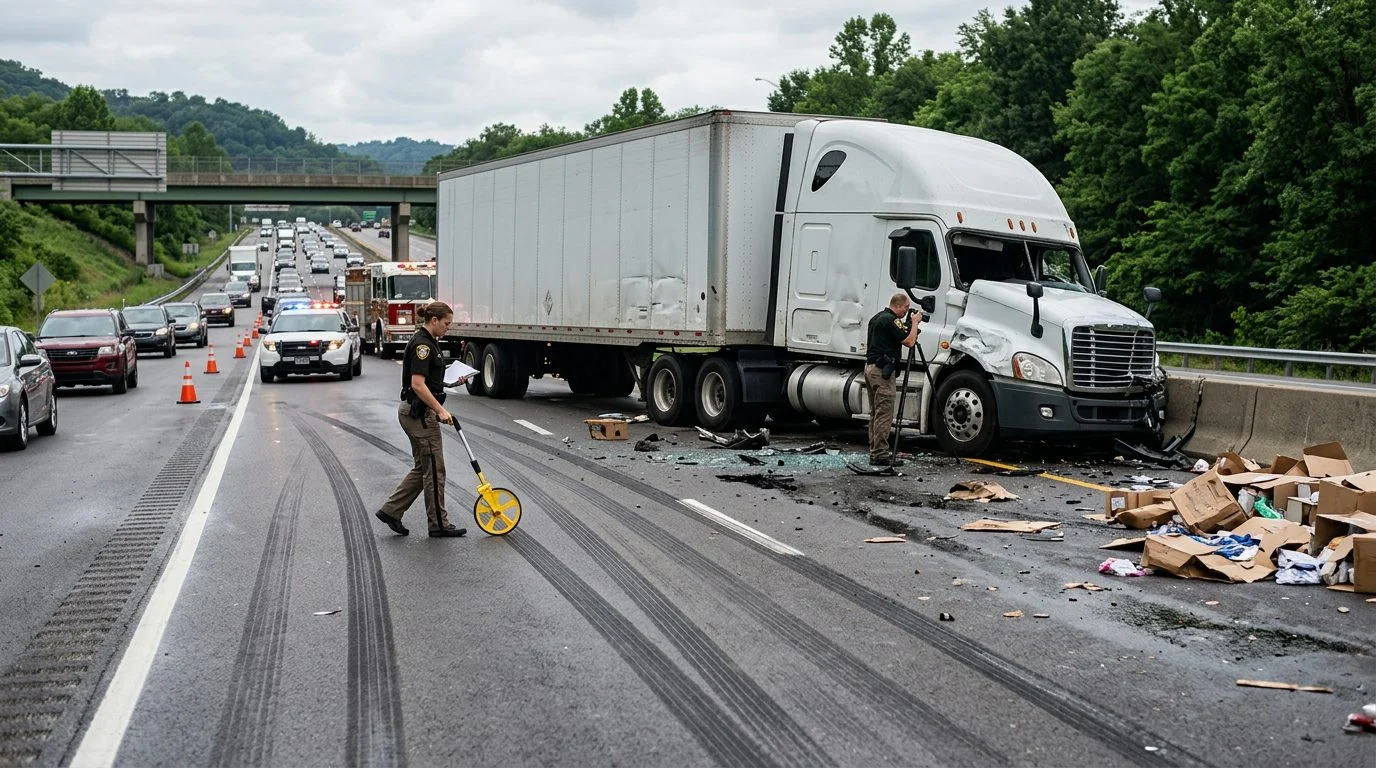
Truck Accidents
Truck Accident Injuries in Charleston, Huntington & West Virginia
When a commercial truck crash leaves you or a loved one seriously hurt, Big Bubba Injury Law is here to help you understand your rights and pursue fair compensation.
Published October 08, 2026
Truck Accidents in Charleston, Huntington, and Across West Virginia
Truck accidents in Charleston, Huntington, Morgantown, and throughout West Virginia are fundamentally different from car crashes. The sheer size and weight of commercial trucks—often 20 to 30 times heavier than passenger vehicles—create collision forces that cause catastrophic injuries and fatalities. When a tractor-trailer collides with a car on I-64, I-77, or I-68, the outcome is rarely minor.
This page explains what makes truck accidents different, why they happen in these specific West Virginia cities, what injuries commonly result, and what steps you should consider taking if you or a family member has been hurt.

Not sure what your next step is?
Talk it through with our team — the first case review is free, confidential, and carries no obligation.
Truck Accidents Are Fundamentally Different from Car Accidents
The weight and size of a commercial truck create collision dynamics that have no parallel in passenger-vehicle crashes. A loaded tractor-trailer can weigh 80,000 pounds or more; a typical car weighs around 3,000 to 4,000 pounds. In a collision, that disparity in mass and momentum means the occupants of the smaller vehicle absorb the vast majority of the force.
Beyond physics, truck accidents involve layers of legal complexity that car accidents do not. Truck drivers and trucking companies must comply with federal motor carrier safety regulations governing hours of service, vehicle maintenance, cargo securing, and driver conduct. When those rules are violated, or when they should have been enforced but weren’t, additional parties may bear responsibility, including the driver, the trucking company, the maintenance contractor, or even the cargo loader. Responsibility generally depends on whether the violation actually caused the harm, and the facts of each case control the outcome.
In a truck accident case, multiple parties may share responsibility. The driver may have been fatigued or distracted. The trucking company may have failed to maintain the vehicle properly. A third-party maintenance contractor may have installed faulty brakes. The cargo may have been loaded or secured improperly. Insurance companies and investigators become involved quickly, and the legal and factual issues multiply.
Why Truck Accidents Happen in Charleston, Huntington, and Morgantown
Charleston, Huntington, and Morgantown sit along or near major interstate corridors that carry heavy commercial traffic every day. I-64 runs through Charleston and Huntington. I-77 passes near Charleston. I-68 connects Morgantown to the broader interstate system. These highways are lifelines for commerce—and they are also where many serious truck accidents occur.
West Virginia’s terrain compounds the risk. The state’s mountainous landscape means steep grades, sharp curves, and challenging road conditions. In winter, rain, snow, fog, and ice make these roads even more hazardous for large vehicles that require longer stopping distances and are more prone to jackknifing on slippery surfaces. A truck traveling at highway speed on a wet or icy grade may lose braking control or tip on a curve far more easily than a car.
Urban and rural transitions also create accident zones. Trucks navigating city limits, construction zones, and the shift from highway to local roads face changing speeds, traffic patterns, and road surfaces. The driver’s attention, the vehicle’s condition, and the company’s scheduling all play a role in whether an accident happens.
Common Causes of Truck Accidents in West Virginia
Driver Fatigue
Federal regulations prohibit drivers from operating a commercial motor vehicle while their ability or alertness is impaired through fatigue, illness, or any other cause that makes it unsafe to operate the vehicle. Despite these rules, fatigued driving remains a leading cause of truck accidents. Federal regulations also limit driving time: a driver may drive a total of 11 hours during a 14-hour period after taking 10 consecutive hours off duty. When drivers or trucking companies violate these hours-of-service rules, tired drivers operate vehicles on West Virginia’s challenging roads with slower reaction times and impaired judgment.
Improper Maintenance
Every motor carrier and intermodal equipment provider must systematically inspect, repair, and maintain, or cause to be systematically inspected, repaired, and maintained, all motor vehicles and intermodal equipment subject to its control, and parts and accessories shall be in safe and proper operating condition at all times. Brake failure, tire blowouts, steering problems, and other mechanical defects are far more dangerous in a truck than in a car. A brake failure on a mountain grade or a tire blowout at highway speed can cause a truck to jackknife, roll, or collide with other vehicles.
Overloading and Improper Cargo Securing
An overloaded or improperly secured cargo shifts the truck’s center of gravity and affects handling. On curves and steep grades, an unbalanced load can cause a truck to tip. Cargo that shifts during braking or acceleration can destabilize the entire vehicle.
Speeding and Unsafe Speed for Conditions
Trucks need far longer stopping distances than cars. A fully loaded truck traveling at 65 miles per hour may need 400 feet or more to come to a complete stop. Excessive speed on wet or icy roads, or speed that is unsafe for the truck’s condition or the road’s grade, is a major accident cause.
Distracted or Reckless Driving
Phone use, eating, adjusting controls, or aggressive maneuvers in a vehicle this size create severe hazards. A momentary distraction can have catastrophic consequences.
Weather and Road Conditions
Rain, snow, fog, and ice on West Virginia roads are particularly hazardous for large vehicles. Poor visibility, reduced traction, and wind gusts all increase accident risk.
Have questions about what happened?
Ask our team directly. The first conversation is free, confidential, and there is no obligation to continue.
Injuries from Truck Accidents
The force involved in truck collisions often causes injuries that are severe, permanent, and life-altering.
Traumatic Brain Injury
A traumatic brain injury (TBI) is a bump, blow, or jolt to the head that can result in cognitive, physical, and emotional changes. In a truck accident, head trauma from impact or sudden deceleration can cause TBI ranging from mild concussion to severe, permanent disability. Survivors may experience memory loss, difficulty concentrating, mood changes, and physical impairment.
Spinal Cord Injury
Spinal cord injury can result in partial or complete paralysis, affecting mobility, sensation, and independence depending on the location and severity of the injury. A truck accident can damage the spine through impact, crushing, or sudden deceleration. The consequences—loss of function, chronic pain, and permanent disability—reshape a person’s life.
Severe Burns
Fuel leaks and fires following a truck accident can cause extensive burn injuries, often requiring long-term hospitalization and reconstructive surgery.
Crush Injuries and Amputations
The weight and size of a truck can crush limbs, requiring amputation. Survivors face not only physical recovery but also adjustment to life without a limb.
Multiple Injuries
Truck accident survivors often suffer broken bones, internal injuries, organ damage, and soft-tissue injuries simultaneously. Recovery is prolonged and expensive.
Wrongful Death
The most severe truck accidents result in fatalities. Families lose a loved one and face not only grief but also financial hardship and the need to understand their legal rights.
What to Do After a Truck Accident
Seek Immediate Medical Attention
Even injuries that seem minor can worsen. A medical record created at the scene or shortly after is important for your health and for any future claim.
Call Emergency Services
Ensure police respond and create an official accident report. The report will document the scene, the vehicles involved, and initial observations about what happened.
Document the Scene
If it is safe to do so, take photos of vehicle damage, road conditions, debris, and the truck’s position. Photos preserve evidence that may otherwise be lost.
Gather Witness Information
Collect names and contact details from anyone who saw the accident. Witness testimony can be crucial.
Preserve Evidence
Do not allow the truck to be repaired or moved until it has been inspected. Request that the trucking company preserve maintenance records, electronic logs, and driver records. This evidence may be critical to your case.
Report to Your Insurance Company
Notify your insurer, but be cautious about detailed statements until you understand your rights. Insurance adjusters work to minimize payouts.
Avoid Discussing Fault
Do not admit liability or sign documents without legal review. Statements made at the scene or to insurance companies can be used against you later.
Why You May Need Legal Help After a Truck Accident
Trucking companies have legal teams and insurance adjusters working to minimize payouts. You deserve representation on your side.
Federal regulations create additional claims and liability pathways that a personal injury attorney can identify and pursue. Catastrophic injuries often require long-term care, ongoing medical treatment, and substantial compensation; an attorney can calculate true damages rather than accepting an early, low-ball offer.
Wrongful death cases involve complex family law and financial claims that require experienced guidance. Evidence can disappear: truck maintenance records, electronic logs, and driver records must be requested and preserved quickly, or they may be lost forever.
Settlement negotiations are complex. Trucking companies and their insurers have experience in these cases and will use it to their advantage. An attorney who understands truck accident claims, federal trucking regulations, and how fault is handled under West Virginia law can help you pursue your case.
Serving Truck Accident Victims Across West Virginia
We serve Charleston injury victims and all of West Virginia’s 55 counties. We serve Huntington injury victims and surrounding areas. We serve Morgantown injury victims and the North-Central region. Whether your accident happened on an interstate, a state route, or a local road, we handle truck accident cases across the state.
Want to know where you stand?
Tell us what happened and our team will walk you through the options available to you, at no cost.
Frequently Asked Questions
How long do I have to file a lawsuit after a truck accident in West Virginia?
In West Virginia, a personal-injury lawsuit generally must be filed within two years after the right to bring the claim accrued (W. Va. Code § 55-2-12). In a wrongful-death case, the action generally must be brought within two years after the decedent’s death, subject to other provisions that may apply (W. Va. Code § 55-7-6). Do not delay; deadlines are strict.
Can I recover damages if I was partly at fault in a truck accident?
Yes. West Virginia follows a modified comparative fault rule: your damages are reduced in proportion to your own percentage of fault, but you are barred from recovery only if your fault is greater than the combined fault of all other parties (W. Va. Code § 55-7-13c). If your fault is less than the combined fault of all other persons, your recovery is reduced in proportion to your degree of fault.
Who can be held liable in a truck accident?
The truck driver, the trucking company, a maintenance contractor, the cargo loader, or the truck manufacturer may all share liability depending on the facts. An attorney can investigate and identify all responsible parties.
What should I do if the trucking company contacts me after an accident?
Do not speak with them without an attorney present. They are not on your side. Refer all inquiries to your lawyer.
Related practice areas
- Truck Accident Claims in West Virginia | Big Bubba Legal