
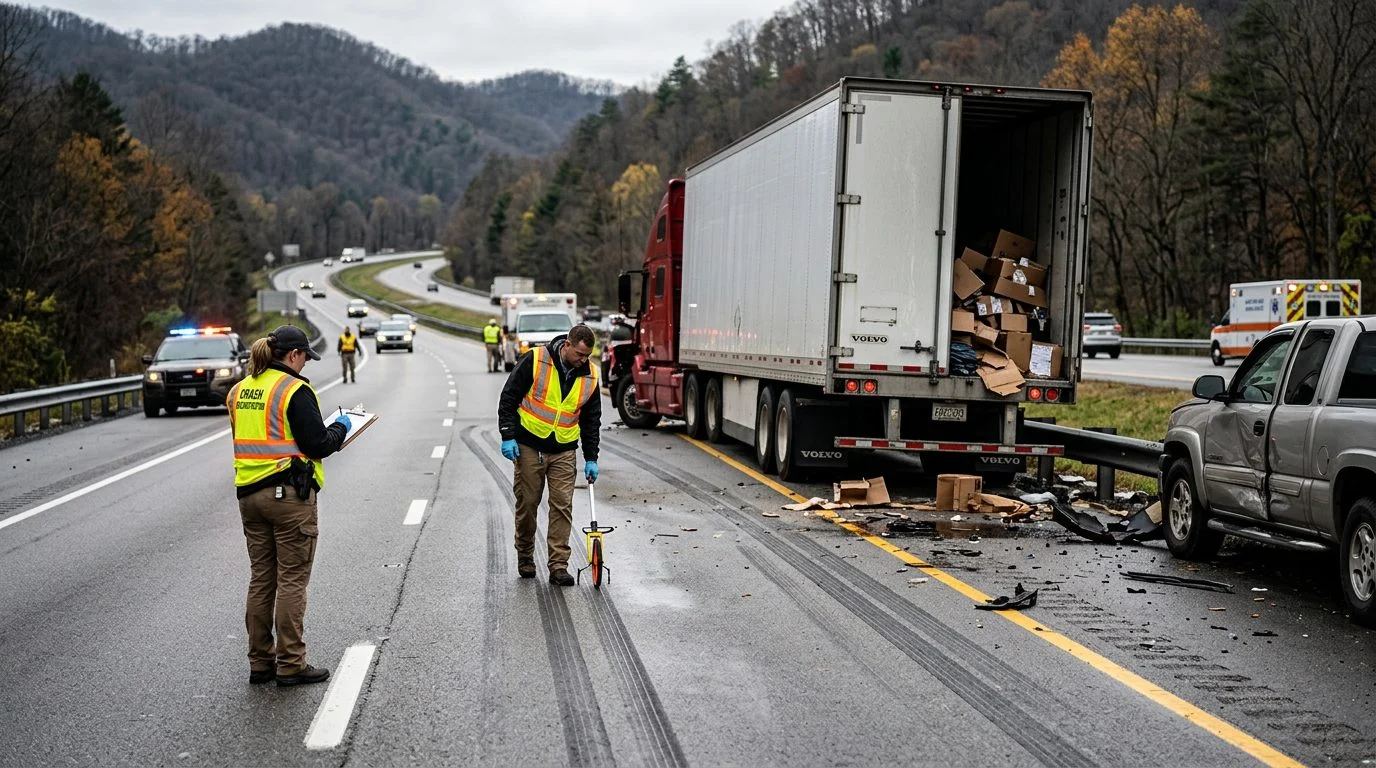
Truck Accident Claims | West Virginia
Why Preserving Truck Crash Evidence Matters
Trucking companies keep logs, maintenance files, and electronic data that may be overwritten or discarded over time. A preservation letter asks them to keep it.
Published November 4, 2026
A truck accident evidence preservation letter is a written request. It asks the trucking side to keep records and the truck itself. It also puts the other side on notice of what matters. This page explains the term “spoliation,” what these letters usually cover, and why timing can matter in a West Virginia truck crash claim.
What “spoliation” means after a truck crash
Spoliation is the loss, destruction, or change of evidence that may matter to a legal claim. Courts treat it differently depending on the facts and the court involved.
The word comes up often in truck cases for a clear reason. The trucking company usually controls most of the records. It holds the driver’s logs, maintenance files, dispatch messages, and the truck itself. The injured person and their family usually hold very little of that material.
Spoliation does not mean anyone did something wrong. Records can be purged on normal schedules, and trucks get repaired all the time. Still, a missing record can make a claim harder to prove, so people ask about it early.
If you were hurt, or you lost someone in a crash, you may have heard this word from a tow yard, an insurer, or a relative. You don’t need to know every legal rule to ask good questions. Knowing the term is a useful start.
If a truck crash has left you or your family wondering whether the truck's records are still being kept, we can talk through your situation in a free case review. Talk it through with Big Bubba — the first case review is free, confidential, and carries no obligation.

What an evidence preservation letter is
A truck accident evidence preservation letter is a written request, usually sent early. It asks the other side to keep specific evidence. The letter names the crash, the date, and the parties. It lists the kinds of material the sender wants kept. It also asks the recipient to confirm in writing that the material is being held.
The letter is not a lawsuit. By itself, it does not stop anyone from throwing records away or repairing a truck. Think of it as notice. It tells the other side what matters, so they can’t later say they didn’t know.
That notice can matter. If evidence disappears after a letter arrives, the letter may show the other side knew what to keep. How a court would weigh that is a question for the specific case. A letter is one step within a broader claim, and it doesn’t promise any particular result.
Why truck crash evidence is time-sensitive
Federal rules set minimum retention periods for many truck company records, and some of those periods are short. Federal rules state that a motor carrier must not alter or erase, or permit or require alteration or erasure of, the original information collected concerning a driver’s hours of service (49 C.F.R. § 395.30(f)).
The federal retention schedule shows how short some windows are. Claims registers that record personal injury claims must be kept for 1 year after settlement, along with their supporting data. Supporting data for periodic reports of accidents, inspections, tests, and hours of service may be kept for only 6 months. federal retention schedule
Driver records of duty status and their supporting documents may be subject to a retention period under federal rules. Under 49 C.F.R. § 396.21, the original or a copy of a periodic inspection report must be retained by the motor carrier, intermodal equipment provider, or other entity responsible for the inspection for fourteen months from the date of the inspection report. inspection report rules
These are minimums, not promises about what a company keeps. Claims often take longer than these periods. A record can become eligible for routine disposal before a case is well underway. That is why timing matters for any truck accident evidence preservation letter.
Physical evidence changes too. A truck can be repaired, sold, or sent to salvage. Damaged parts can be thrown out. Dash camera footage can be overwritten on a loop. Routine business steps like these can change what remains.
What a preservation letter typically asks the other side to keep
A typical letter asks the other side to keep electronic data, driver records, the vehicle and its parts, and trip communications. The right list changes with how the crash happened.
- Electronic data: electronic logging device (ELD) records, engine control module data, and GPS or telematics information. Federal rules bar a carrier from altering or erasing original hours-of-service information. ELD edit and retention rules
- Driver records: duty status logs, hours-of-service records, training files, and drug and alcohol testing records. Federal ELD rules require that a driver and the motor carrier ensure the driver’s ELD records are accurate, and the post-accident testing requirements page covers post-accident testing separately. post-accident testing requirements
- Vehicle and parts: the truck, the trailer, damaged components, and maintenance and inspection records.
- Communications and cargo: dispatch messages, phone records tied to the trip, dash camera footage, bills of lading, and load information.
Federal ELD rules prohibit a motor carrier from coercing a driver to make a false certification of the driver’s data entries or record of duty status, and the false records rule bars a motor carrier, its agents, officers, representatives, or employees from making a fraudulent or intentionally false entry on any record required to be used, completed, or retained to comply with any requirement of this subchapter or part 325 of subchapter A. false records rule A letter that names these items gives the other side a clear list to follow.
Who may receive a preservation letter
The trucking company, the driver’s employer if different, the vehicle’s owner, and the trucking side’s insurer may each hold relevant evidence. One truck can involve several companies.
West Virginia law describes an “employer defendant” in a commercial motor vehicle case. It can include the vehicle’s owner, the operator’s employer, and any other entity that holds legal control over the vehicle or driver. West Virginia employer liability law That is why a letter may need to reach more than one party.
The insurer for the trucking side may hold claim files and other records. Some insurers may dispute a claim, so a complete written request matters.
Tow yards and storage facilities may hold the truck after a crash. They can be part of preservation planning. You may not know every party holding evidence at the start. crash report guidance A crash report may help identify the parties involved.
How the letter fits with medical and crash records
A preservation letter targets the other side’s evidence. Your medical records document your own injuries, and the crash report documents the crash. Both matter, and each covers different ground.
Your medical records show your injuries, treatment, and recovery. Tell every provider how the crash happened. Keep copies of discharge papers, imaging results, and treatment notes. A dated list of visits can help you stay organized.
The crash report and the truck’s logs can show what happened on the road. If another driver was at fault, that driver’s records may become part of the claim.
West Virginia uses a modified comparative fault rule. Under W. Va. Code § 55-7-13c, fault chargeable to you does not bar recovery unless it is greater than the combined fault of all other persons. W. Va. Code § 55-7-13c reads: “(c) Any fault chargeable to the plaintiff shall not bar recovery by the plaintiff unless the plaintiff’s fault is greater than the combined fault of all other persons responsible for the total amount of damages, if any, to be awarded.” Otherwise, recovery is reduced in proportion to your fault. West Virginia generally allows two years to file a personal injury action, and exceptions may apply. West Virginia limitation period
For the broader process, see truck accident claims in West Virginia.
Not sure what your next step is?
Talk it through with Big Bubba — the first case review is free, confidential, and carries no obligation.
Steps to take now
Start by keeping what you can safely gather yourself, then reach out early. Early contact gives the firm more time to discuss a preservation letter with you.
- Take photos of the scene, the vehicles, and any visible damage, if you can do so safely.
- Write down the names and contact details of any witnesses, along with the date and time of the crash.
- Keep a dated list of treatment visits and the providers you saw.
- Save every letter you receive from an insurer or the trucking company.
The firm handles truck accident claims, commercial vehicle cases, and wrongful death claims for families. It can talk with you about whether a truck accident evidence preservation letter fits your facts. The firm offers a free case review, which is confidential and carries no obligation to continue. A review can’t promise any particular result, but it can give you clear next steps.
If a serious truck crash or a family’s wrongful death loss has you asking what the truck’s records still hold, contact us and tell us what happened.