
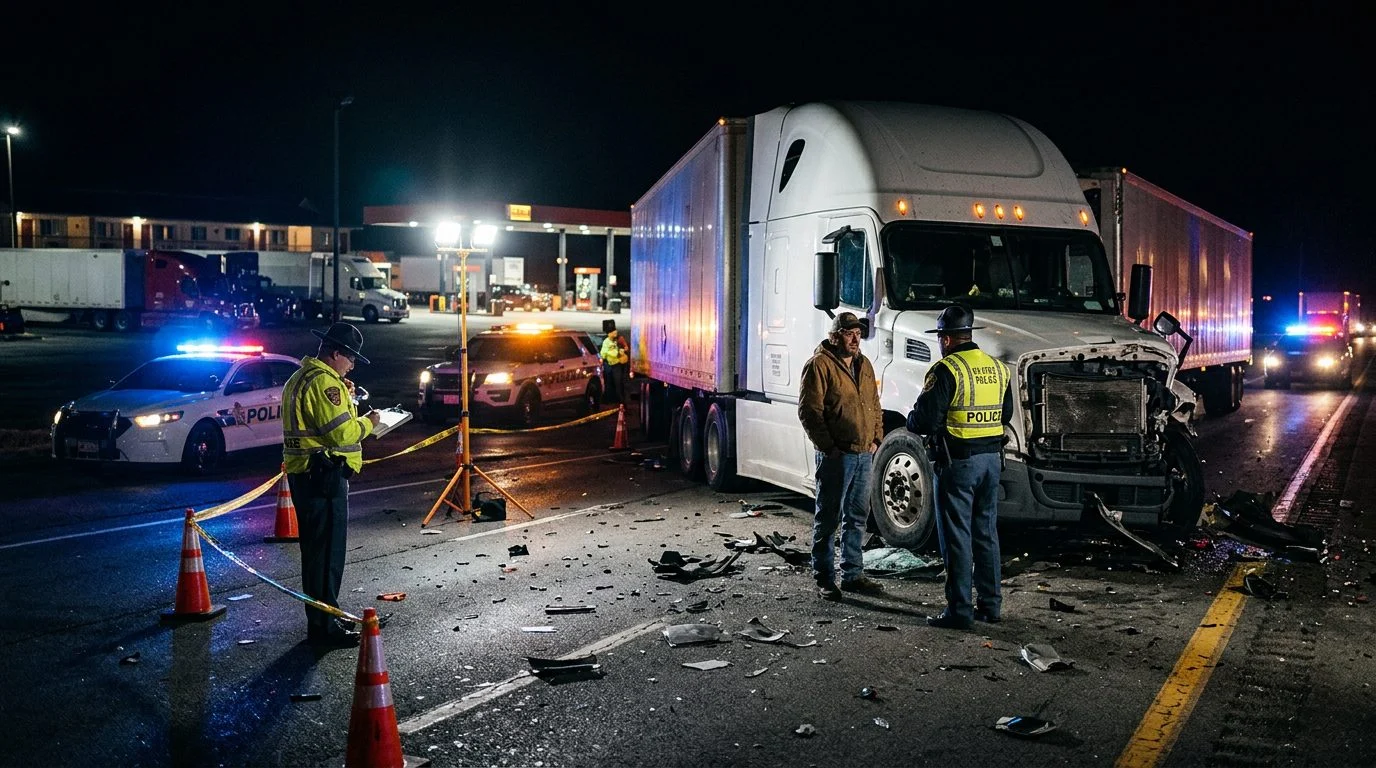
Truck Accidents | West Virginia
Truck Driver Drug Testing After a Crash in West Virginia
Drug and alcohol testing can play a major role in a truck accident claim. Learn what to ask about, what records to protect, and how the firm can help you get started.
Published November 1, 2026
Yes, in many cases. Federal rules require many commercial truck drivers to be tested for alcohol and drugs after certain crashes on public roads. This page explains the truck driver drug test after accident West Virginia rules that apply, when testing must happen, and what results and refusals can mean for an injury or wrongful death claim. We handle truck accident and commercial vehicle claims for people across West Virginia. The details below come from federal regulations and West Virginia law.
Are Truck Drivers Drug and Alcohol Tested After a Crash?
Yes. Federal rules require many commercial drivers to be tested for alcohol and drugs after a qualifying crash. The post-accident testing rule applies to surviving drivers after a crash involving a commercial motor vehicle operating on a public road in commerce in two cases. The first is when the crash involved a death and the driver was performing safety-sensitive functions with respect to the vehicle. The second is when the driver receives a citation under State or local law for a moving traffic violation arising from the accident, within 8 hours of the occurrence for alcohol testing or within thirty-two hours for controlled substances testing, and the crash involved bodily injury with immediate medical treatment away from the scene or disabling damage requiring tow-away. The FMCSA testing requirements explain which tests apply and when they happen.
A test run by law enforcement can still count. It counts if it meets the rules and the employer obtains the results. The federal post-accident testing rule sets out the details. Because the rules can change, that regulation is the place to confirm current requirements.
If you want to talk through how these records may apply to your crash, reach out to the firm for a free case review . Talk it through with Big Bubba — the first case review is free, confidential, and carries no obligation.

Which Truck Crashes Trigger Post-Accident Testing?
Under 49 C.F.R. § 382.303, an employer must test each surviving driver for alcohol as soon as practicable after a commercial motor vehicle crash when the driver receives a citation within 8 hours for a moving traffic violation arising from the accident and the accident involved bodily injury that immediately requires medical treatment away from the scene. The same citation-based rule applies to controlled substances testing, with a thirty-two-hour window. For alcohol testing, the employer must test each surviving driver who was performing safety-sensitive functions with respect to the vehicle if the accident involved the loss of human life, or who receives a citation within 8 hours of the occurrence for a moving traffic violation arising from the accident if the accident involved bodily injury requiring immediate medical treatment away from the scene or disabling damage requiring tow-away (49 C.F.R. § 382.303). Testing is also required when a vehicle has disabling damage and must be towed away, and the driver is issued a citation. Under the federal definitions, disabling damage keeps a vehicle from leaving the scene in its usual way after simple repairs.
Picture a tractor-trailer that rear-ends a car on a two-lane county road in Harrison County. The car driver is taken away by ambulance. The truck’s front end is too damaged to drive away. In a crash with no death, an ambulance transport or a tow-away alone does not trigger testing of the truck driver; testing is required only if the driver also receives a citation under State or local law for a moving traffic violation arising from the accident, and for alcohol testing that citation must come within 8 hours of the occurrence (49 C.F.R. § 382.303(a)(2) and (b)(2)).
Families often do not learn that a test happened unless someone asks. The employer keeps these records under federal rules. That is why the question is worth raising early.
Time Limits for Alcohol and Drug Tests After a Crash
The employer must test as soon as practicable after the crash. Under the federal rule, an alcohol test that is not given within two hours requires a written record of the reasons. If the alcohol test is not given within eight hours, the employer must stop trying.
Drug testing has a longer window. If a drug test is not given within 32 hours, the employer must stop trying. It must also keep a record of why the test was not promptly given.
The driver has limits too. A driver who is subject to post-accident testing shall remain readily available for such testing. A driver who must take a post-accident alcohol test may not use alcohol for eight hours after the accident, or until the test is taken, whichever comes first, under a separate rule, 49 C.F.R. § 382.209. This is set out in the use-after-accident rule.
Medical care comes first. Federal rules say nothing requires delaying necessary medical attention for injured people. Gaps in the testing timeline often become questions in a claim, so the written reasons matter.
What a Drug or Alcohol Test Result Can and Cannot Show
A result shows what the test detected in a sample collected at a specific time. It does not, by itself, show who caused the crash. Federal records treat results differently. Verified positive drug results and alcohol results of 0.02 or greater must be kept. Negative drug results and alcohol results below 0.02 must be kept for at least one year, as the employer record rules state.
A positive result raises questions about the driver’s status and the company’s decisions. A negative result answers one question but not others. A test that was never given raises questions about timing and the reasons on file. Each outcome points to different facts.
Crash reports, witness accounts, vehicle data, and driver logs fill in the rest. How a result fits one crash depends on the facts of that crash.
What Does It Mean When a Driver Refuses a Post-Accident Test?
A refusal is a violation of federal rules. No driver may refuse a required post-accident alcohol or drug test. No employer may let a driver who refuses keep doing safety-sensitive work. The refusal rule sets out both points.
Refusal covers more than saying no. It also includes failing to give a required urine or oral fluid sample, as the refusal definitions explain.
A driver who cannot give a sample for a medical reason is in a different position. Federal rules treat a driver who cannot provide a sufficient amount of urine or oral fluid as having refused only if a required medical evaluation finds no adequate medical explanation for the failure.
State law links refusal to damages, too.
How Testing Records Can Fit Into a Truck Crash Claim
Testing records can be one part of the evidence in a truck crash claim. Other evidence can include crash reports, driver records, and hours-of-service logs. Each piece helps show what happened on the road.
Time limits matter. West Virginia generally allows two years to file a personal injury claim, under W. Va. Code § 55-2-12. It must be commenced within two years after the death, subject to the provisions of section eighteen, article two, chapter fifty-five, under W. Va. Code § 55-7-6. W. Va. Code § 55-7-6 reads: “The provisions of this section shall not apply to actions brought for the death of any person occurring prior to July 1, 1988.”
Some records are kept for only a year, so early requests matter. For the wider process, read our truck accident guide.
Common Questions
Are truck drivers drug tested after an accident?
Often, yes. For crashes in which someone needs immediate medical treatment away from the scene, or a vehicle has disabling damage that requires a tow, federal rules require post-accident testing of many commercial drivers only when the driver also receives a citation for a moving traffic violation arising from the crash.
How long do trucking companies keep test records?
Negative drug results and alcohol results below 0.02 must be kept for at least one year. Verified positive results and refusal records are also required records that must be maintained for a minimum of five years.
Can a truck driver’s drug test be used in a lawsuit?
It can be one piece of evidence. It sits alongside the crash report, witness accounts, and driver logs.
Not sure what your next step is?
Talk it through with Big Bubba — the first case review is free, confidential, and carries no obligation.

Talk With the Firm About Your Crash
If a commercial driver in your crash was tested, refused, or was never asked to test, the timing and records may matter. The firm handles car, truck, and commercial vehicle crash claims, along with catastrophic injury and wrongful death cases. We serve Charleston and communities across West Virginia. If you want to talk through how these records may apply to your crash, reach out to the firm for a free case review.