
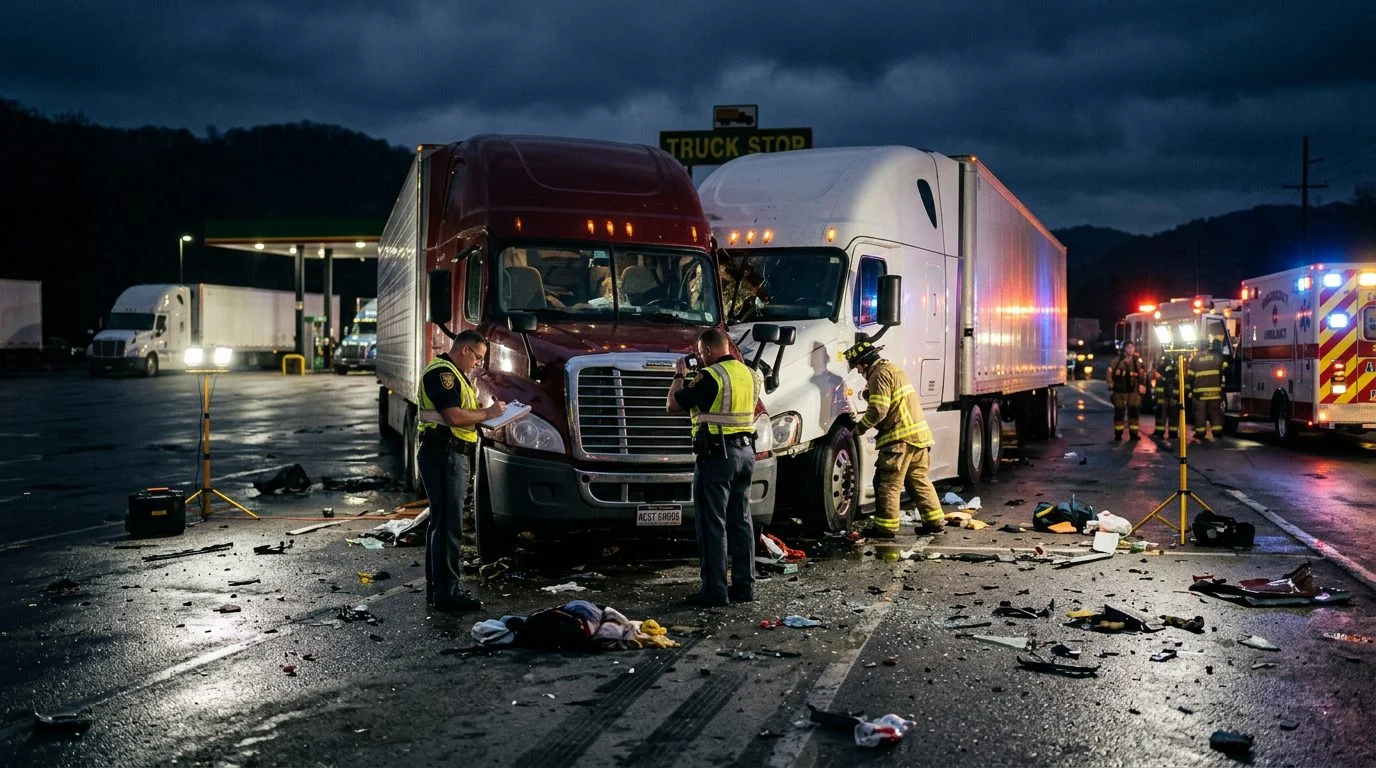
Truck Crash Claims in West Virginia
Truck Driver Phone Records After a Crash: What They May Show
Phone records are one piece of evidence, not a final answer. Here is how they may fit into a West Virginia truck crash claim, and how the firm can help you review your situation.
Published November 2, 2026
Truck driver phone records can show whether a phone was in use around the time of a crash. They are one piece of evidence, and they do not decide fault on their own. If you are looking into a crash with a commercial truck in West Virginia, this page explains what these records may show, which ones may matter, and how they fit with other proof. Phone use is an alleged or possible factor here until the evidence shows otherwise.
Why Phone Use Often Comes Up After a Truck Crash
Questions about a truck driver’s phone use often come up after a serious crash. A witness may say the driver looked down or seemed distracted. Investigators may ask what the driver was doing in the moments before impact.
Families often hear about phone use secondhand, from a news story, a friend, or someone at the scene. That can make a hard situation feel even harder.
You did not choose to be part of this crash. If you are a family member, you may be handling grief, medical care, and time away from work all at once. It’s normal to feel overwhelmed by the questions.
A concern about phone use is a reason to look closer. It is not a finding. The evidence has to show what happened. Our truck accidents page covers the wider picture of these claims, and early questions often shape which evidence is still available.
If you're wondering whether a truck driver's phone use belongs in your family's story, you can reach out to the firm for a free case review, which is confidential. Talk it through with Big Bubba — the first case review is free, confidential, and carries no obligation.

Federal Rules on Phone Use for Commercial Drivers
Federal rules limit texting and hand-held phone use by drivers of commercial motor vehicles. These rules set a clear standard that a claim may measure driving conduct against.
Under 49 C.F.R. § 392.80, a driver generally may not engage in texting while driving, with a narrow emergency exception. A motor carrier may not allow or require its drivers to text while driving. For this rule, driving includes being temporarily stopped in traffic with the motor running.
A separate rule, 49 C.F.R. § 392.82, covers hand-held mobile telephones. A driver generally may not use a hand-held phone while driving a commercial motor vehicle on a highway. This rule also has an emergency exception. It does not apply once the driver has moved off the highway and stopped where the vehicle can safely remain.
A rule violation is not the same as fault. Whether a violation played a part in a particular crash depends on the facts and the evidence.
What Phone Records Can Show About the Time of a Crash
Phone records can show calls, texts, and data activity with a time stamp. Those times can be compared with the time of the crash.
Call logs show when a call started and how long it lasted. Text and data records may show activity at specific times. The timing is what matters most in these records.
Timestamps may not line up exactly. Different companies and devices can record time differently, and a clock may be off. A close match or a gap may or may not be meaningful.
Records can also be incomplete. A carrier may not keep every type of activity. Some records may need someone to interpret them. Call and text logs usually do not show how a phone was held, so they rarely tell the whole story alone.
Which Phone Records May Be Relevant, and Which May Not
Records from the minutes before and during a crash are usually the ones that matter most.
Records from unrelated days or hours may be less relevant. A request that asks for everything may draw objections. Courts can decide disputes about how wide a request should be.
Different sources may hold different records. The driver’s own phone may hold data the carrier does not. The carrier may keep call and text logs. Some devices and vehicles may store their own activity data. Each source may be relevant in a different way.
Privacy also matters. A request is usually narrowed to the time and information that bear on the crash. A simple test helps: ask whether the record shows what the driver was doing around the time of the crash. If it does, it may matter. If it does not, it may not be the focus.
How Phone Records Are Requested in a Claim and Why Timing Matters
Phone records are usually requested in writing first. If a lawsuit is filed, they can be requested through the court process.
A preservation request is a written letter asking the other side to keep evidence. It may cover phone records, driver logs, vehicle data, and photos. Sending one early can help, because some records are kept only for limited periods. How long any record is kept depends on the company and the facts.
Once a lawsuit is filed, the parties can use discovery. Discovery is the formal process of exchanging information before trial.
Driver logs also matter. Under 49 C.F.R. § 395.8, motor carriers subject to the requirements of this part, except private motor carriers of passengers (nonbusiness), must require drivers to record their duty status for each 24-hour period. The same section says the driver signs the duty status record, and that signature certifies that all entries the driver made are true and correct.
Timing for the claim is a separate question. West Virginia generally requires a wrongful death action to be brought within two years after the death, and exceptions may apply. See W. Va. Code § 55-7-6.
Some insurers and trucking companies may dispute or limit what they produce. If that happens, a court can decide the dispute.
How Phone Evidence Fits With Crash Reports, Driver Logs, and Witness Accounts
Phone records are one kind of evidence. Investigators and attorneys compare them with other sources to build a timeline of the crash.
The police crash report may record what an officer saw, measured, or was told at the scene. It is not a finding of fault. Witness statements can add details about how the truck was moving and what the driver seemed to be doing.
Driver logs and electronic records may show when a driver was on duty and driving. Federal Hours of Service rules set driving limits, rest breaks, and sleeper-berth rules for commercial drivers.
Some trucks use telematics. The WV fleet telematics overview describes telematics as recording vehicle information such as speed, braking, idle time, and distance.
When these sources are lined up, they can show a sequence of events. No single source decides the case.
Under W. Va. Code § 55-7-13a, recovery in personal injury, property damage, and wrongful death actions is predicated on comparative fault, and liability is allocated to each person in direct proportion to that person’s percentage of fault. Under W. Va. Code § 55-7-13c, a plaintiff’s recovery is barred only if the plaintiff’s fault is greater than the combined fault of all other persons. Otherwise, recovery is reduced in proportion to the plaintiff’s own fault.
Not sure what your next step is?
Talk it through with Big Bubba — the first case review is free, confidential, and carries no obligation.
What to Know Early in a Truck Crash Case
If a loved one was hurt or killed in a crash with a commercial truck, the firm can talk through what happened with you. You may be asking whether the driver’s phone use should be looked into, and you may be asking on someone else’s behalf. That is a hard place to start.
The firm handles car accident, truck accident, commercial vehicle accident, catastrophic injury, traumatic brain injury, spinal cord injury, and wrongful death matters. We serve Charleston injury victims, along with Huntington, Morgantown, and other communities across West Virginia.
To talk through whether the driver’s phone use is relevant to your family’s situation, you can request a free case review from the firm. The review is confidential, and there is no obligation to continue.
Related practice areas
- Truck Accident Claims in West Virginia | Big Bubba Legal
- Truck Accidents in Charleston
- Truck Accidents in Huntington
- Truck Accidents in Morgantown