
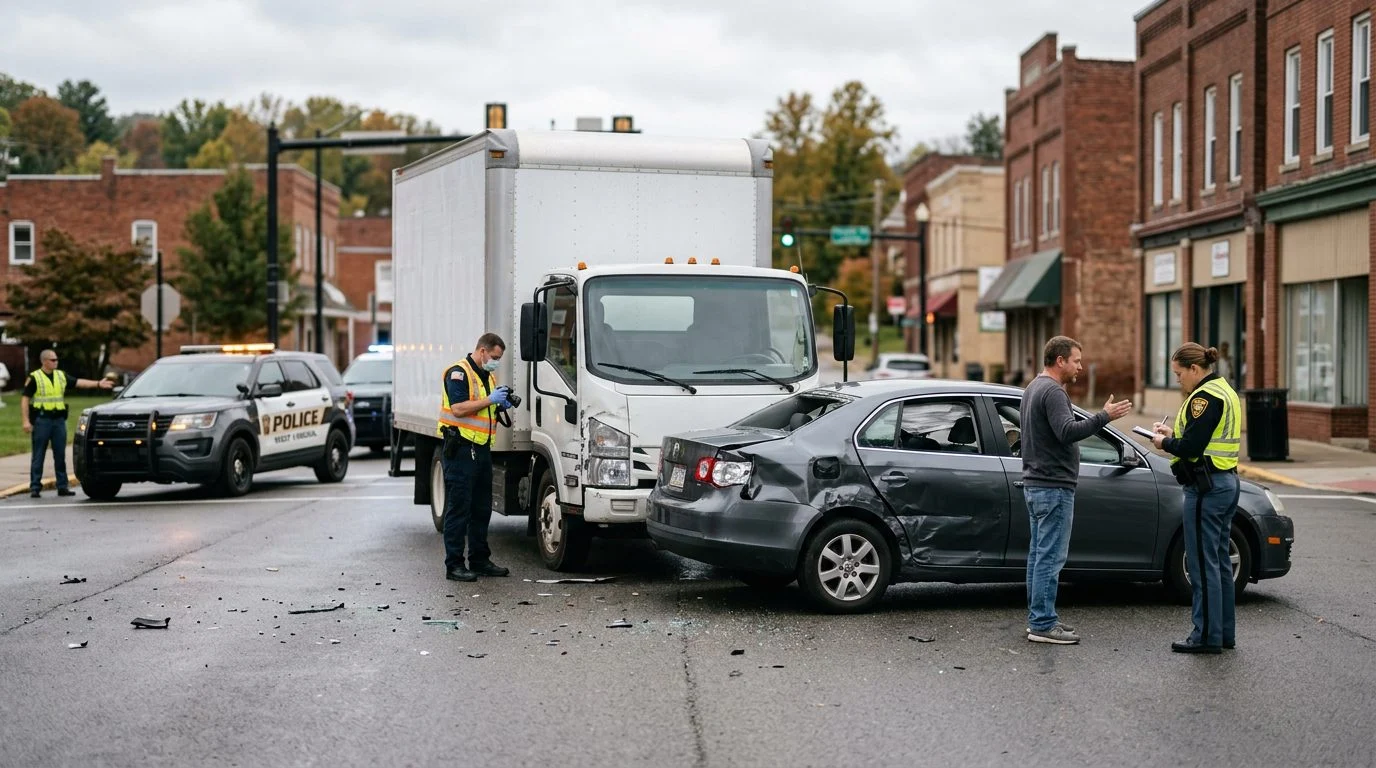
Commercial Vehicle Accidents
Company Truck Hit Your Car? What to Do Now in West Virginia
Immediate steps to protect yourself and your claim—and when to call Big Bubba.
Published October 02, 2026
Company Truck Hits Your Car: What to Do Now
If a company truck has just hit your car, safety comes first. Get medical help if anyone is hurt. Then, the steps you take in the next few hours—gathering information, documenting what happened, and reporting the accident—can make a real difference in your claim.
This guide walks you through what to do right now, what to document, and when to reach out for legal help.
If you have questions about liability or what you may be entitled to recover. Talk it through with our team — the first case review is free, confidential, and carries no obligation.
Immediate Steps at the Scene
Check for injuries and call 911 if anyone is hurt.
Your health and safety come first. Call emergency services even if injuries seem minor. The officer who investigates the crash must prepare a report of it (W. Va. Code § 17C-4-7). This creates an official record.
Move to safety if possible.
If both vehicles can move and traffic allows, get them out of the roadway. Turn on hazard lights. Place warning triangles or flares behind your vehicle to alert oncoming traffic.
Do not admit fault or apologize.
Statements you make at the scene can be used against you later. Stick to facts: what you saw, where you were, what happened. Don’t speculate about causes.
Exchange information with the truck driver.
Get the driver’s full name, phone number, home address, and driver’s license number. Ask for the company name. Write down the truck’s license plate, vehicle identification number (VIN), and any company markings or logos. This establishes it was a company vehicle.
Get the company’s contact information.
Ask the driver for the trucking company’s name, phone number, and address. If the driver is unclear, note any signage on the truck.
Request the driver’s insurance information.
Get the insurance company name, policy number, and agent contact details. This is the company’s commercial insurance, which typically covers company vehicle accidents.
Take photographs and video at the scene.
Document damage to both vehicles, the accident scene, road conditions, traffic signs, weather, and vehicle positions. Photograph the company truck’s name, logo, and license plate clearly. Preserve these images immediately.
Get names and contact information from witnesses.
If anyone saw the accident, ask for their full name, phone number, email, and what they saw. Witness statements are often critical in establishing liability.
Document Everything After the Accident
Write down your account while it’s fresh.
Within a few hours, write a detailed narrative: where you were, what you saw the truck do, how the collision occurred, and what you felt or heard. Include the date, time, and exact location.
Record the date, time, location, and weather conditions.
Note whether it was raining, snowing, foggy, or clear. Was it daytime or dark? Were streetlights on? These details matter.
Note any injuries, pain, or symptoms that develop.
Injuries from motor vehicle accidents don’t always show up immediately. Keep a record of pain, bruising, headaches, neck stiffness, or other symptoms. This documentation links the accident to your injuries.
Keep all medical records, receipts, and bills.
Save every receipt, bill, and medical record from emergency rooms, urgent care, or your doctor’s office. These documents prove the extent of your injuries and treatment costs.
Save repair estimates and invoices for your vehicle.
Get written estimates from repair shops for damage to your car. Once repairs are complete, keep the invoices. These establish repair or replacement costs.
Preserve photos and video from the scene.
Don’t delete them from your phone or camera. Back them up to a cloud service or email them to yourself.
Keep copies of the police report once filed.
Contact the local police department or sheriff’s office to request a copy of the accident report. The report includes the officer’s observations, any citations, and an official record.
Document any lost wages if you miss work.
If you can’t work because you’re injured or your car is in the shop, keep records of time missed and income lost.
Report the Accident
File a police report in West Virginia.
Call the local police department, sheriff’s office, or state police if the accident occurred on an interstate. Provide a factual account of what happened. Get the officer’s name, badge number, and report number. Ask when and how you can obtain a copy.
Report the accident to your own insurance company promptly.
Insurance policies generally require you to report accidents promptly, so check your policy’s notice terms. Provide the facts, the other driver’s information, and the company name. Do not speculate about fault.
Do not sign anything from the company’s insurance without understanding it.
Insurance companies may send documents to sign, including liability waivers or settlement agreements. Do not sign anything you don’t fully understand.
Avoid giving a recorded statement to the company’s insurer without legal advice.
The company’s insurance adjuster may ask to record a statement from you. You have the right to decline or have an attorney present. A recorded statement can be used against you if your claim becomes disputed.
Keep records of all communications with insurance companies.
Save emails, letters, and notes of phone calls. Record the date, time, name of the person you spoke with, and what was discussed.
What Happens When a Company Truck Hits Your Car?
The company may be liable under vicarious liability.
This legal doctrine holds an employer responsible for the negligence of an employee acting within the scope of employment. If the truck driver was working for the company at the time of the accident, the company itself may be liable for the driver’s negligence.
The truck driver’s employer typically carries commercial insurance.
Unlike personal auto insurance, commercial vehicle insurance covers accidents involving company trucks and employees. This insurance usually has higher coverage limits because commercial vehicles pose greater risk.
Your claim may involve multiple parties.
Depending on the circumstances, liability may rest with the truck driver, the company, the company’s insurance, a vehicle manufacturer (if there was a mechanical defect), a maintenance contractor, or others. An attorney can help identify all potentially responsible parties.
The company may try to settle quickly.
Insurance companies sometimes offer fast settlements to close claims cheaply. Don’t rush into an agreement. You may not yet understand the full extent of your injuries, long-term treatment costs, or what a fair settlement looks like.
If injuries are involved, the situation becomes more complex.
Injuries from commercial truck collisions can be serious. Medical expenses, lost income, and pain and suffering may be recoverable. The more serious the injury, the more important it is to understand your rights before settling.
When to Seek Legal Help
If you or anyone in your vehicle was injured, even if injuries seem minor at first.
Injuries can worsen or develop over time. An attorney can help ensure you understand the full scope of your damages and that any settlement reflects your actual losses.
If the company or its insurer denies responsibility or refuses to communicate.
If the company claims the accident wasn’t the driver’s fault or won’t return your calls, you may need legal representation to pursue your claim.
If repair costs or medical bills are substantial.
The larger your losses, the more important it is to have professional guidance in valuing your claim and negotiating a fair settlement.
If you are unsure about your rights or what a fair settlement looks like.
An attorney can explain what you may be entitled to recover and help you evaluate any offer before you accept it.
If the company’s insurer pressures you to settle quickly.
Pressure tactics—deadlines, low initial offers, or refusals to consider your full damages—are red flags. An attorney can handle negotiations on your behalf.
If the accident involved a large commercial truck.
Delivery, construction, utility, and other commercial vehicles of 10,001 pounds or more used in interstate commerce are subject to Federal Motor Carrier Safety Regulations that govern driver qualifications, maintenance, and safe operation. Violations of these regulations can establish negligence. An attorney familiar with these regulations can investigate whether safety violations contributed to the accident.
If you have questions about liability or what you may be entitled to recover.
West Virginia law permits recovery of damages for losses caused by negligence, including vehicle damage, medical expenses, lost income, and pain and suffering. An attorney can assess your specific situation and advise you on your claim.
Not sure what your next step is?
Talk it through with our team — the first case review is free, confidential, and carries no obligation.
Can I Sue a Truck Company for Damaging My Car?
Yes, you may have a claim against the company for vehicle damage and other losses.
If the truck driver was acting within the scope of employment when the accident occurred, the company may be liable. You can pursue a claim through the company’s insurance or, if necessary, through a lawsuit.
Damages you may recover include vehicle repair or replacement costs, medical expenses, lost wages, and other losses directly caused by the accident.
The specific damages available depend on the circumstances and the extent of your injuries.
The company’s liability depends on whether the driver was acting within the scope of employment.
If the driver was making a delivery, traveling to a job site, or performing other work duties, the accident likely occurred within the scope of employment. If the driver was on a personal errand unrelated to work, liability may be limited to the driver personally.
West Virginia law allows you to recover damages for losses caused by negligence.
You don’t need to prove the company intentionally caused the accident—only that the driver was negligent (failed to exercise reasonable care) and that negligence caused your losses.
Key Takeaways
- Prioritize safety and medical attention first. Call 911 if anyone is hurt.
- Gather detailed information at the scene: driver name and contact, company name, truck plate and VIN, insurance details, witness names and contact information.
- Take photographs and video of vehicle damage, the scene, road conditions, and the company truck’s identifying information.
- Report the accident to police and your insurance company promptly.
- Document everything: medical records, repair estimates, lost wages, and all communications with insurance companies.
- Do not agree to anything hastily or without understanding the terms. Don’t sign documents or give recorded statements without knowing what you’re agreeing to.
- Reach out for legal guidance if injuries are involved, the company resists your claim, or you’re unsure about your rights. Many people in your situation find that talking to an attorney early helps them avoid costly mistakes and understand what they’re entitled to recover.
When a Company Truck Hits Your Car, You Need Answers
If you’ve been hit by a company truck and you’re injured or unsure about your rights, contact Big Bubba today for a free case review. We help people understand their rights after commercial vehicle accidents and serious injuries. We also handle truck accident claims and can guide you through the insurance claim process.
Big Bubba | Personal Injury Law Firm | West Virginia
Representing people seriously hurt in car and commercial truck accidents, catastrophic injuries, and families in wrongful death cases.
Frequently Asked Questions
What should I do immediately after a company truck hits my car?
Call 911 if anyone is hurt. Move to safety if possible. Exchange information with the truck driver, including their name, phone number, driver’s license, and the company name. Get the truck’s license plate and VIN. Take photographs of the damage, scene, and the company truck’s markings. Get witness names and contact information.
Can I sue a company for a truck accident if the driver was at fault?
Yes. If the truck driver was acting within the scope of employment when the accident occurred, the company may be liable under the principle of vicarious liability. An attorney can help you identify all potentially responsible parties and pursue your claim.
What damages can I recover if a company truck hits my car?
You may recover vehicle repair or replacement costs, medical expenses, lost wages, and other losses directly caused by the accident. The specific damages available depend on the circumstances and the extent of your injuries.
Should I give a recorded statement to the company’s insurance adjuster?
You have the right to decline or to have an attorney present. A recorded statement can be used against you if your claim becomes disputed. It’s often wise to consult with an attorney before giving any recorded statement.
What is vicarious liability?
Vicarious liability is a legal doctrine that holds an employer responsible for the negligence of an employee acting within the scope of employment. If the truck driver was working for the company at the time of the accident, the company itself may be liable for the driver’s negligence.
How long do I have to file a claim after a company truck hits my car?
West Virginia has statutes of limitations that govern how long you have to file a lawsuit. The specific timeframe depends on the type of claim. An attorney can advise you on the deadline that applies to your situation.
Safety first. If anyone is injured, call 911 immediately. Move to a safe location if possible and stay out of traffic. Your health and safety come before anything else.
What to do at the scene
Get the details
Exchange information with the truck driver: name, phone number, driver's license number, and the company name. Record the truck's license plate and VIN. Ask for the company's insurance information.
Document everything
Take photographs of the damage to your vehicle, the scene, the company truck's markings and condition, and any visible injuries. Capture road conditions and traffic signals if relevant.
Gather witnesses
Get the names and contact information of anyone who saw the crash. Witness statements can be crucial to your claim.
Report the accident
File a police report and get a copy of the report number. Notify your own insurance company, but do not admit fault or sign anything beyond the police report without legal advice.
Have questions about what happened?
Ask our team directly. The first conversation is free, confidential, and there is no obligation to continue.
Why commercial truck accidents are different
Multiple parties may be liable
The driver, the trucking company, the vehicle owner, and the company that hired the truck may all share responsibility. Big Bubba investigates all angles to identify who should pay for your injuries and losses.
Complex regulations apply
Commercial vehicles are subject to federal and state safety rules. Violations of those rules—maintenance failures, driver fatigue, improper loading—can strengthen your claim.
Time matters
Evidence disappears, memories fade, and witnesses move on. The sooner you act, the better we can preserve the facts and build your case.
Insurance companies play hardball
Commercial insurers have teams of lawyers and adjusters. You need someone in your corner who understands their tactics and knows how to push back.
Do not delay.
Injuries from truck crashes can be severe and may not show up right away. Seek medical attention even if you feel fine. A doctor's records will document your injuries and support your claim. Contact Big Bubba as soon as possible so we can begin protecting your rights.
Common questions about truck accidents in West Virginia
Can I sue the trucking company?
Yes. If the company's negligence—or the negligence of its driver, maintenance crew, or hiring practices—caused the crash, the company can be held liable. We investigate the company's records, driver history, and vehicle maintenance to build your case.
What if I was partially at fault?
West Virginia allows you to recover damages even if you share some fault, as long as you are not more than 50% responsible (W. Va. Code § 55-7-13c). The amount you recover is reduced by your percentage of fault.
What damages can I recover?
Medical bills, lost wages, pain and suffering, property damage, and in cases of catastrophic injury or death, additional damages for loss of enjoyment of life or loss of companionship. We fight for fair compensation for all your losses.
How long do I have to file a claim?
West Virginia law sets strict time limits for filing a lawsuit. Do not wait. Contact Big Bubba right away so we can protect your rights and meet all deadlines.
Big Bubba is here for you
Call anytime
Reach Big Bubba by phone to tell us what happened. We’ll listen and talk with you about your options.
Request a case review
We'll review the details of your crash and injuries at no cost. You'll know where you stand and what your options are.
No fees unless there is a recovery
We handle your case on a contingency basis. You pay no attorney fees unless we recover money for you. You are responsible for court costs and case expenses.
Serving West Virginia
We represent people seriously hurt in car and commercial truck crashes across West Virginia. If you were hit by a company truck, we can help.
Ready to talk to Big Bubba?
Related practice areas
- Truck Accident Claims in West Virginia | Big Bubba Legal
- How Long Does It Take to Settle a Truck Accident Case?