
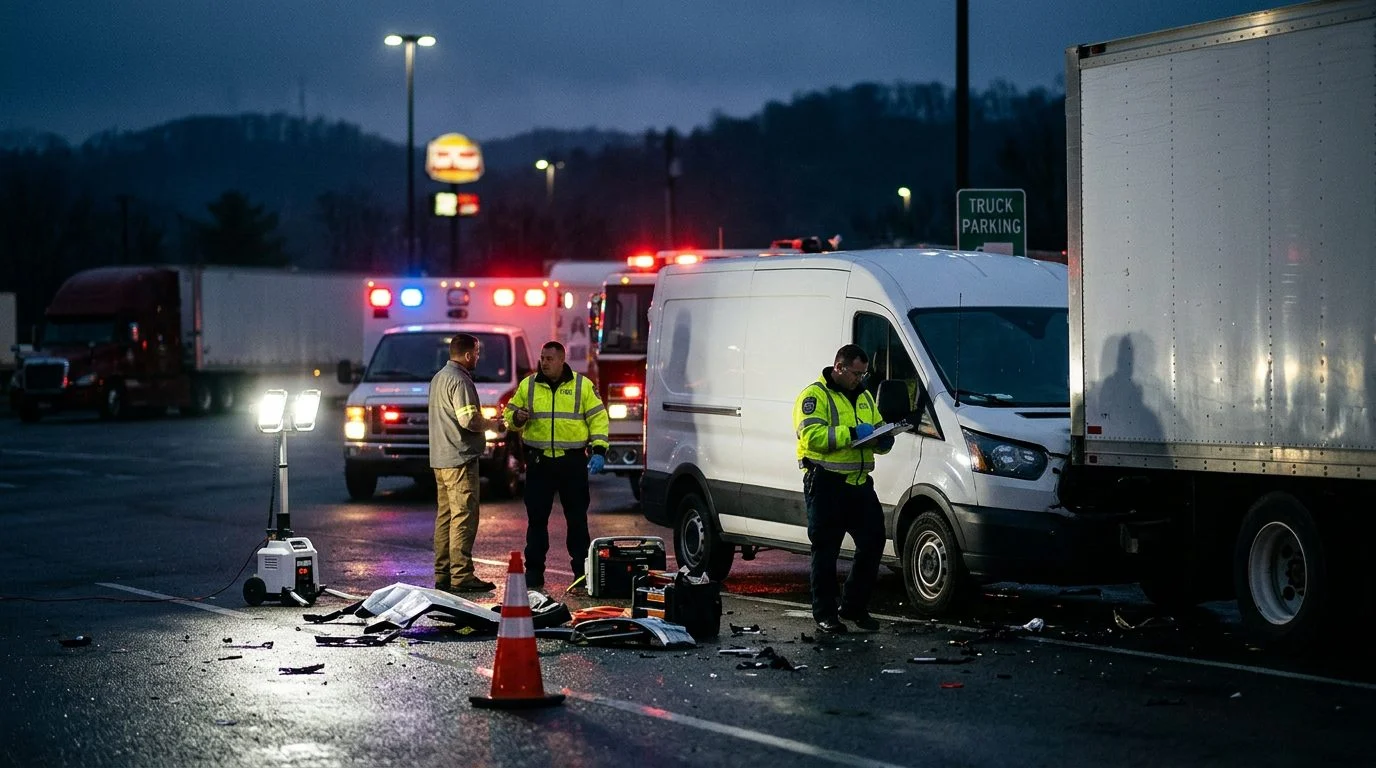
Work Van Accidents | West Virginia
Hurt in a Work Van Crash? Start With a Free Case Review
Crashes involving work vans can raise questions about who was driving, who owned the vehicle, and who may be responsible. Reach out and we will talk through what happened.
Published November 11, 2026
If a work van hit you, or a work van hit someone you love, you may be asking who is responsible and what comes next. A work van accident claim can reach past the driver to the company that owned or controlled the van.
West Virginia generally allows two years to file most personal injury claims, and exceptions may apply (W. Va. Code § 55-2-12). The sections below explain the main parties, the claim types, and the steps that often come first.
What Makes a Work Van Crash a Commercial Vehicle Matter
A work van crash becomes a commercial vehicle matter when the van is used for business and fits the law’s definition of a commercial motor vehicle. Not every company van does.
West Virginia’s commercial vehicle statute uses a defined term that includes certain trucks, tractors, and trailers. It leaves out vehicles that mainly carry passengers, such as school buses. W. Va. Code § 55-7-32 does not apply to those vehicles: its definition of commercial motor vehicle excludes a school bus and other vehicles primarily engaged in transporting passengers.
Federal rules add a second question. The federal motor carrier rules apply to employers, employees, and commercial motor vehicles that transport property or passengers in interstate commerce. Commercial driver’s license standards also reach some intrastate drivers.
Classification matters because it can shape which company records exist and which parties may be reviewed. A van that falls under federal rules may leave a different paper trail than a personal vehicle.
If a company van crash left you or someone you love hurt, someone else may be responsible, and we can help you understand your options. Talk it through with Big Bubba — the first case review is free, confidential, and carries no obligation.
Who Can Be Involved in a Work Van Accident Claim
The driver, the employer, and sometimes the van’s owner or a repair shop may all be involved. Each party is tied to the crash by its own facts, so no one is assumed responsible in advance.
- The driver who was operating the van when the crash happened.
- The employer. West Virginia’s statute treats the vehicle owner, the operator’s employer, and anyone with legal control of the vehicle as an “employer defendant.” W. Va. Code § 55-7-32
- A leasing company or owner, if it differs from the employer.
- A repair shop or maintenance contractor, if a poor repair may have contributed.
- A parts maker, if a defect may have played a role.
- Other drivers whose conduct may have caused or added to the crash.
Employers can face claims in more than one way.
Workers’ Compensation and Other Claims After a Work Van Crash
If you were working when the crash happened, workers’ compensation may be one route. A claim against other responsible parties may be another route.
Workers’ compensation is a separate system for injuries on the job. It can work differently from a lawsuit, and it may not cover every loss you face. A claim against someone outside your employer, such as another driver or a parts maker, may still be possible.
Keep every workers’ compensation form, letter, and payment record you receive. Write down the dates and who sent each item. These papers can affect how a claim is organized, so review them carefully. Ask questions before you sign anything.
What a Work Van Accident Claim May Cover
A claim may seek compensation for medical bills, lost income, and other losses tied to the crash. The exact mix depends on your injuries and your losses.
- Past and future medical bills related to the crash.
- Lost wages, and lost ability to earn in the future if the injury affects your work.
- Pain, suffering, and loss of enjoyment of life.
- Damage to the vehicle and to personal belongings.
- For brain or spinal cord injuries, ongoing care needs may be part of the review.
- For wrongful death, a verdict may include sorrow, mental anguish, and solace, lost income and services, care and hospital expenses, and reasonable funeral expenses. W. Va. Code § 55-7-6
Under W. Va. Code § 55-7-13a, comparative fault is the degree to which a person’s fault was a proximate cause of an alleged personal injury, death or property damage, expressed as a percentage, and liability is allocated to each person in direct proportion to that person’s percentage of fault (W. Va. Code § 55-7-13a). If you were partly at fault, your recovery is predicated on principles of comparative fault, with liability allocated in direct proportion to your percentage of fault. Under West Virginia’s comparative fault law (W. Va. Code § 55-7-13c), your fault generally does not bar recovery unless it is greater than the combined fault of all other persons responsible for the damages, and when your fault is less than that combined fault, your recovery is reduced in proportion to your degree of fault. W. Va. Code § 55-7-13c
How a Work Van Accident Claim Usually Starts
A claim usually starts with medical care, a crash report, and early contact with the firm. Each step builds the record that a claim review needs.
- Get medical care. Follow the treatment plan, because medical records tie injuries to the crash.
- Get the crash report. Note the responding agency and the report number.
- Write down company details. Record the company name, phone number, and any unit or DOT number on the van.
- Talk with the firm early. The firm offers a free case review, with no obligation to continue.
- Preserve evidence. The firm may send letters asking responsible parties to keep records and evidence.
- Review and next steps. Investigation and claim review follow. Timing varies with the facts and the parties involved, and a lawsuit may follow if needed.
Timing matters in one more way. West Virginia law limits settlement talks during the first twenty days after an injury, when the injured person is in a hospital or unable to work. Under W. Va. Code § 55-7-11a, a settlement, release of liability or statement obtained in violation of that section may be disavowed by the injured person at any time within one hundred eighty days from the date of the personal injury, by executing a written statement of disavowal and forwarding a copy to the person who violated the section. W. Va. Code § 55-7-11a
Evidence That May Matter After a Work Van Crash
Photos, witness details, and company records often matter most. Some company data can be lost over time, so early preservation can help.
- Photos of the scene, vehicle damage, and visible injuries, taken when it is safe.
- Names and contact details of witnesses.
- Dashcam, GPS, or telematics data, which a company may overwrite on its own schedule.
- Driver logs, schedules, and training or qualification records, where federal rules apply.
- Vehicle maintenance and inspection records.
- Medical records and bills that link your injuries to the crash.
Federal rules set minimum retention periods for certain company records. After the required retention periods, a company subject to this part may destroy records at the discretion of its management, but this does not excuse compliance with the lawful requirements of any other governmental body prescribing longer retention periods. 49 CFR 379.3 That is one reason early contact with the firm may matter.
Not sure what your next step is?
Talk it through with Big Bubba — the first case review is free, confidential, and carries no obligation.
Questions People Ask About Work Van Accident Claims
Most people ask about deadlines, passengers, and insurers first. The short answers below are a starting point.
Can a passenger in a work van bring a claim?
Passengers may have claims against responsible parties. Who is responsible is decided crash by crash.
What is the deadline for a work van accident claim?
West Virginia generally allows two years to file a personal injury claim, and exceptions may apply. W. Va. Code § 55-2-12
Will the insurer contact me?
Some insurers may dispute a claim. Talking with the firm before giving a statement may help you understand your options.
What if the van belonged to a contractor, not the company I work for?
Both the contractor and the company may be reviewed. The question is who owned or legally controlled the van.
What if a work van hit me while I was driving?
If another driver was at fault, that driver and the vehicle owner may both be relevant.
Do I need to know who was at fault before reaching out?
No. You can describe what happened, and the facts of the crash will be reviewed.

What to Do Next After a Work Van Crash
The next step is to describe what happened to the firm. A crash with a work van can leave you with questions about who is responsible and what to do.
If a work van pulled into your lane on a West Virginia highway, or a company van crash took someone you love, the first days can feel overwhelming. The firm handles car accident, truck accident, and commercial vehicle accident claims. It also handles catastrophic injury matters, including traumatic brain injury and spinal cord injury, and wrongful death cases. We serve Charleston, Huntington, and Morgantown injury victims and families across West Virginia.
If a company van may have caused your injury or a loved one’s death, reach out to us and tell us what happened.