
Wrongful Death · West Virginia
Wrongful Death in West Virginia: A Civil Claim Built for Grieving Families
When someone else's wrongful act takes a loved one, the legal path can feel unfamiliar. Here is a plain-language look at how these claims work.
Published November 22, 2026
After a crash takes a loved one’s life, families often ask a hard question: what kind of lawsuit is a wrongful death case? A wrongful death lawsuit is a civil claim, not a criminal case.
It lets a decedent’s personal representative seek compensation after a death caused by another party’s wrongful act, neglect, or default that would have entitled the injured person to sue had death not occurred. This guide explains how these claims work in West Virginia, who brings them, what they must show, and the timing rules that matter most.
What a wrongful death lawsuit is
A wrongful death lawsuit is a civil claim filed after a person dies because another party’s wrongful act, neglect, or default caused the death. Under W. Va. Code § 55-7-5, the party who would have been liable had the person lived can face a damages action even after the death.
The money is meant to compensate the people left behind and the estate. The claim asks what the family lost because of the death.
Picture a two-lane road crash where another driver is said to have crossed the center line. The driver of the other car dies days later from injuries. If that driver’s negligence caused the crash and the death, the family may have a claim.
Negligence is a plain idea. It means failing to use the care a reasonable person would use in the same situation. Many crashes involve more than one person, so a claim may name more than one party. For more background, read our wrongful death claims in West Virginia overview.
If a crash took someone you love, you may have questions about your options. We're glad to talk them through with you in a free case review. Talk it through with Big Bubba — the first case review is free, confidential, and carries no obligation.

Civil or criminal: how the two differ
A wrongful death lawsuit is civil, while a criminal case is brought by the government. Middle District of Florida guidance explains that civil disputes are between private parties, while criminal prosecutions are brought by the government.
A criminal case can lead to charges against the person accused of a crime. A wrongful death lawsuit does not bring criminal charges. Its goal is compensation for the family, not a criminal penalty.
The two can move on separate tracks. A criminal case does not automatically decide a civil claim, and a civil claim does not decide a criminal charge. Each has its own rules and its own proof.
Civil and criminal cases are separate proceedings, and families weighing their options often find that difference worth understanding. Families should know which kind of case they are looking at, since each follows its own path.
If another driver was at fault, a civil claim may be available, depending on the facts. The civil case looks at fault and losses, not whether someone is charged with a crime.
Who can bring a wrongful death claim in West Virginia
In West Virginia, the claim is brought by the personal representative of the deceased person’s estate. A personal representative is the person a court appoints to manage the estate.
W. Va. Code § 55-7-6 says every such action shall be brought by and in the name of a duly appointed personal representative. The recovery is then distributed as the statute directs.
The same section lets the jury or court decide how damages are split. It names the surviving spouse and children, including adopted children and stepchildren, along with brothers, sisters, parents, and any persons who were financially dependent on the person who died or would otherwise be equitably entitled to share in the distribution.
The rules depend on the family’s circumstances. Who is named, who depended on the person, and how the estate is opened can all affect the case. These questions are worth reviewing early, before deadlines pass. Some families are not sure who counts as a beneficiary, and that is a normal question to ask.
We serve Charleston and Huntington injury victims, along with families across West Virginia.
What a family must show: the basic elements of negligence
A family generally must show that the other party owed a duty of care, broke that duty, and caused the death. The claim also depends on the losses the law allows the family to recover.
Duty means the other party owed a reasonable level of care. Everyone on the road generally owes others that care.
Breach means that care was not given. Take a driver who may not have stopped for a red light. Whether that failure happened is a question of proof.
Causation connects the breach to the death itself. Causation is central, so it needs careful attention early.
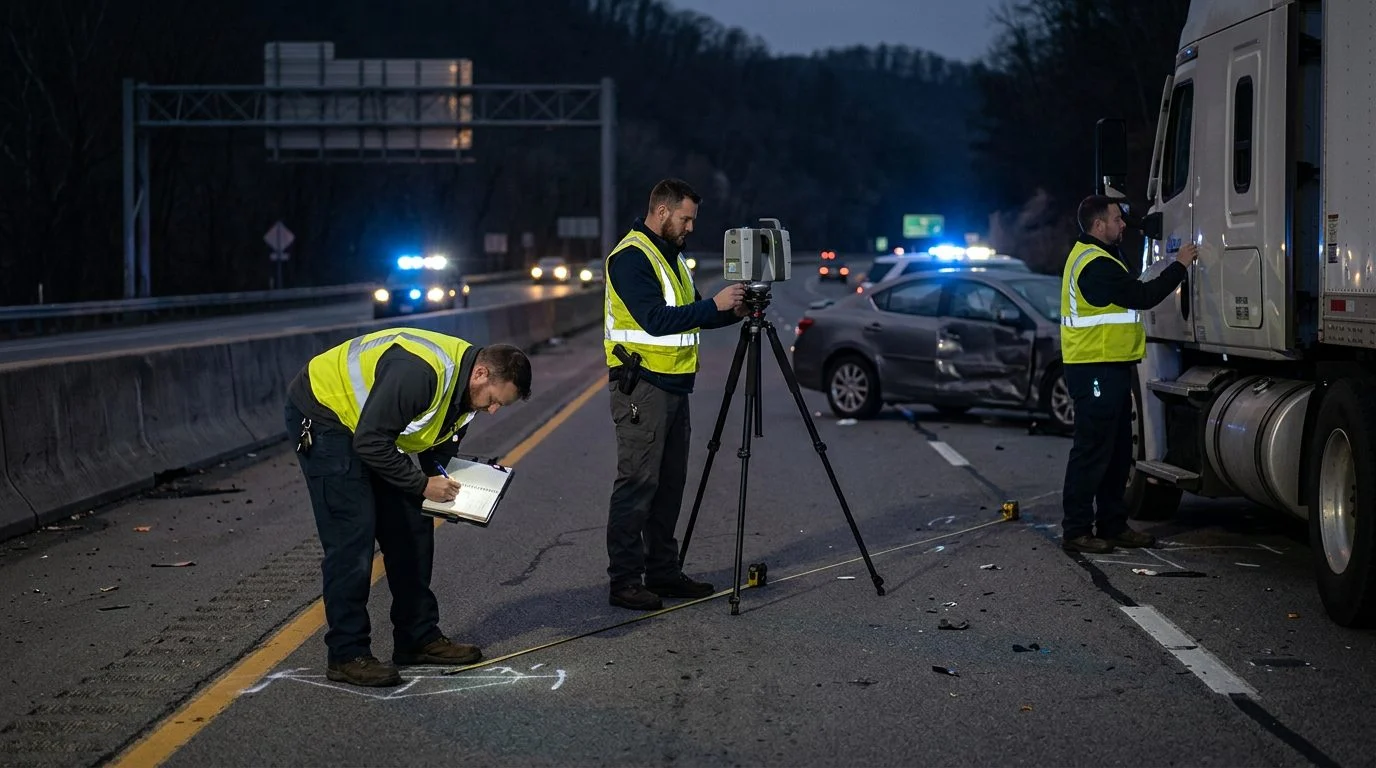
In a truck case, questions may include how the vehicle was driven, loaded, or maintained. Each question needs its own proof. Photos, police reports, and vehicle data may help show each element.
West Virginia also uses a comparative fault rule. Under W. Va. Code § 55-7-13c, fault chargeable to the person who died does not bar recovery unless it is greater than the combined fault of all others responsible. If it is less, recovery is reduced in proportion to that fault.
Crashes that can lead to a wrongful death claim
Fatal car crashes and fatal commercial vehicle crashes can both lead to a wrongful death claim. Each raises different questions about who may be responsible.
In car crashes, impaired, distracted, or speeding drivers are common examples of conduct that may be at issue. Under W. Va. Code § 55-7-13c, a driver whose impaired driving was a proximate cause (a direct cause) of the damages may be jointly and severally liable. That is an exception to the usual rule that each defendant pays its own share.
Truck and commercial vehicle crashes may involve more than one party. West Virginia defines an “employer defendant” to include the owner of a commercial motor vehicle, the employer of the person driving it, and others with legal control over it. See W. Va. Code § 55-7-32.
Some deaths come later. A person may die days, weeks, or longer after a catastrophic injury, such as a traumatic brain injury or spinal cord injury. West Virginia law says an injury case does not end just because the injured person dies. Under W. Va. Code § 55-7-8, the case may continue through the personal representative.
Every crash is different. The details shape what is possible, and a family’s situation may not match these examples.
What damages a wrongful death lawsuit may cover
A wrongful death claim may cover funeral expenses, medical care tied to the injury, and the family’s losses from the death. The statute says the case proceeds as if it were an action under sections five and six of this article, and those sections set out these categories.
Under W. Va. Code § 55-7-6, damages may include:
- Sorrow, mental anguish, and solace, including companionship, comfort, guidance, and advice of the person who died.
- Reasonably expected loss of the person’s income, and of the services, care, and assistance the person provided.
- Expenses for care, treatment, and hospitalization tied to the injury that led to the death.
- Reasonable funeral expenses.
Bills, receipts, and pay records may help show the economic losses.
A separate claim may also cover harm the person suffered between the injury and death. Under W. Va. Code § 55-7-8, only one recovery is allowed for each element of damages.
West Virginia also lets certain injury claims survive the injured person’s death. Under W. Va. Code § 55-7-8a, if the injured person dies before starting an action and it is not at the time of death barred by the statute of limitations, the personal representative may begin it within the period that would have applied had the person lived.
Not sure what your next step is?
Talk it through with Big Bubba — the first case review is free, confidential, and carries no obligation.

Timing and common reasons a claim can be delayed or dismissed
West Virginia generally allows two years from the date of death to bring a wrongful death action, and exceptions may apply. W. Va. Code § 55-7-6 sets this two-year period in subsection (d).
Claims can be delayed or dismissed for several common reasons:
- The case is filed after the deadline has passed.
- The person filing has not been properly appointed as personal representative.
- The claim leaves out a party who may share responsibility.
- The proof does not clearly connect the conduct to the death.
Some insurers may dispute a claim. Evidence gathered early can matter when that happens.
If you are reading this after a crash took someone you love, you may be grieving and facing many decisions at once. You do not have to sort out these rules alone. Big Bubba Injury Law can help you understand how they may apply to your family. You can ask for a free case review to talk through your situation.
Related practice areas
- Wrongful Death Claims After a Crash in West Virginia
- Wrongful Death in Charleston
- Wrongful Death in Huntington
- How to Get a Truck Accident Crash Report in West Virginia